

Every agency knows the excitement of seeing campaigns perform, traffic increase, and enquiries start coming in. The numbers look good, reports are shared, and it feels like the goal has been achieved.
But a lead submission is not the outcome. It is the beginning of a journey where the steps after conversion decide whether that enquiry becomes a sales opportunity or gets lost in the process.
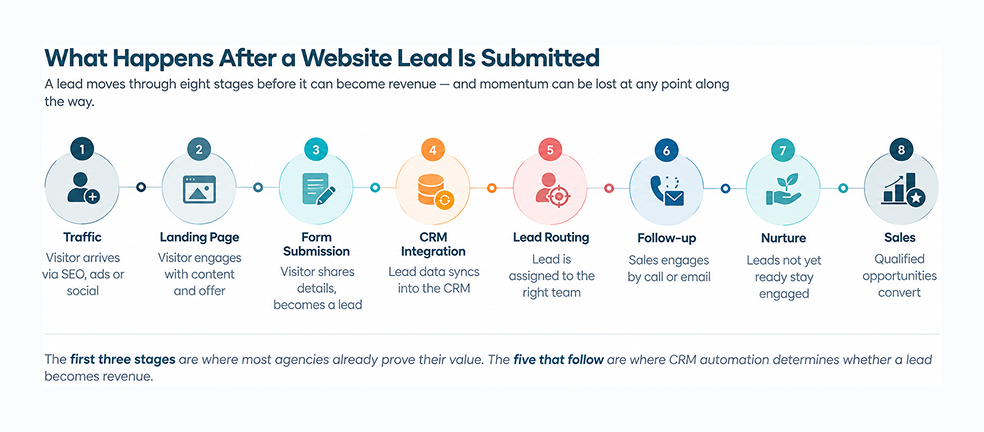
Many agencies invest heavily in driving traffic and generating leads, but what happens afterward often depends on disconnected systems, delayed follow-ups, unclear ownership, or manual processes. A valuable lead can quickly lose momentum if it is not captured, routed, and nurtured effectively.
According to Salesforce’s Sales Report, sales teams continue to spend significant time on non-selling activities, creating a growing need for connected processes and automation.
For digital agencies, this creates an opportunity to go beyond lead generation. By helping clients improve their website-to-CRM connection, automation workflows, and sales handoff processes, agencies can contribute to the outcomes that matter most – turning enquiries into business growth. With AI automation and smarter marketing systems reshaping customer journeys, the next stage of agency value lies in understanding what happens after the lead comes in.
What Happens After a Website Lead Is Submitted?
Most agencies are excellent at creating the moment of conversion. They build campaigns, optimize landing pages, improve targeting, and bring the right audience to the website. But once someone clicks “Submit,” the lead enters a completely different journey – one where marketing, technology, and sales processes need to work together.
This is where things often get interesting. A lead does not automatically become a sales opportunity just because it reaches the client’s inbox. Without the right lead management process, CRM workflows, ownership, and automation systems in place, even high-intent enquiries can lose momentum before they reach the sales team.
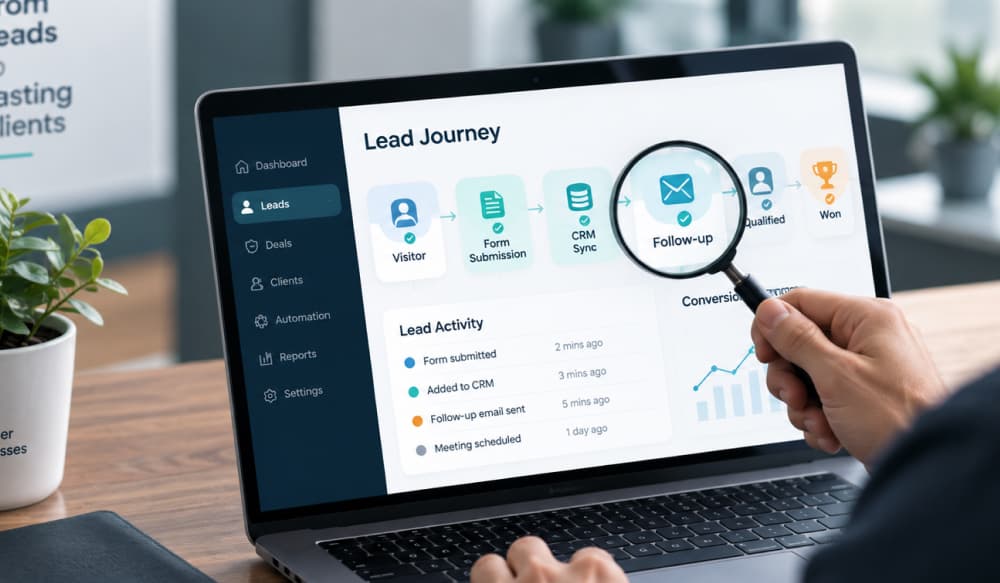
| Stage | What Happens | Why It Matters for Agencies |
| Traffic | Visitors arrive through SEO, paid campaigns, social media, referrals, or other marketing channels. | Agencies need visibility into which sources generate valuable enquiries, not just clicks. Conversion attribution helps connect marketing efforts with actual business outcomes. |
| Landing Page | The visitor interacts with content, messaging, offers, and conversion elements before taking action. | A strong landing page experience influences lead quality and determines whether visitors move forward. |
| Form Submission | The visitor shares details and becomes a potential sales opportunity. | Effective lead capture ensures businesses collect accurate information required for qualification and follow-up. |
| CRM Integration | Lead information moves from the website into a CRM system for tracking and management. | Website-to-CRM integration and CRM data synchronization reduce manual processes and help prevent valuable enquiries from being missed. |
| Lead Routing | Leads are assigned to the right salesperson, team, or workflow based on defined criteria. | Automated lead routing improves ownership, reduces response delays, and creates a smoother sales handoff. |
| Follow-up | Sales teams engage with prospects through calls, emails, or automated responses. | Lead follow-up automation helps businesses respond consistently while improving the chances of moving prospects forward. |
| Nurture | Leads that are not ready immediately continue receiving relevant communication. | Lead nurturing workflows and marketing automation help businesses maintain engagement throughout the buying journey. |
| Sales | Qualified opportunities move into active conversations and revenue generation. | Connecting marketing and sales through a stronger marketing-sales handoff helps measure the true impact of digital campaigns. |
The challenge for agencies is that website conversion is often treated as the finish line. In reality, it is the point where the marketing journey hands over responsibility to the systems and processes that determine what happens next.
Modern businesses are increasingly focusing on connected customer journeys, automation, and better data visibility because fragmented systems can create gaps between customer interest and business outcomes. Gartner highlights that organizations need connected customer experience strategies to meet evolving customer expectations.
For agencies, this creates an opportunity to move beyond lead generation services. By understanding CRM automation, workflow automation, lead qualification, and customer journey automation, agencies can help clients improve not only how leads are generated but how those leads progress toward revenue.
Where Client Lead Journeys Break After Conversion
Generating leads is usually where agencies prove their value. The campaign performs, the landing page converts, and the client sees new enquiries entering the pipeline. But the reality check comes afterward – because a lead entering the system does not automatically mean it is moving toward revenue.
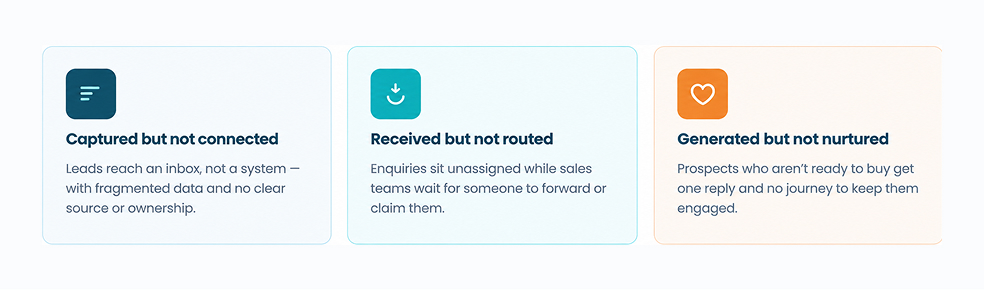
The biggest gaps often appear after the conversion point, where websites, CRMs, sales teams, and follow-up processes need to work together. This is where agencies can create additional value by improving the systems behind the lead instead of stopping at the form submission.
Leads Are Captured But Not Connected to Business Systems
A visitor fills out a form, clicks submit, and technically becomes a lead. But what happens next? Does the information reach the right CRM system? Is the data complete? Can the client track where that enquiry came from and what happens after?
Without proper website-to-CRM integration and CRM data synchronization, businesses often operate with fragmented information, making it harder to understand lead quality and marketing performance.
Agencies can help clients close this gap by connecting websites, forms, CRMs, and automation workflows to create a more reliable lead management process.
Key gaps usually include:
- Disconnected systems: Website forms, marketing platforms, and CRMs may not share data effectively.
- Poor CRM data quality: Missing fields, duplicate records, or incomplete customer information can impact sales decisions.
- Manual processes: Teams spending time moving data between systems instead of focusing on qualified opportunities.
According to Salesforce’s State of Sales Report, 81% of sales teams report that they are either experimenting with or using AI, showing how businesses are increasingly adopting automation to improve sales processes and reduce manual effort. Salesforce State of Sales Report
Leads Are Received But Not Routed Effectively
A new enquiry arrives, but who owns it? This simple question creates bigger operational issues than many businesses expect. A lead can have strong intent, but if it reaches the wrong person or sits unattended, the opportunity starts losing value.
A structured, automated lead-routing process helps businesses assign enquiries based on factors such as service interest, location, customer type, or sales team availability.
Agencies that understand CRM workflow automation can help clients replace manual lead distribution with smarter systems that improve speed and accountability.
Common routing challenges include:
- No automated assignment: Leads depend on someone manually forwarding or reviewing enquiries.
- Delayed response times: Sales teams may not engage quickly enough while customer intent is high.
- Unclear ownership: Multiple teams may assume someone else is responsible for follow-up.
Harvard Business Review’s research on online sales leads found that companies that respond quickly to enquiries have a significantly higher chance of qualifying those leads compared with companies that respond later. The Short Life of Online Sales Leads – Harvard Business Review
Leads Are Generated But Not Nurtured
Not every website lead is ready to start a sales conversation immediately. Some prospects need more information, more trust, or simply better timing before making a decision.
The problem begins when businesses treat every lead the same way. Without lead nurturing workflows, lifecycle stages, and a clear marketing-sales handoff, potential opportunities can disappear after the first interaction.
This is where agencies can expand beyond campaign execution and help clients create customer journey automation that keeps prospects engaged until they are ready to move forward.
Common nurture gaps include:
- Limited follow-up processes: Leads may receive one response and no further engagement.
- Missing lifecycle stages: Businesses may not know whether a lead is new, qualified, inactive, or sales-ready.
- Weak marketing and sales alignment: Teams may lack visibility into who owns the next action.
The opportunity for agencies is clear: successful lead generation is not only about bringing more enquiries. It is about creating a connected system where every lead has a defined journey after conversion.
How Agencies Can Build Better Lead Management Workflows
Generating leads is only the first step. The bigger opportunity for agencies lies in improving what happens after conversion – ensuring leads move smoothly from the website into systems, teams, and workflows that support sales outcomes.
This does not mean every agency needs to become a CRM consultancy. It means identifying where client lead journeys lose momentum and helping create a more connected path between marketing efforts and business growth.
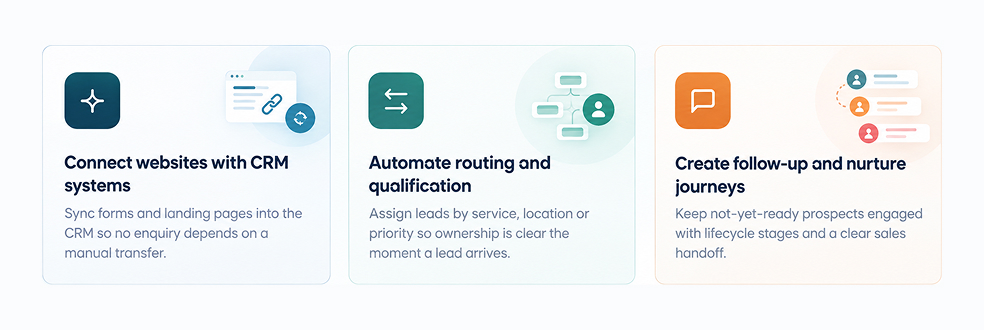
Connecting Websites With CRM Systems
A website enquiry should not disappear into an inbox or become another manual task for the client team. When lead data moves seamlessly from forms and landing pages into a CRM, businesses gain better visibility into lead sources, customer intent, and conversion progress.
Agencies can help clients strengthen their website-to-CRM integration by focusing on:
- Accurate lead data flow: Connecting website forms, landing pages, and CRM platforms without manual transfers.
- Better CRM data quality: Reducing incomplete records, duplicate entries, and missing information.
- Connected workflows: Using AI automation and integrations to improve how marketing and sales systems communicate.
HubSpot’s State of Marketing Report highlights that marketers continue to prioritize connecting data and improving customer experiences, reinforcing the need for integrated marketing systems. HubSpot State of Marketing Report
Automating Lead Routing and Qualification
A new lead arrives, but who owns the next action? Without a defined process, even valuable enquiries can sit untouched or reach the wrong person.
With automated lead routing and CRM workflow automation, agencies can help clients create clearer systems for assigning and qualifying leads based on factors such as service interest, location, customer type, or priority.
Key improvements include:
- Faster lead assignment: Sending enquiries to the right team automatically.
- Smarter qualification: Identifying leads based on predefined business rules.
- Clear ownership: Ensuring every enquiry has a defined next step.
The goal is not to replace the client’s sales process. It is to remove unnecessary friction around it.
Creating Automated Follow-Up and Nurture Journeys
Not every lead is ready for a sales conversation immediately. Some prospects need more information, trust-building, or the right timing before moving forward.
This is where lead nurturing workflows help businesses stay connected beyond the first interaction. Agencies can help clients build journeys that support prospects until they are ready to engage.
This can include:
- Automated follow-up sequences: Maintaining timely communication after conversion.
- Lifecycle stage tracking: Understanding where leads are in the buying journey.
- Marketing-sales handoff: Creating better alignment between teams.
The real agency opportunity is not just generating more enquiries. It is helping clients build a system where every lead has a clear path forward – from first interaction to potential revenue.
Beyond Lead Generation: The New Opportunity for Digital Agencies
Generating traffic and enquiries is only one part of the client growth equation. The bigger challenge often appears after conversion – when leads need to move through CRMs, workflows, follow-ups, and sales processes that may involve multiple teams and systems.
For agencies, this creates an opportunity to expand the client conversation beyond campaign performance and explore how the complete lead lifecycle supports business outcomes.
Agencies can help clients identify opportunities around:
- Improving post-conversion workflows: Understanding where leads slow down between enquiry, qualification, and sales engagement.
- Connecting marketing and sales systems: Creating better visibility between campaigns, CRM data, and customer journeys.
- Reducing operational friction: Helping clients replace disconnected processes with smarter automation workflows.
- Improving conversion visibility: Moving conversations beyond lead volume toward lead quality and revenue impact.
The goal is not for agencies to replace their clients’ internal teams or own every business process. It is about helping clients create a stronger connection between marketing efforts and measurable outcomes.
When additional technical expertise or delivery capacity is required, agencies can continue owning the strategy and client relationship while bringing in specialist support to execute specific requirements
Measuring What Happens After the Lead Is Generated
Generating leads gives agencies an important performance metric, but it does not show the complete picture. A campaign may deliver hundreds of enquiries, yet the real impact depends on what happens afterward – how leads are handled, qualified, nurtured, and moved toward revenue.
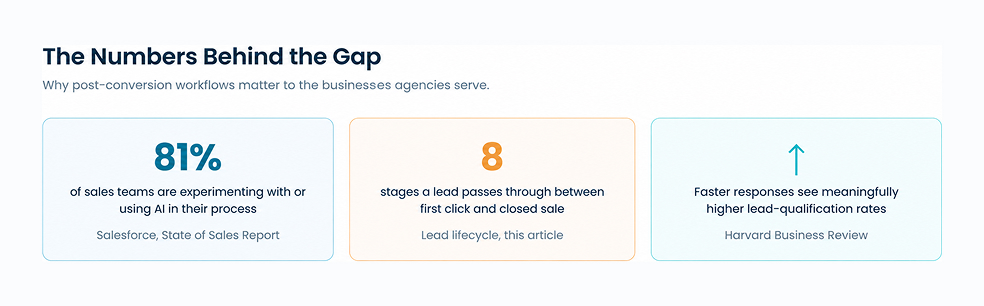
This is where agencies can help clients look beyond lead volume and focus on lead quality, conversion attribution, and customer journey performance.
Agencies can improve visibility by helping clients understand:
- Marketing-to-revenue connection: Linking campaign performance with sales outcomes instead of measuring only clicks or form submissions.
- Lead quality tracking: Identifying which channels generate valuable opportunities, not just more enquiries.
- Lifecycle movement: Understanding how leads progress through qualification, follow-up, nurture, and sales stages.
- Conversion attribution: Connecting marketing efforts with measurable business impact.
With CRM analytics, AI-powered reporting, and connected marketing systems, agencies can help clients move from fragmented data to a clearer view of the complete lead lifecycle.
The goal is not to take over the client’s sales process. It is to help agencies bring stronger insights into client conversations and show the value created after the lead enters the system.
How Agencies Can Extend Their Role From Traffic Partners to Growth Partners
Generating traffic will always be a core agency responsibility, but client expectations are moving beyond campaign reports and lead numbers. The next level of value comes from helping clients understand what happens between the first enquiry and the final business outcome.
Agencies do not need to own every internal client process. The opportunity is to identify where systems, teams, and workflows can work better together.
Identifying Gaps Across Client Systems
A lead journey often involves multiple touchpoints – website forms, CRMs, marketing platforms, sales tools, and reporting systems. When these systems are disconnected, agencies may have limited visibility into what happens after conversion.
Agencies can help clients identify opportunities around:
- CRM and website integration gaps: Improving how lead data moves between platforms.
- Workflow inefficiencies: Reducing manual tasks through smarter automation workflows.
- Data visibility issues: Connecting marketing activities with lead progression and revenue outcomes.
Collaborating Across Marketing and Sales Teams
The lead journey does not stop when marketing generates an enquiry. Better alignment between marketing and sales teams helps create clearer ownership, faster responses, and stronger customer experiences.
Agencies can support this by helping clients improve:
- Marketing-sales handoff processes: Ensuring leads move smoothly between teams.
- Lead lifecycle tracking: Understanding where prospects are in the buying journey.
- Conversion attribution: Connecting campaigns with measurable business impact.
Building a More Complete Digital Growth Ecosystem
The future opportunity for agencies is not just delivering traffic – it is helping clients create connected digital ecosystems where websites, automation, data, and sales processes support each other.
By extending beyond lead generation, agencies can become strategic growth partners while continuing to own the client relationship and bringing in specialist expertise when required.
Conclusion
Generating leads will always remain a core agency responsibility, but the client’s real business impact depends on everything that happens after conversion. The ability to connect websites, CRM systems, automation workflows, and sales processes creates a clearer path from enquiry to revenue.
For agencies, this is an opportunity to strengthen client relationships without changing ownership. By identifying workflow gaps, improving visibility, and creating better-connected digital ecosystems, agencies can continue leading the strategy while bringing in the right expertise when required.
With deep experience across web development, automation, CRM integrations, and digital transformation, ZealousWeb helps agencies extend their delivery capabilities without disrupting their client relationships. Our team works as an extension of agency teams to support specific technical requirements, improve connected workflows, and help businesses create better post-conversion experiences.
Review a Client Lead Journey
FAQs
How will our agency maintain control over the client relationship while working with your team?
We work as an extension of your team, not as a replacement for your agency. Your agency remains the strategic owner and primary client contact while we support the agreed technical, automation, or integration requirements behind the scenes.
Can your team adapt to our existing project workflows and communication process?
Yes. We align with your existing processes, tools, communication channels, and reporting structure to ensure our collaboration fits naturally into your delivery model.
How do you handle client data, CRM access, and sensitive business information?
We follow structured access practices and work with the level of access required for the project. Our team focuses on maintaining confidentiality while supporting integrations, automation workflows, and technical implementations.
What happens if our client needs CRM automation support but we do not want to build that capability internally?
We can provide the required technical expertise while you continue managing the client relationship. Our team supports specific requirements such as CRM integrations, workflow automation, data synchronization, and implementation needs based on your project scope.
Can your team work alongside our developers, marketers, or sales consultants?
Yes. We collaborate with existing agency teams and adapt based on project requirements. Whether you need additional technical support or specialist expertise for a specific workflow, we integrate into your delivery process.
How do you ensure your work aligns with our agency's quality standards?
We begin by understanding your processes, project expectations, and client requirements. Our team follows defined workflows, maintains clear communication, and focuses on delivering solutions that support your agency's standards.
Can we involve your team only for specific projects instead of ongoing support?
Absolutely. Agencies can engage us based on their requirements - whether they need support for a specific CRM integration, automation workflow, technical implementation, or additional delivery capacity during high-demand periods.
How does ZealousWeb help agencies improve client outcomes beyond lead generation?
We help agencies extend the digital journey beyond lead capture by supporting areas such as website-to-CRM integration, automation workflows, lead management processes, and connected digital experiences. This allows agencies to continue owning the strategy while strengthening the overall value delivered to clients.