

Every agency team has tools these days.
Project boards, dashboards, Slack channels, sprint notes, reporting sheets, automation layers, and enough “quick updates” to make everyone feel busy.
And yet, the same problem keeps returning.
Work is moving, but delivery is not always predictable. Tasks are assigned, but ownership is not always clear. Reports are shared, but they do not always explain progress. QA happens, but sometimes only after the client, user, or leadership team has already spotted the issue.
That is not a tool problem. It is a workflow visibility problem.
A delivery workflow mapping template helps agencies and SaaS teams see how work actually moves from request to execution to review to reporting. It shows where ownership is missing, where approvals slow down, where QA should enter, and where delivery risk begins.
For agencies, a clear agency delivery workflow protects client confidence and reduces follow-up chaos. For SaaS teams, a structured SaaS delivery workflow improves alignment between product, engineering, QA, growth, and leadership.
This is why workflow mapping for agencies and workflow mapping for SaaS matter. It turns scattered activity into execution systems that teams can actually trust.
Because more tools do not automatically create better delivery. Sometimes, they only help teams document the confusion more beautifully.
Why Agencies and SaaS Teams Need Delivery Workflow Mapping Before Scaling Further
Growth does not break agencies.
Unclear workflows do.
When an agency is small, delivery gaps are easier to hide. Someone follows up. Someone fixes the missed detail. Someone remembers what the process was supposed to be. The system may be weak, but the team carries it through effort.
That changes when the agency grows.
More clients mean more approvals. More projects mean more handoffs. More people mean more chances for ownership to become unclear. Suddenly, the same delivery process that once felt manageable starts creating delays, rework, and client pressure.
This is where delivery workflow mapping becomes essential.
A clear delivery workflow template helps agencies see how work moves from request to execution, review, QA, approval, and reporting. It shows who owns what, where work slows down, and which steps need better control before the agency scales further.
For growing agencies, this is not documentation for the sake of documentation. It is delivery protection.
| Without Workflow Mapping | With Workflow Mapping |
| Teams rely on memory and follow-ups | Teams work through visible ownership |
| Handoffs depend on assumptions | Handoffs are clearly defined |
| QA enters late | QA is built into the workflow |
| Reporting explains activity | Reporting shows delivery progress |
| Leadership reacts to delays | Leadership spots bottlenecks earlier |
| Growth adds pressure | Growth becomes easier to manage |
This is why agencies need workflow mapping before scaling operations.
It gives delivery teams clarity, account managers confidence, QA teams better timing, and leadership a sharper view of capacity. More importantly, it prevents growth from becoming a louder version of the same operational mess.
Because scaling an agency without workflow clarity is possible. But it usually means the team grows first, and the system catches up only after something breaks
What a Delivery Workflow Mapping Template Actually Helps You See
Most agencies think delivery problems are visible.
They are not.
By the time a missed deadline, repeated revision, client escalation, or quality issue appears, the real breakdown has usually happened much earlier. It sat inside an unclear handoff, an assumed owner, a delayed approval, or a QA step that entered too late.
That is where a workflow mapping template becomes useful.
It gives agencies a clearer view of how work actually moves across strategy, execution, review, QA, approval, reporting, and client communication. A strong delivery process template does not simply organize tasks. It exposes the parts of the workflow that create delay, rework, and delivery pressure.
What Work Is Moving, Stuck, Repeated, or Unclear
A task marked “in progress” does not always mean progress.
Sometimes it means the work is waiting for input. Sometimes it means the brief is being reinterpreted for the third time. Sometimes it means no one wants to admit the next step is unclear.
A process mapping template helps agencies separate real movement from visible activity. It shows what is moving forward, what is stuck, what is repeating, and what needs intervention before it becomes a client-facing problem.
Where Ownership Is Missing Across Roles and Teams
Delivery slows down when ownership is assumed instead of assigned.
This happens often in agency operations. Strategy creates the direction. Delivery starts the task. QA reviews late. Account managers chase updates. Leadership steps in only when the client starts asking uncomfortable questions.
An operational workflow template makes ownership visible across every stage. It shows who starts the work, who reviews it, who approves it, and who communicates it. That clarity reduces follow-ups and gives teams a better rhythm.
Which Approvals Are Slowing Down Delivery
Approvals protect quality, but unclear approvals quietly damage timelines.
If every task needs a review but no one knows who has the final say, delivery becomes a waiting room. Internal reviews, client approvals, senior checks, and QA sign-offs start overlapping without clear sequence.
A project workflow template helps agencies identify where approvals are required, who owns them, and where they are delaying execution. This gives teams better process visibility without removing the controls that protect quality.
Where QA Enters Too Late in the Process
QA should not arrive like an inspector after the building is complete.
When quality checks happen only at the end, agencies spend more time fixing preventable issues. Rework increases. Delivery confidence drops. Account managers are left explaining delays that could have been avoided with earlier review points.
A clear workflow mapping template shows where QA should enter before work reaches the client. This improves delivery quality and reduces the pressure of last-minute corrections.
How Reporting Fails to Reflect Real Delivery Progress
Many agency reports show activity.
Fewer show delivery health.
A report may mention completed tasks, hours used, or campaigns updated, but still fail to show what moved forward, what is blocked, what required QA, and what impact the work created.
This is where an agency operations template becomes valuable. It connects delivery status with client-facing progress. It helps account managers report with clarity instead of filling slides with polite updates that say very little.
What Leaders Can Identify Before Delivery Risk Becomes Client Risk
Leaders should not discover workflow issues through client frustration.
A mapped workflow gives agency leaders early signals: repeated blockers, weak handoffs, overloaded roles, slow approvals, unclear ownership, and late QA patterns.
That is the value of delivery visibility. It allows agencies to fix the system before delivery pressure becomes retention pressure. Because the real question is not only what a workflow mapping template should include.
When agencies can see how delivery actually moves, they can stop managing chaos through follow-ups and start improving the system itself.
Where Delivery Workflows Usually Break Across Agencies and SaaS Teams
Delivery workflows rarely fail because one person missed one task.
They usually break at the points where work moves from one stage to another: planning to execution, execution to QA, QA to reporting, and reporting to leadership or client communication. These workflow bottlenecks often stay invisible until they become repeated delays, rework, or client pressure.
For growing agencies, the real challenge is not just managing work. It is seeing where the delivery system is leaking before the client does.
Key Workflow Breakpoints
- Strategy-to-execution gaps after planning
The plan is approved, but the execution path is not clear. Teams know the goal, but not always the exact next step, priority, owner, or dependency. - Task ownership gaps between teams or delivery pods
Work slows down when responsibility is assumed instead of assigned. Everyone is involved, but no one clearly owns the next move. - QA gaps before work reaches clients
QA enters too late, usually when the work is already close to submission. This turns quality control into a last-minute correction. - Communication gaps across internal and external teams
Updates live across calls, chats, emails, and tools. The team communicates often, but the delivery truth remains scattered. - Reporting gaps between completed work and business impact
Reports show tasks completed, but not what changed because of them. This weakens client confidence and makes delivery value harder to prove. - Decision gaps when leadership cannot see the delivery of health clearly Leaders see problems only after delays, escalations, or client concerns. By then, the workflow issue has already become a delivery risk.
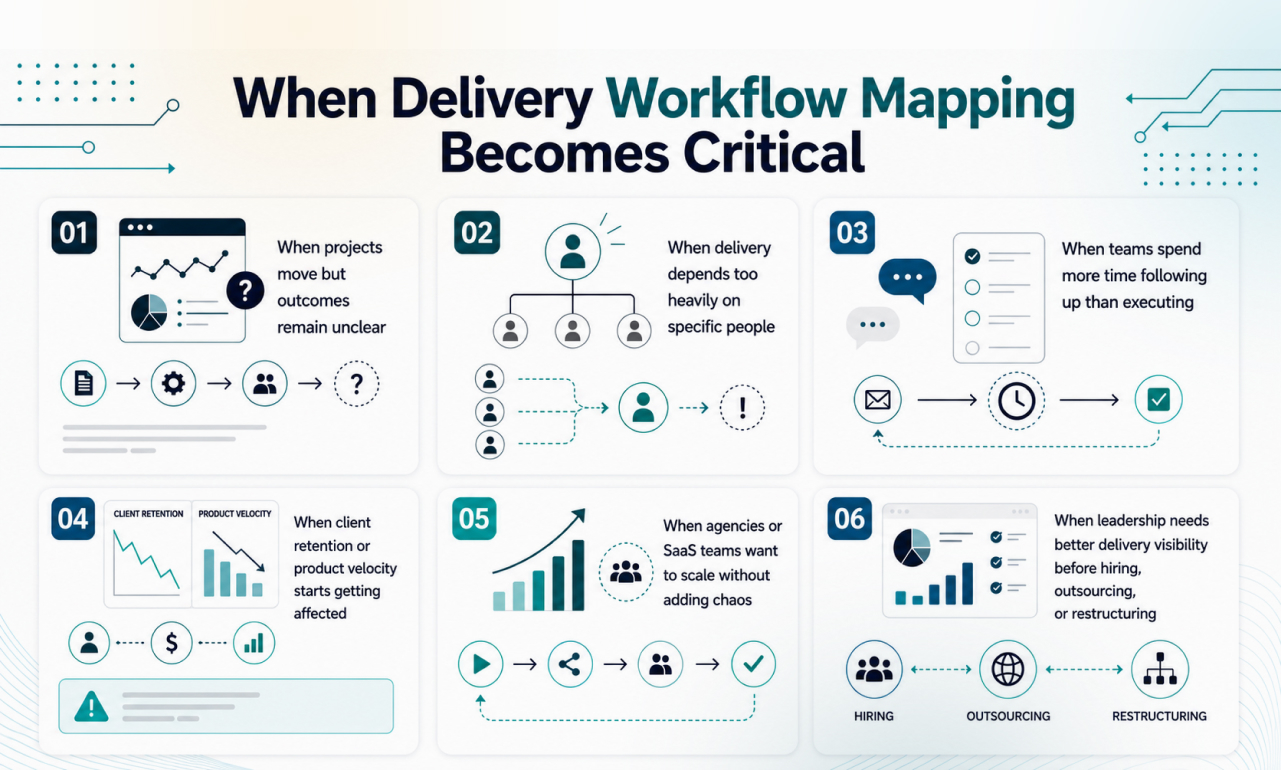
When Delivery Workflow Mapping Becomes Critical
Delivery workflow mapping becomes critical when work is moving, but control is not.
For agencies and growing teams, the warning signs are usually subtle at first: projects need constant follow-ups, ownership depends on memory, QA enters late, client updates feel reactive, and leadership only sees the pressure after timelines start slipping.
At that point, the issue is no longer just a delivery delay. It is a visibility gap.
A workflow map helps teams see where the pressure begins, which stage is slowing delivery, and what needs to be corrected before growth turns into operational strain. The illustration below breaks down the key moments when workflow mapping moves from “good to have” to essential.
How to Build a Delivery Workflow Mapping Template That Reduces Chaos
A delivery workflow template should not become another internal document that looks useful but quietly disappears into a shared drive.
For agencies, it should work as an execution control layer. It must show how work enters, who owns it, where approvals happen, when QA enters, and how progress is reported.
Step 1: Define the Workflow Objective
- Start with the purpose.
- Is the workflow for onboarding, campaign delivery, website execution, reporting, or support?
- Define what the workflow must improve before mapping the steps.
Step 2: Identify Every Stage From Request to Delivery
- Map the complete journey.
- Show how work moves from request to task, task to execution, execution to QA, QA to approval, and approval to delivery.
Step 3: Assign Clear Ownership at Each Stage
- Every stage needs one clear owner.
- Not “the team.” Not “someone from delivery.” One accountable role that moves the work forward.
Step 4: Map Dependencies, Approvals, and Blockers
- List what each stage needs before it can move.
- This includes access, briefs, client inputs, internal approvals, tools, or technical dependencies.
Step 5: Add QA and Review Checkpoints
- QA should not enter at the end.
- Build review points into the workflow before work reaches the client. This reduces rework and protects delivery confidence.
Step 6: Define Delivery Metrics and Reporting Signals
- Decide how progress will be measured.
- Track timelines, blockers, revisions, QA issues, approval delays, and client-facing completion status.
Step 7: Create Feedback Loops for Continuous Improvement
- A workflow map should improve with use.
- Review it regularly to identify repeated delays, unclear steps, and stages that need simplification.
The best workflow mapping process does not just document delivery. It gives agencies a clearer system to control work before chaos becomes client-facing.
What to Include in a Delivery Workflow Mapping Template
A delivery workflow mapping template should make the agency’s delivery system easier to see, not harder to maintain.
It should capture the practical details that decide whether work moves smoothly or gets stuck between people, approvals, QA, and reporting. The goal is to create one clear view of ownership, progress, blockers, and delivery impact.
Before using the template, it helps to know what details actually belong inside it. The checklist below highlights the core fields every agency should map before calling a workflow complete.
| What to Include in a Delivery Workflow Mapping Template | |
|
✅ Core workflow elements ✅ Workflow stage ✅ Task or activity ✅ Owner ✅ Dependency reviewer ✅ Priority level ✅ Timeline |
✅ Quality and impact tracking
✅ Approval status ✅ QA checkpoint ✅ Delivery status ✅ Reporting note ✅ Business impact or outcome signal |
A good workflow template does not add process for the sake of it. It gives agencies a clearer view of what must move, who must own it, and where delivery can slow down.
How Workflow Mapping Improves Ownership, QA, Velocity, and Reporting
A mapped workflow gives agencies something most delivery systems quietly lack: shared clarity. When every stage has a defined owner, review point, timeline, and reporting signal, delivery becomes easier to manage and harder to misread. Teams stop depending on memory, scattered updates, and last-minute follow-ups.
✅ Clear ownership reduces internal confusion
Everyone knows who owns the next step, who reviews it, and who moves it forward. This reduces repeated follow-ups and keeps delivery from sitting between teams.
✅ QA checkpoints reduce rework before delivery
Quality checks enter before the work reaches the client. That means fewer avoidable corrections, cleaner outputs, and stronger delivery confidence.
✅ Mapped workflows improve execution velocity
When dependencies, approvals, and blockers are visible, teams spend less time searching for clarity and more time moving work forward.
✅ Reporting becomes easier by workflow stage
Instead of reporting vague activity, account managers can show what is in progress, what is approved, what is blocked, and what has been delivered.
✅ Leadership gains better delivery visibility
Leaders can see capacity pressure, repeated bottlenecks, QA issues, and delivery health before they become client-facing risks.
How Agencies Can Use Workflow Mapping to Improve Client Retention
Clients rarely leave because of one delayed task.
They leave when delays become patterns, updates feel unclear, and delivery starts becoming harder to trust. This is where workflow mapping for client retention helps agencies turn delivery visibility into stronger account confidence.
For growing agencies, retention is not only about doing good work. It is about proving that good work is moving through a reliable agency delivery system.
Key Benefits for Agency Client Retention
- Workflow visibility builds client confidence
Account managers can clearly see what is moving, blocked, approved, and completed. This makes client communication sharper and more reliable. - Predictable delivery improves account health
Clear ownership, timelines, QA stages, and approvals reduce last-minute surprises and strengthen long-term trust. - Completed work connects better with client-facing outcomes
Agencies can show what changed, why it matters, and how the work supports the client’s business goals. - Delivery proof becomes stronger than activity reporting
Clients do not need fuller reports. They need clearer proof of progress, movement, and impact. - Account managers lead better conversations
With better delivery visibility, account managers can discuss progress, risks, next steps, and outcomes with confidence.
A strong client retention strategy is built inside the workflow, not only inside client calls. When delivery is visible, accountable, and easier to explain, agencies create the confidence clients need to stay.
What Pricing or Engagement Models Make Sense When Bringing in Delivery Support
For agencies, pricing should not be read as “who is cheapest?”
The better question is: which location and model gives the right balance of execution depth, QA discipline, communication rhythm, and delivery control? Offshore pricing varies by region, skill level, complexity, and engagement model. Recent 2026 benchmarks place India around $15 to $30/hour in some estimates, Asia more broadly around $20 to $50/hour, Latin America around $25 to $60/hour, and Eastern Europe around $30 to $70/hour.
| Location/Region | Approx. Pricing | Best Fit For | Agency Note |
| India / South Asia | $15 to $50/hour | White-label execution, delivery support, QA, development, marketing operations | Strong fit when agencies need scale, cost control, and recurring execution capacity |
| Southeast Asia | $20 to $50/hour | Support operations, QA, admin-heavy delivery, coordination | Useful for process-driven work where structure and documentation are already clear |
| Eastern Europe | $30 to $70/hour | Complex engineering, senior development, product-heavy execution | Better fit when technical depth matters more than cost efficiency |
| Latin America | $25 to $60/hour | Nearshore delivery for US agencies, engineering, product support | Strong timezone fit for North American agencies needing closer collaboration |
| Africa | $20 to $45/hour | Cost-sensitive execution, support roles, selected technical work | Works well when scope is controlled and delivery governance is strong |
| North America/Western Europe | $50 to $200+/hour | Senior consulting, local strategy, high-touch technical leadership | Best for advisory or strategic oversight, less ideal for scalable execution-heavy delivery |
The right delivery model is not always the cheapest region or the highest-priced expert. For agencies, the stronger choice is the partner that brings execution structure, QA discipline, reporting clarity, and enough delivery visibility to protect client confidence.
Which Regions Agencies, and SaaS Teams Consider for Scalable Execution Support
Agencies usually look for offshore execution support when internal capacity starts limiting delivery speed, margin control, and client consistency.
The goal is not just to find a cheaper team. It is to find the right region, rhythm, and delivery structure that can support scale without creating more coordination noise.
| Region | Why Agencies Consider It | Best Fit For | What to Evaluate |
| India / South Asia | Cost-efficient scale, strong technical talent, mature outsourcing ecosystem | White-label execution, development, QA, marketing operations, delivery support | QA discipline, reporting structure, timezone workflow, ownership clarity |
| Southeast Asia | Process-driven support capacity and competitive pricing | Admin-heavy delivery, support operations, QA coordination | Documentation quality, communication rhythm, process maturity |
| Eastern Europe | Strong engineering depth and technical specialization | Complex development, product engineering, senior technical execution | Higher cost, availability, timezone fit, delivery management |
| Latin America | Nearshore timezone alignment for US agencies | Engineering, product support, execution collaboration | Cost vs. skill depth, communication consistency, scalability |
| Africa | Growing offshore talent pool with cost-sensitive execution options | Support roles, selected technical tasks, controlled-scope delivery | Governance, QA structure, delivery consistency |
| North America / Western Europe | Local context, senior consulting, strategic oversight | Strategy, advisory, high-touch technical leadership | Higher cost, limited scalability for execution-heavy delivery |
For most growing agencies, the best region is not automatically the cheapest one. It is the region that offers the right balance of cost control, delivery quality, communication rhythm, and long-term scalability. A strong offshore execution partner should reduce pressure on the agency’s system, not become another workflow to manage.
How ZealousWeb Helps Agencies and SaaS Teams Build Delivery Systems That Create Calm Control
ZealousWeb works as an operating system partner for agencies that need more than task-level support. As an execution systems partner and white label outsourcing partner, we help agencies map workflows across strategy, delivery, QA, reporting, and leadership visibility, so scattered tools and disconnected tasks become structured operating workflows.
ZealousWeb’s USP
- Execution systems, not random task support
We help agencies build delivery structures that reduce chaos, not just increase output. - White-label execution under your brand
Our team supports delivery quietly in the background while your agency owns the client relationship. - Workflow clarity across delivery stages
Strategy, execution, QA, approvals, reporting, and leadership visibility are mapped into one operating rhythm. - QA-led delivery discipline
Work is reviewed before it becomes a client-facing problem, reducing rework and delivery pressure. - Scalable support for growing agencies
Agencies can expand delivery capacity without turning every new client into another operational burden. - Better reporting confidence
We help agencies connect completed work with clearer client-facing progress, not just activity updates.
ZealousWeb helps agencies move from overloaded delivery to system-led execution. Because scaling should not mean adding more pressure to the same unclear workflow. It should mean building a delivery system that creates calm control.
Conclusion
Delivery problems rarely begin with a lack of effort.
They usually begin when the agency grows faster than its workflow. Tasks increase, approvals multiply, QA becomes reactive, reporting gets harder to connect with progress, and leadership starts seeing pressure only after the team is already stretched.
A delivery workflow mapping template gives agencies a clearer way to see how work actually moves, where it slows down, who owns each stage, and what needs stronger control before delivery risk becomes client risk. It turns delivery from scattered activity into a system that can be reviewed, improved, and scaled.
For agencies ready to move beyond follow-up-led delivery, ZealousWeb brings the structure behind the scenes. As an operating system partner, we help agencies build execution systems across workflow mapping, QA discipline, white-label delivery, reporting clarity, and scalable support, so growth feels controlled instead of chaotic.
Because the strongest agencies do not just deliver more work. They build systems that make delivery easier to trust.
Build a Delivery System Your Agency Can Actually Scale
Map Your Workflow With Us
FAQs
Will we gain capacity or create more coordination overhead?
We reduce coordination load by working through clear ownership, defined workflows, QA checkpoints, and reporting rhythms, so your team gains execution capacity instead of another layer to manage.
Will their definition of “done” match ours?
We align completion standards before delivery begins. For us, “done” means client-ready, reviewed, documented, and aligned with your agency’s quality expectations.
Will they think in outcomes or just complete tasks?
We do not treat delivery as ticket closure. We connect execution with client retention, ROI, reporting clarity, and the business outcome your agency is accountable for.
Could we become too dependent on them?
Our role is to strengthen your delivery system, not make it dependent on us. We keep workflows, documentation, ownership, and reporting transparent so your agency stays in control.
Will they protect our client trust when pressure increases?
Yes. During delays, escalations, urgent fixes, or high-value client moments, we focus on clear communication, fast ownership, QA discipline, and protecting your agency’s credibility.