

Most e-commerce brands are not losing momentum because their ideas are weak. They are losing it because someone oversold speed, undersold effort, and completely skipped explaining the e-commerce app development stages.
A “quick build” turns into endless calls, vague progress updates, and timelines that keep slipping like festival sale dates. Founders are left guessing what is actually happening, while businesses bleed time, money, and patience. The real problem is not technology. It is the absence of clarity around app development lifecycle phases and what each phase truly demands before an app ever reaches the store.
This article cuts through the optimism and assumptions, offering a realistic view of how e-commerce apps are built in 2026 so businesses can plan with confidence, ask better questions, and stop paying for surprises that should never have existed in the first place.
Basic Steps of E-commerce App Development
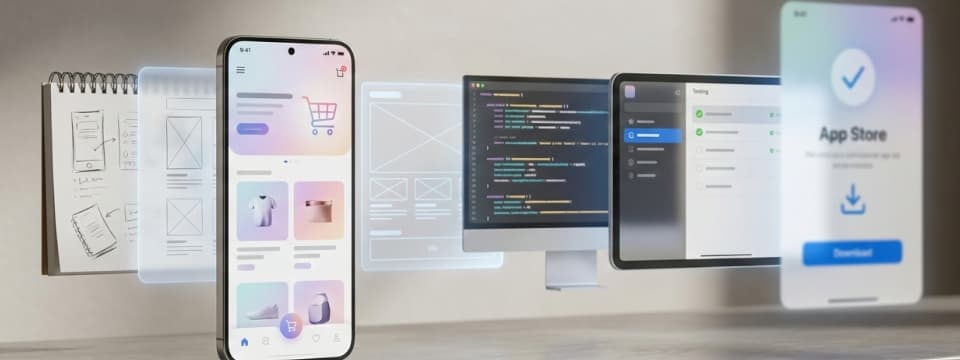
Every e-commerce app story starts the same way: confidence high, timelines optimistic, and a quiet assumption that development is just “design, code, launch.” Then reality shows up. What founders actually experience is a sequence of decisions, validations, trade-offs, and checkpoints that exist for a reason, neatly documented in app development phases explained but rarely respected in practice.
These ecommerce app development stages are not red tape; they are damage control. When brands understand the mobile app development phases step by step, timelines stop feeling random, and delays stop feeling personal. Below is what really happens, without the fluff, buzzwords, or fantasy deadlines.
| Step | What Happens | Why It Matters |
| Idea validation | Assumptions are challenged before anything is built | Prevents timeline breaks in app development phases, as explained. |
| Feature scoping | Priorities replace wish lists. | Keeps ecommerce app development stages realistic. |
| UX & prototyping | Early screens expose flaws fast | Stabilizes the stages of mobile app development. |
| Build & launch | Code, testing, and store prep happen in sequence. | Relies on solid app development lifecycle phases. |
Key Phases of E-commerce App Execution
This is the part most founders wish someone had explained before timelines were committed and invoices started stacking up. Before a single line of code is written, execution quietly begins with decisions that answer uncomfortable but necessary questions like “What happens before development starts?”, “Why can’t teams just start coding?”, and “How much time does planning and UX really take?” These phases are where delivery either becomes predictable or painfully chaotic. What follows is a clear breakdown of the exact execution phases teams move through next, starting with the decisions that set everything else in motion.
Discovery and Technical Planning Phase
A founder comes in saying the app is “simple,” until discovery reveals it must handle COD rules, GST, multi-warehouse inventory, and returns across multiple pincodes. This is also where teams realise the “same-day delivery” promise depends on courier partner constraints and cutoff times, which instantly reshape scope and timelines.
- Confirms what the app must do on day one vs later
- Aligns stakeholders on flows like checkout, returns, delivery, and refunds
- Defines risks, dependencies, and a realistic execution plan
System Design and Architecture Setup
A growing e-commerce brand planning a festive sale learns their app must survive traffic spikes, not just average daily users. Another common moment here is when the brand wants to add marketplaces later (Amazon, Flipkart) or a POS in stores, and the architecture has to be designed now so it does not collapse when integrations are added.
- Designs for scalability, stability, and future expansion
- Sets up data flows for product catalog, users, orders, and inventory
- Avoids mid-build redesigns by locking key technical decisions early
Development Sprints and Third-party Integrations
A team starts sprints confidently, then the payment gateway KYC takes longer than expected, or the shipping aggregator API rate-limits requests during testing, delaying order tracking. It is also common for a loyalty or analytics tool to require additional event setup, forcing changes across multiple screens and pushing sprint timelines.
- Builds features in iterations with clear deliverables per sprint
- Integrates payments, shipping, CRM, analytics, and notifications
- Manages external dependencies that can impact delivery pace
Stabilization, Testing, and Pre-launch Hardening
Everything looks perfect until testing on real devices shows the checkout fails on older Android versions, or the cart breaks under peak load simulation. Another typical pre-launch issue is app store rejection due to missing permissions disclosure or login-related policy requirements, causing last-minute fixes and resubmissions.
- Stress-tests critical flows like login, cart, checkout, and payments
- Fixes performance issues, crashes, and edge cases before release
- Finalizes app store readiness to prevent launch-day surprises
When these execution phases are respected, app development stops feeling unpredictable and starts feeling controlled. Timelines stabilise because decisions are made early, not patched later, and launches feel deliberate instead of rushed. This clarity is what separates e-commerce apps that scale confidently from those that spend months recovering from avoidable mistakes.
E-commerce App Development Timelines by Scope
Once execution phases are understood, the next question every founder asks is the same: how long will this actually take for my business? The answer depends less on ambition and more on scope. E-commerce app development timelines shift dramatically based on whether you are validating a market, scaling operations, or building for enterprise-grade complexity. The table below breaks this down in a way that aligns expectations with reality.
Timeline Breakdown by App Scope
| App Scope | What It Typically Includes | Estimated Timeline |
| MVP e-commerce app timeline | Core flows like product listing, cart, checkout, basic payments, and limited integrations are designed to validate demand quickly | 8-12 weeks |
| Growth-stage app with integrations and automation | Advanced payments, shipping automation, CRM, analytics, personalization, and operational workflows | 4-6 months |
| Enterprise e-commerce app with scale and compliance | Enterprise e-commerce app with scale and compliance | 6–9+ months |
These timelines are not promises; they are planning benchmarks. Real delivery depends on how clearly scope is defined, how quickly decisions are made, and how many external systems are involved. Understanding where your app fits today makes it easier to plan realistically and avoid stretching a short-term build into a long-term headache.
Inside the Build Phase: What Takes Time and Why
Once the product discovery phase for mobile apps is complete, teams move from planning to execution, and this is where most e-commerce brands realise that timelines are shaped less by ambition and more by dependencies. What looks like “development” on paper actually unfolds across engineering, integrations, sprint cycles, and testing layers, each adding time for very real reasons.
Frontend and Backend Development Timelines
Frontend work—crafting responsive UIs with React Native or Flutter—typically spans 4-6 weeks, focusing on user flows like product browsing or patient dashboards. Backend development, building APIs with Node.js or Django for data handling, mirrors this but can extend to 6-8 weeks due to database optimization and scalability needs. Ecommerce app backend development time often hinges here.
- Key time sinks: Custom animations, cross-device testing (iOS/Android), and API endpoints syncing real-time inventory or user auth.
- Why it drags: Mismatched tech stacks or evolving designs from stakeholders add 1-2 weeks per revision.
- Pro tip: Use agile tools like Jira to track progress daily.
Payment, Inventory, and Third-Party Integrations
Integrations are the silent killers of timelines, often claiming 3-5 weeks as you connect Stripe/Razorpay for payments, warehouse APIs for inventory, or tools like Google Analytics and Firebase. API integration timeline for apps and third-party integration app timeline dominate searches for good reason.
- Payment gateways: 1-2 weeks for setup, testing edge cases like failed transactions or refunds—India’s UPI compliance adds extra scrutiny.
- Inventory sync: Real-time stock updates via ERP systems (e.g., Zoho Inventory) require custom webhooks, prone to data mismatches.
- Third-party hurdles: OAuth for social logins or shipping APIs (Shiprocket) hit API limits or documentation gaps, inflating debug time.
Sprint Cycles, Reviews, and Milestone Tracking
Agile sprints (2-week cycles) structure the chaos, with 4-6 sprints per build phase. Each ends in demos, code reviews, and retrospectives to catch issues early.
- Timeline impact: Reviews add 2-4 days per sprint; client feedback loops can double this if revisions pile up.
- Milestone markers: Alpha (basic functionality, week 4), Beta (integrated features, week 8), ensuring alignment before QA.
- Best practice: Weekly stand-ups and burn-down charts keep momentum—tools like ZealousWeb’s custom dashboards shine here.
Testing, QA, and Pre-Launch Readiness
Shift from building to polishing: Allocate 4-6 weeks for rigorous testing to ensure your app handles real-world stress. This phase catches 70-80% of bugs missed in development, preventing launch disasters like cart abandonment or data breaches.
Functional tests verify user journeys (e.g., checkout flows), performance simulates 1,000+ concurrent users with LoadRunner, and security scans for OWASP vulnerabilities like SQL injection.
- Functional & bug fixing: 1-2 weeks scripting 500+ test cases; stabilization iterates fixes until <1% failure rate.
- Performance & security: 1 week benchmarking load times (<3s page loads) and penetration testing—healthcare apps demand HIPAA/GDPR compliance.
- Release readiness: Final smoke tests, A/B variants, and staging deploys confirm stability.
Final Go-Live Preparation
Deploy to production, monitor with New Relic, and prep rollback plans. Train teams, update docs, and announce via newsletters.
- Checklist essentials: SSL certs, CDN setup, and 24/7 monitoring.
- Launch day: Soft rollout to 10% traffic, scaling on success metrics.
Mastering the mobile app development process timeline means anticipating QA timeline for mobile apps and integration hurdles upfront. Partner with experts like ZealousWeb to compress your frontend backend development timeline and hit launch velocity.

App Store Submission and Launch Reality
You’ve nailed the mobile app development process timeline—now face the final gatekeeper: app store reviews. Apple App Store review timelines and Google Play Store review process can add 1-4 weeks unpredictably, turning “launch ready” into “hurry up and wait.” Healthcare or e-commerce apps face extra scrutiny for privacy and payments, so plan buffers into your QA timeline for mobile apps. Here’s the unvarnished reality for committed builders.
Apple App Store Review and Approval Timelines
Apple App Store review timelines average 1-2 days for expedited (login required), but stretch to 7-14 days during peaks like holidays or iOS updates. Submit via App Store Connect with full metadata, screenshots, and demo accounts—healthcare apps trigger manual reviews for HIPAA-like claims.
- Factors extending time: Incomplete UAT timeline for app development artifacts, beta tester feedback gaps, or IPv6 non-compliance.
- Pro move: Use TestFlight for 90-day betas; resubmits add 24-48 hours each.
- India-specific: UPI payment integrations rarely flag, but ensure Aadhaar data handling complies.
- Track status religiously—delays here derail bug fixing timeline before app launch momentum.
Google Play Store Review Process
The Google Play Store review process is faster: 1-3 days for 70% of apps, up to 7 days for new developers or high-risk categories like finance/e-health. Upload via Play Console; automated scans hit first, then human review for policy violations.
- Speed boosters: Pre-launch reports from Play Console tools catch 80% of issues upfront.
- Timeline pitfalls: App performance testing duration failures or ad network mismatches trigger rejections.
- E-commerce edge: Closed testing tracks refine third party integration app timeline before public release.
- India devs love its leniency on regional payments, but watch for malware flags on embedded HMI apps.
Common Causes of App Store Delays
App store rejection reasons and delays plague 30-50% of first submissions—top culprits include guideline 2.1 (app incompleteness), 4.2 (design minimums), and 5.1 (privacy). Common causes of app store delays often trace to overlooked API integration timeline for apps bugs surfacing in sandbox testing.
- Privacy pitfalls: Missing NSUserTrackingUsageDescription or unencrypted health data.
- Crash-prone code: Unhandled mobile app sprint timeline edge cases from rushed frontend backend development timeline.
- Metadata misses: Vague descriptions or non-functional demo logins.
Fix and resubmit swiftly—average 2-3 cycles per launch.
Navigate Apple App Store review timelines and Google Play Store review process by baking in 2-week buffers post-QA. ZealousWeb streamlines submissions for ecommerce app backend development time pros, slashing common causes of app store delays. Contact us to launch without the drama—your mobile app sprint timeline deserves it.
MVP vs Full-Scale E-commerce App: Timeline Trade-Offs
In the mobile app development process timeline, choosing MVP vs full-scale e-commerce app dictates your launch speed—MVPs hit markets in 8-12 weeks vs 20-32 for polished beasts. Frontend backend development timeline shrinks dramatically with MVP, prioritizing core like cart/checkout over bells like AR try-ons. This trade-off suits bootstrapped healthcare marketplaces or ZealousWeb clients racing QA timeline for mobile apps.
Weigh options below, then see MVP vs full-scale timelines side-by-side.
| Aspect | MVP Approach (8-12 Weeks) | Full-Scale Launch (20-32 Weeks) |
| Core features | Essentials: Browse, cart, payment integrations | + AI recs, loyalty, AR previews |
| Team size/costs | 3-5 devs, 40-60% lower budget | 8-12 devs, full QA/security audits |
| Risk level | High iteration post-launch via mobile app sprint timeline | Lower upfront, but scope creep delays |
| Time to revenue | 2-3 months; validate third party integration app timeline | 5-7 months; market-tested but slower ROI |
What Slows Down E-commerce App Development
E-commerce app development delays plague 60% of projects, stretching mobile app development process timeline from 12 to 24+ weeks as scope creep e-commerce and integration delays app development pile up.
Following are the factors that slows down the app development
- Scope creep e-commerce: Vague docs add 4-8 weeks; lock MVP via Jira.
- Integration delays app development: Third party integration app timeline snags (Razorpay/ERP) claim 3-6 weeks; mock APIs early.
- Feedback bottlenecks: Slow UAT timeline for app development halts sprints; use Slack/Jira gates.
- Talent shortages: Frontend backend development timeline gaps from unavailable React Native devs; hire offshore early.
- Compliance hurdles: HIPAA/GDPR audits extend app performance testing duration by 2-4 weeks; pre-audit docs.
- Budget overruns: Unplanned bug fixing timeline before app launch inflates costs 30%; fixed-price contracts.
- Testing gaps: Inadequate QA timeline for mobile apps misses crashes; automate 70% with Appium.
Address what slows down e-commerce app development upfront with strict scoping and agile rituals to hit your mobile app sprint timeline.
Strategies for Speeding Up E-commerce App Delivery
Shave 30-50% off your e-commerce app development delays with proven tactics targeting scope creep ecommerce, integration delays app development, and QA timeline for mobile apps. India builders optimizing mobile app development process timeline prioritize these to launch faster than competitors. Compress frontend backend development timeline without sacrificing quality—here’s how.
- Adopt no-code/low-code tools: Bubble/Adalo cuts third party integration app timeline by 40%; ideal for MVP carts.
- Pre-built templates & SDKs: FlutterFlow for UI, Firebase for backend—slash ecommerce app backend development time 2x.
- Parallel workflows: Design + dev sprints overlap; automate UAT timeline for app development with CI/CD (GitHub Actions).
- Fixed-scope MVPs: Ruthlessly prioritize; defer nice-to-haves post-launch via mobile app sprint timeline.
- Offshore/nearshore teams: India talent pools speed frontend backend development timeline at 50-70% US rates.
- AI-assisted testing: Tools like Testim automate 80% app performance testing duration, shrinking bug fixing timeline before app launch.
- Weekly milestone demos: Tight feedback bottlenecks loops prevent late pivots.
Implement these to master what slows down e-commerce app development—track your wins and scale smarter.
Incorporating AI into E-commerce App Development and Its Impact on Timelines
AI ecommerce app development timeline adds 4-12 weeks but boosts conversion 20-40% via recs/chatbots—healthcare marketplaces love personalized treatment suggestions.
Custom AI inflates the mobile app development process timeline, yet APIs like OpenAI slash the frontend and backend development timeline. Weigh AI model development timeframe against the ROI for your QA timeline for mobile apps.
What the 30 % Rule Means for AI Timelines and Expectations
The 30 percent rule AI timelines warns custom models deliver 30% of promised accuracy in v1—expect iterative tuning extending bug fixing timeline before app launch by 40%. Manage scope creep e-commerce by starting with 70% MVP AI.
- Reality check: Training data curation alone takes 2-4 weeks.
- Mitigate: Hybrid rule-based + AI hybrids launch 50% faster.
- Expectation set: v1 ROI proves concept for full scaling.
AI Model Development for E-commerce: Steps, Cost, and Timeframe
AI model development for ecommerce follows data prep → train → deploy: 6-12 weeks total, ₹5-15L cost for mid-scale (e.g., rec engine).
| Step | Duration | Cost (₹) | Key Tools |
| Data Collection | 2-4 Weeks | 1-3L | BigQuery, User Logs |
| Model Training | 2-3 Weeks | 2-5L | TensorFlow, HuggingFace |
| Integration/Testing | 2-4w | 2-7L | API integration timeline for apps via FastAPI |
Prioritize transfer learning to compress AI e-commerce app development timeline—your mobile app sprint timeline accelerates post-proof.
Budget and Timeline Planning for E-commerce Apps in 2026
E-commerce app development cost 2026 ties directly to mobile app development process timeline—faster builds cut overhead 25-40%, but rushed QA timeline for mobile apps inflate fixes later. India-based projects average ₹15-50L total, with frontend backend development timeline dictating 60% of burn.
Plan holistically to sync e-commerce app backend development time with revenue goals.
How Timelines Influence Total Development Cost
Longer mobile app development process timeline (20+ weeks) hikes e-commerce app development cost 2026 via extended team hours—12-week MVPs save ₹8-12L vs full-scale marathons. App testing phase timeline compression via automation yields highest ROI.
- 12-week MVP: ₹15-25L (3-5 devs @ ₹1.5L/month).
- 24-week full-build: ₹35-50L (+50% labor, bug fixing timeline before app launch).
- Speed premium: No-code tools trim 20-30% off third party integration app timeline.
One-Time Build vs Long-Term Maintenance Planning
One-time ecommerce app cost ignores 15-20% annual maintenance—app store submission timeline repeats plus updates for iOS 20/Android 17. Budget 20% of build for Year 1 ops.
- Build-only mindset: Saves upfront, crashes on app performance testing duration gaps.
- Maintenance reality: ₹3-8L/year (servers, API integration timeline for apps refreshes).
- Smart split: 70% build, 30% 2-year runway.
Aligning Timelines with Business Launches and Growth
Sync mobile app sprint timeline to festive peaks (Diwali sales) or healthcare cycles—QA timeline for mobile apps buffers prevent missing Black Friday. Scale-ready MVPs flex with 2x traffic post-launch.
- Launch alignment: 8-week MVP hits Q2 2026 growth; full-build risks H2.
- Growth phasing: Post-launch sprints add features without halting revenue.
- ROI trigger: Revenue Week 13 justifies e-commerce app backend development time investment.
Master e-commerce app development cost 2026 by timeline-driven budgeting—faster isn’t always cheaper, but aligned always wins.
Conclusion
E-commerce app development rarely fails because of effort; it fails because timelines are guessed instead of engineered. When brands understand how discovery, execution, integrations, testing, and launch realities actually unfold, planning becomes predictable, and decisions become grounded. Teams that work with experienced partners like ZealousWeb benefit from this clarity early, turning complex timelines into structured delivery paths that support scale rather than slow it down.

FAQs
We’ve Been Burned by Agencies Before. How Do We Know Timelines Won’t Keep Changing?
Timelines usually slip when scope is vague or discovery is rushed. We prevent this by defining clear phase boundaries, decision checkpoints, and dependency ownership upfront. We commit to timelines only after identifying realistic risks.
What If Third-Party Tools Delay Us? Do We Lose Weeks Waiting?
Third-party integrations are a major timeline risk. We plan early for approvals, sandbox mismatches, and API limits, build buffers around integrations, and parallelize work so one dependency doesn’t stall the entire project.
Can We Realistically Launch Around a Fixed Business Date or Sales Window?
Yes—if the timeline is reverse-planned from that date. We align milestones with sales events or seasonal peaks and flag early if a target is unrealistic, rather than forcing a rushed launch.
What’s the Real Risk of Cutting Testing Time to Launch Faster?
Cutting testing rarely saves time long-term. Issues missed in QA often cause weeks or months of production fixes. Treating testing as risk insurance ensures a stable launch instead of a recovery phase.
How Do We Know When an App Is “Launch-Ready” Versus “Just Finished”?
An app is launch-ready when it performs reliably in real-world conditions—not just internal demos. We validate performance, edge cases, and store compliance before sign-off to prevent post-launch issues.
At What Point Should We Involve a Development Partner Like ZealousWeb?
The earlier, the better. Involving ZealousWeb early allows us to shape scope, sequence decisions, and design timelines that hold under pressure—avoiding breakdowns that often occur mid-build.