

A business is ready to compete in AI search when its buyers already use tools like ChatGPT, Perplexity, Gemini, and Google AI Overviews to research, compare, and shortlist solutions, and when the brand has original expertise, technical accessibility, and external authority strong enough to be cited in a generated answer rather than just ranked on a results page. This is the core test behind GEO readiness – the practical starting point for any generative engine optimization or AEO strategy in 2026, and the question every business needs a straight answer to before investing further.
Being ready for AI search visibility has nothing to do with company size, publishing volume, or how much content already sits on the website. A ten-person consultancy with sharp, original expertise can earn a citation in an AI Overview or AI-generated answer more easily than an enterprise brand publishing at scale with generic, commodity content. What actually determines readiness is buyer behavior, content credibility, technical foundations, authority, and whether stronger AI visibility can move a measurable business outcome – not headcount or budget. The sections below walk through each of these factors, then close with a scorecard you can use to decide whether your business should pilot, build, or strengthen its foundations first.
What Makes a Business Ready for Generative Engine Optimization?
GEO readiness is the alignment of six things: buyer behavior, AI-search opportunity, content credibility, technical foundations, external authority, and commercial value. Miss two or three of these and a GEO strategy either won’t have anything to optimize toward, or won’t be able to prove it worked.
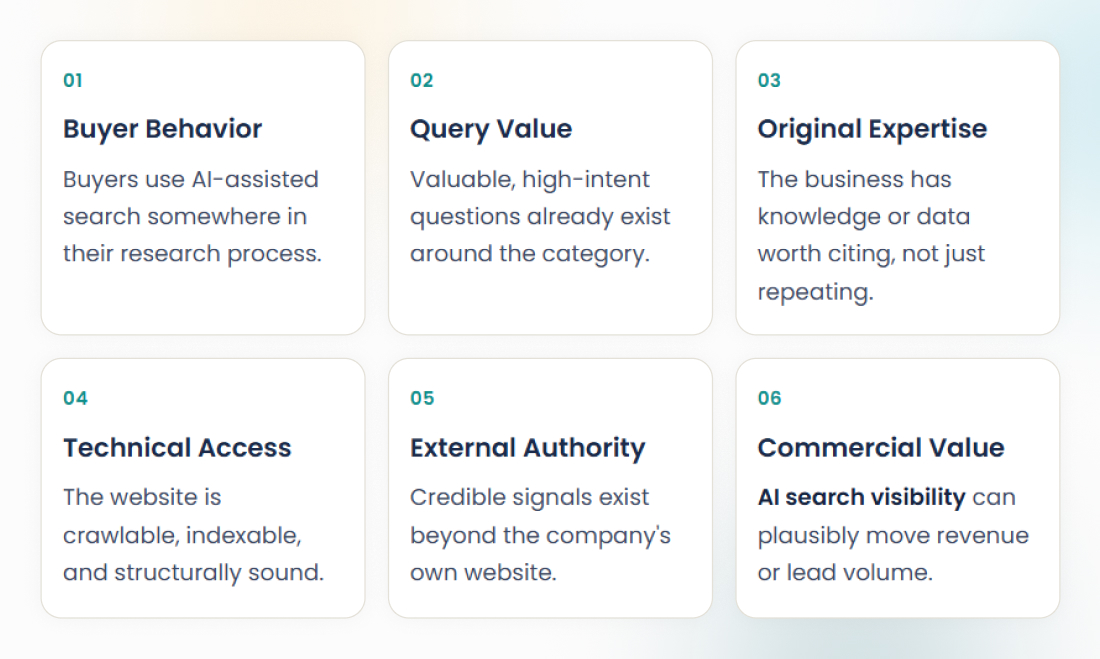
A business is GEO-ready when it can check most or all of these six boxes at once – buyer behavior, AI-search opportunity, content credibility, technical foundations, external authority, and commercial value – because generative engines look for the same signals humans use to trust a recommendation: proof the brand is relevant, credible, accessible, and worth citing. Missing one or two signals means starting with a pilot; missing four or more means the foundation needs work before GEO investment pays off.
Do Buyers Use AI Search to Research, Compare, or Shortlist Solutions?
An AEO or GEO strategy earns its keep when buyers are already using search and generative AI search tools to understand a problem, compare options, check pricing, and build a shortlist before a salesperson ever hears from them. This is no longer a minority behavior. A 2026 multi-study synthesis by Loganix, drawing on Averi’s analysis of 680 million AI citations, found that 73% of B2B buyers now use tools like ChatGPT and Perplexity somewhere in their purchase research. Separate Forrester research reported by Apollo puts generative AI adoption in self-guided B2B research at 89%, and a March 2026 G2 survey of 1,076 decision-makers found 71% specifically use AI search tools for vendor research – comparing options, building shortlists, and drafting RFP questions, not just summarizing documents.
The more research, comparison, and validation a purchase requires, the more opportunity AI-generated answers have to shape the outcome before a vendor is ever contacted directly.
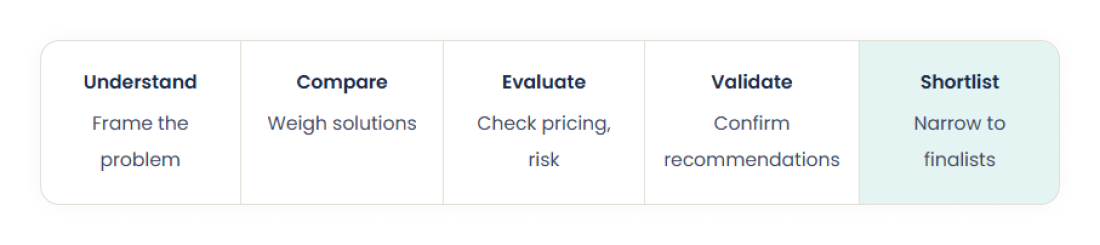
This research-heavy pattern is most pronounced in B2B services, SaaS, healthcare, professional services, and other high-consideration categories, where conversational search has effectively become a pre-sales layer that runs before the buyer journey most brands are built to measure.
Is There a Meaningful AEO and GEO Opportunity in the Market?
Before investing in an AEO strategy, it’s worth checking whether the opportunity is real: do AI Overviews appear for the category’s important searches, do platforms answer relevant questions, are competitors already being cited, and is the brand conspicuously absent from high-value answers? Query opportunity tends to fall into four groups.
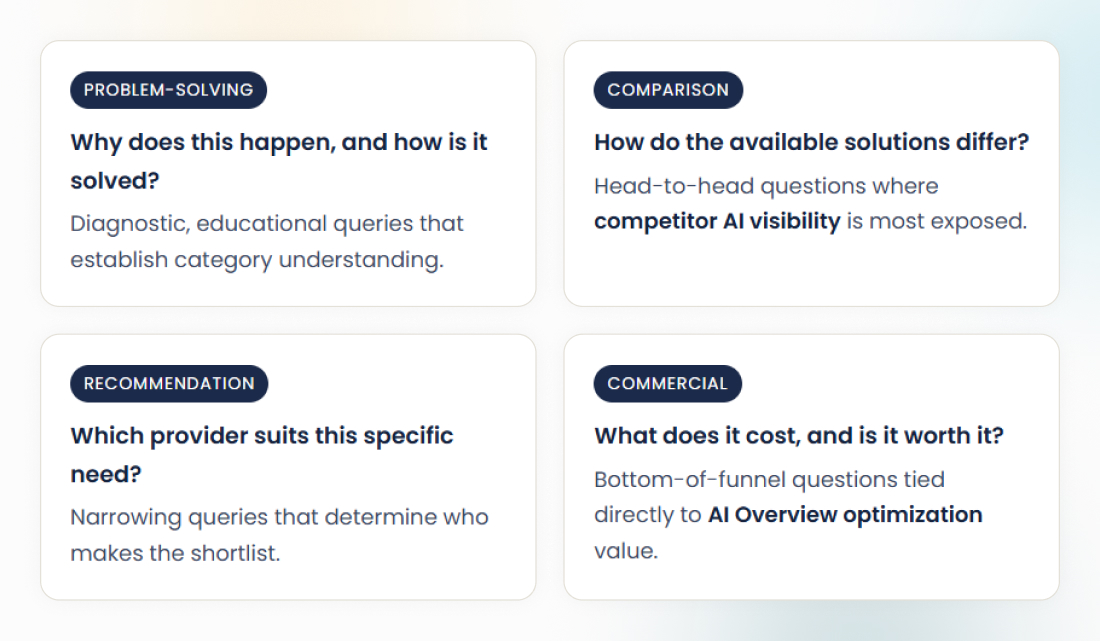
A meaningful AEO and GEO opportunity exists when AI Overviews and AI platforms already answer the category’s problem-solving, comparison, recommendation, and commercial queries, competitors are visibly cited in those answers, and the brand itself is absent – because that gap between demand that already exists and visibility the brand hasn’t earned yet is the clearest signal that GEO investment has something real to capture, not just a hypothetical upside to chase.
Does the Business Have Original Expertise That AI Engines Can Cite?
Publishing more content does not, by itself, create GEO readiness. Google’s own search guidance is direct on this point: creators should prioritize original, people-first content that demonstrates real expertise, experience, authority, and trustworthiness – regardless of whether AI assisted in producing it. In practice, that means subject-matter experts, first-hand experience, original research, proprietary process, and case studies with real outcomes carry far more weight than another rewritten explainer.
| Content Type | Commodity Content | Citable Content |
| Souce of claims | Restates what’s already ranking | Original-data,first-hand experience |
| Voice | Generic, unattributed | Named expert, verifiable credentials |
| Evidence | General statements | Case studies, outcomes, framework |
| Point of view | Neutral summary | Defensible opinion backed by evidence |
| AI Citation odds | Low-easily replaced | Higher-improves the answers |
Businesses are better positioned for GEO when they contribute information, evidence, or experience that actually improves an answer – not when they simply repeat what’s already available everywhere else. This is what makes expert-led content and original research the real currency of AI citations.
Are the SEO, Content, and Technical Foundations Ready for AI Search?
A business does not need flawless SEO before starting GEO. But critical crawlability problems, thin content, unclear positioning, or weak site architecture will cap how often a brand appears in AI Overviews and other generative search experiences, no matter how strong the expertise behind it is.
| . | |
| ✓ Crawlability and indexation | ✓ Clear entity information |
| ✓ Strong internal linking | ✓ Genuinely helpful informational content |
| ✓ Author and organization credibility | ✓ Content freshness |
| ✓ Structured data where relevant | ✓ Page experience and accessibility |
Structured data helps search engines and AI systems understand what a page’s entities and content actually are – but it supports strong content and sound technical SEO for GEO; it doesn’t substitute for either.
Does the Brand Have Credible Authority Beyond Its Website?
Self-published claims only go so far. Off-site authority – the kind that comes from being mentioned, cited, reviewed, and referenced by others – signals to AI systems that a brand’s expertise is recognized outside its own marketing copy. External authority strengthens GEO readiness by showing that a business’s expertise, reputation, and claims are recognized beyond its own website. Chasing artificial mentions to game entity signals is the wrong instinct here – search engines are built to discount exactly that kind of manufactured validation, so real digital PR for GEO outperforms shortcuts every time.
Run through these eight signals honestly, and you’ll know exactly where your authority gap sits:
- Media mentions – Has a journalist or industry publication referenced your business in the last 12 months, or would a search turn up nothing beyond your own site?
- Industry citations – Are you cited in reports, roundups, or research the way your competitors are, or is that space currently empty for your brand?
- Customer reviews – Do you have enough recent, detailed reviews on third-party platforms to outweigh a single bad one, or is your review profile thin and dated?
- Expert contributions – Has someone from your team been quoted, interviewed, or published outside your own channels?
- Trusted directories – Is your business listed – accurately and consistently – on the directories your category’s buyers actually check?
- Partnerships and associations – Do named partnerships or certifications back up the claims on your site, or are they asserted with nothing to point to?
- Conference and podcast appearances – Has anyone outside your company put a mic in front of you, or is your expertise only ever self-published?
- Consistent entity data – Does your business name, description, and positioning match across every platform, or does it shift depending on where someone looks?
If more than two or three of these come back “no,” that’s not a content problem – it’s an authority gap, and it’s the reason AI systems keep citing competitors instead of you. A brand has credible authority beyond its website when its expertise, reputation, and claims are independently confirmed by media, reviews, directories, and industry sources it doesn’t control – because AI systems weight third-party validation more heavily than self-published claims, and a business with real off-site signals will out-cite a business with better copy but no outside proof.
Can GEO Generate Measurable Visibility, Leads, and ROI?
GEO ROI shows up when better visibility in AI-generated answers increases brand consideration, qualified demand, or pipeline – not simply when citation counts go up. The commercial case gets stronger with higher average deal values, longer sales cycles, and more competitive categories, where earning a spot on the AI-generated shortlist matters more than ever.
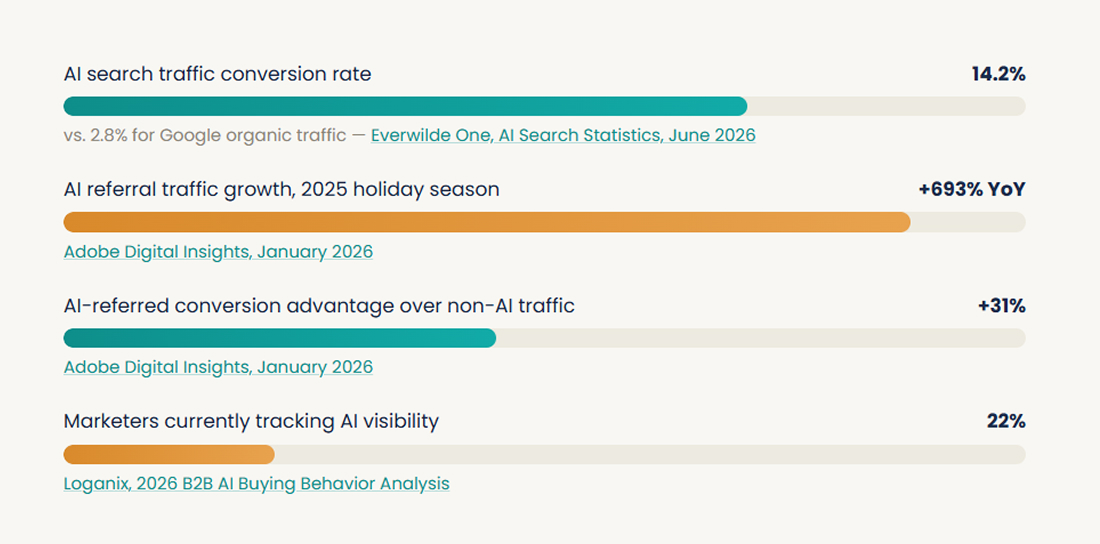
That last figure matters most for planning purposes: with only about one in five marketers tracking AI search ROI today, brands that start measuring LLM visibility, share of AI-generated answers, and assisted conversions now are working with far less noise than the market will have in a year.
How Can a Business Assess Its GEO Readiness?
Use this GEO readiness assessment as a working scorecard – not a pass/fail test, but a way to see which of the ten factors need attention before scaling investment.
| Readiness Factor | Questions To Ask |
| Buyer’s Behavior | Do buyers research and compare before purchasing? |
| AI-Search Demand | Are relevant questions already answered by AI platforms? |
| Query Value | Can those answers influence commercial decisions? |
| Expertise | Does the business have original knowledge worth citing? |
| Content | Can the website answer key questions clearly? |
| Technical Readiness | Can search engines access and interpret the content? |
| Authority | Is the brand validated by credible external sources? |
| Commercial Values | Can stronger visibility influence meaningful revenue? |
| Measurements | Can AI visibility and business outcomes be tracked? |
| Commitment | Can the business sustain ongoing optimization? |
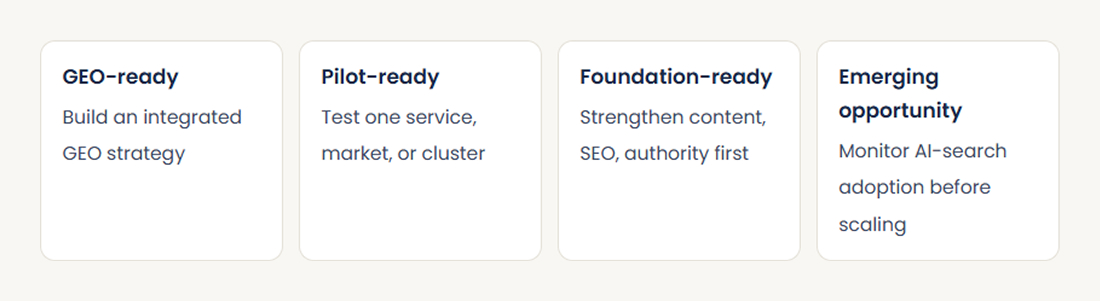
A business can assess its GEO readiness by scoring itself against these ten factors – buyer behavior, AI-search demand, query value, expertise, content, technical readiness, authority, commercial value, measurement, and commitment – because a strong score across most factors points to a full GEO strategy, a handful of gaps points to a pilot, and multiple gaps means the foundation needs work before GEO spend will pay off. The scorecard isn’t pass/fail; it’s a diagnostic that tells a business exactly where to start.
Should the Business Start With a GEO Pilot or a Full SEO Strategy?
Not every business is ready for the same starting point, and that’s fine – the scorecard above should point toward one of three sensible next steps.
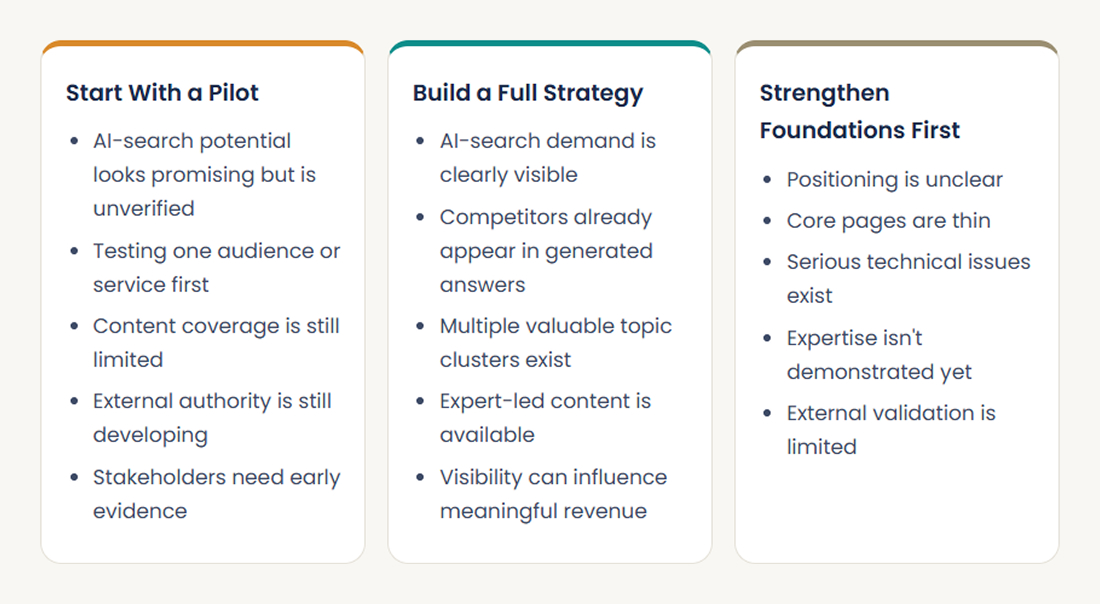
This gives every reader a constructive next step without suggesting that the business is unsuitable for GEO.
A business should start with a GEO pilot when AI-search potential looks promising but is still unverified, content coverage is limited, or stakeholders need early evidence before committing further – and should move to a full GEO strategy when AI-search demand is clearly visible, competitors already appear in generated answers, and expert-led content and authority are already in place. There’s no wrong starting point here, only the wrong one for where a business currently stands: pilot to test, build to scale, or strengthen foundations first if the scorecard shows real gaps – the kind of call ZealousWeb helps businesses make correctly before a single dollar goes into execution.
Conclusion
A business is ready for GEO when AI-assisted research already shapes how its buyers decide, commercially valuable questions exist in its market, and the brand has credible expertise that can genuinely improve a generated answer. Strong technical foundations, real external authority, measurable goals, and the discipline to keep optimizing are what turn that readiness into results that actually move revenue. This is the same ten-factor lens ZealousWeb applies before recommending a pilot, a full build, or a foundations-first pass – because the wrong starting point wastes a quarter, and the right one compounds.
Build AI-Ready Content That Gets Found, Trusted, and Cited
Let's Talk

FAQs
What Types of Businesses Benefit Most From GEO?
Businesses with research-heavy buyer journeys - B2B services, SaaS, healthcare, and other high-consideration categories - benefit most, since buyers already compare and validate options through AI search before contacting a vendor.
Does a Business Need Strong SEO Before Starting GEO?
Not flawless SEO, but a functioning foundation. Critical crawlability issues, thin content, or unclear site architecture will limit how often a brand appears in AI Overviews, regardless of expertise.
How Is GEO Readiness Measured?
Through ten factors spanning buyer behavior, AI-search demand, content, technical access, authority, commercial value, and measurement capability - scored together, not in isolation, to reveal where a business actually stands.
Should a Business Start With a GEO Pilot?
Yes, when AI-search potential looks promising but is still unverified, content coverage is limited, or stakeholders need early evidence before committing to a full, integrated GEO strategy.