

ZealousWeb
behavioral lead scoring

How to Charge 2x for WordPress Projects Using Behavioral Lead Scoring

March 20, 2026Posted By: Narayani Pradhan
B2B Lead GenerationBehavioral Lead ScoringConversion OptimizationWordPress Development

Most WordPress websites today are well-built, fast, and visually polished.

But for many agencies, the outcome is still the same: the site goes live, and the value stops there.

Today, agencies have access to more capable development environments than ever. Page builders, flexible frameworks, and AI-assisted workflows have made execution faster and more efficient. That’s progress, but it has also created a new problem. When delivering a “good website” becomes easier, the work itself starts to feel interchangeable.

This is where most agencies hit a ceiling.

Not because of lack of skill, but because the website is treated as a finished deliverable instead of an ongoing system.

If you’ve ever felt that your work delivers more value than what clients are willing to pay for, it’s worth reading further.

What is Behavioral Lead Scoring?

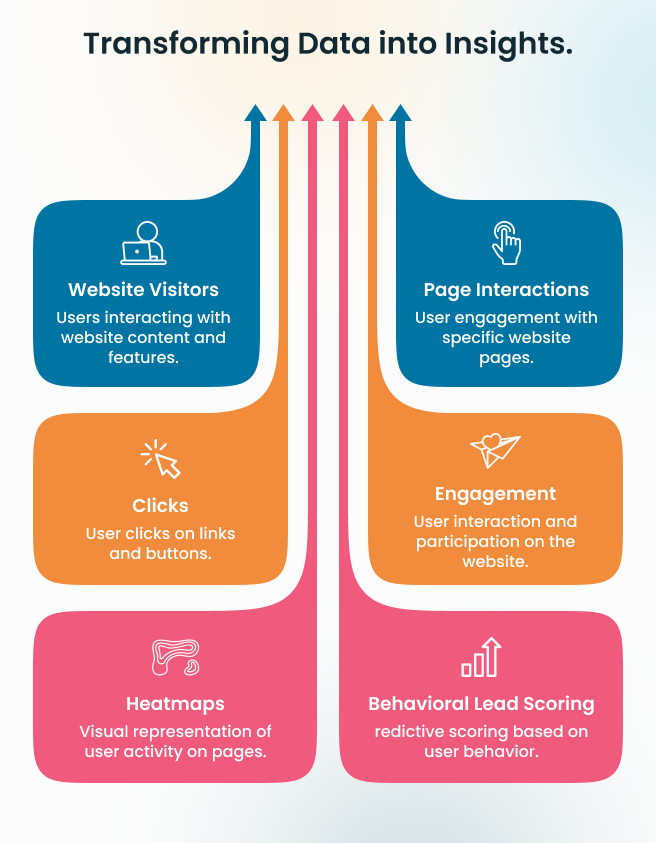
Behavioral lead scoring is a structured way to measure visitor intent by assigning measurable value to the actions that matter most on a website. Not every visit carries the same significance. A casual browser reflects a different level of engagement than someone exploring service pages, returning multiple times, or moving deliberately through content that signals a purchasing decision is forming.
Transforming Data into Insights.


A scoring framework brings clarity by translating behavior into a ranked view of the visitor pool:

  • Actions that indicate serious interest accumulate points
  • Low-intent behavior reduces the overall score
  • Visitors are ranked by engagement rather than traffic volume or recency

For a client’s sales team, this changes how time and attention are prioritized:

  • Focus moves toward prospects already demonstrating meaningful interest
  • Decisions are based on behavior rather than intuition
  • High-intent visitors are identified before the first conversation takes place

The result is a shift from passive traffic reporting to intelligence that a sales team can act on immediately. For agencies, that shift represents something equally important — a service that clients can see working, month after month, in direct connection to their sales outcomes.

Which channels are bringing in the visitors who show the strongest intent? That is the question behavioral lead scoring makes possible to answer, and the foundation on which the entire value engine is built.

Setting Up the "Value Engine"

Behavioral lead scoring becomes genuinely powerful when it operates as a continuous system — one that tracks engagement across the entire site, accumulates signals over time, and surfaces a clear picture of which visitors are moving toward a decision and which are not.

Interpreting Visitor Engagement

The system evaluates how visitors interact with the pages that matter most. Exploring service pages, reviewing pricing, engaging with detailed resources, or returning to key content multiple times — these actions indicate a visitor who is actively evaluating, not passively browsing. Measured consistently, they create a ranked view of the visitor pool that gives sales teams a reliable starting point rather than a flat list of names to work through.

This is what agencies are actually delivering when they implement a scoring system — not a technical configuration, but a prioritization engine that makes a client’s sales effort more focused and more efficient from the moment it goes live.

Linking Engagement to Traffic Sources

Understanding who is engaging is valuable. Understanding where they’re coming from is what makes that intelligence strategic.

When engagement scores are connected to traffic sources, the conversation shifts from volume to quality. A channel driving consistent high-intent visitors is worth a very different investment than one generating high traffic with low engagement. Agencies that can surface this distinction are no longer reporting on campaigns — they’re advising on where the budget should go and why.

That kind of guidance is what separates a development partner from a vendor. And it’s the kind of insight that makes a client reluctant to walk away at the end of a project.

From Insight to Strategic Asset

When behavioral data and source-level intelligence are read together, the website stops functioning as a reporting tool and starts functioning as a decision-making resource. Clients gain clarity on which visitors deserve attention, which channels are producing real commercial value, and where sales and marketing efforts are most likely to convert.

For agencies, this is the moment the engagement model changes. The website is no longer a deliverable with a handover date. It becomes an active system that continues generating insight, one that requires an ongoing relationship to interpret and act on effectively. And for businesses that are serious about growth, that kind of ongoing intelligence is not something they want to lose once they have it.

How to Structure Your "Premium" Package

When behavioral lead scoring is part of the delivery, a WordPress engagement doesn’t end at launch. The work naturally organizes into three distinct phases, each creating clear client value and justification for investment.

Phase 1: Discovery and Strategy

Before configuring the system, the agency works closely with the client to define what a high-intent visitor looks like for their business. Key questions include:

  • Which pages signal serious interest?
  • Which actions show the visitor is actively evaluating a solution?
  • Which engagement patterns match the client’s ideal customers?

The answers form the foundation of the scoring framework, ensuring every rule reflects real customer behavior, not assumptions. This phase also positions the agency as a strategic partner from day one.

Phase 2: Implementation and Configuration

With the scoring framework defined, the system is built to track and evaluate visitor behavior automatically. Form interactions and site engagement are linked to visitor profiles so that every meaningful action contributes to a score.

The system continuously interprets engagement signals:

  • Visitors exploring high-value pages accumulate stronger scores
  • Returning visitors signal deeper interest
  • A ranked view of the audience emerges in real time

By the end of this phase, the website is no longer a static deliverable — it becomes a live system that surfaces the prospects most worth the client’s attention.

Phase 3: Ongoing Insights and Retainer

The final phase turns project work into a recurring partnership. Each month, the agency delivers a structured report highlighting:

  • High-intent visitors ranked by engagement
  • On-site behavior and interaction history
  • Channels driving the most qualified traffic

Sales teams gain a prioritized view of prospects, backed by real behavioral data. For the client, the impact is immediately visible. For the agency, the report demonstrates ongoing value and makes a retainer easy to justify and maintain.

Each phase builds on the last, creating a service structure that grows in value rather than ending at handover. When the work is structured this way, the monthly retainer is not a difficult conversation. It is a natural outcome of the value already being delivered.

The AI "Super-Charge"

Once behavioral lead scoring is in place, the website already reveals which visitors are showing the strongest engagement. AI takes this a step further, moving beyond numerical scores to interpret patterns, evaluate lead quality in context, and produce insights that give sales teams something more useful than a ranked list.

From Activity to Interpretation

Rather than presenting raw engagement data, AI assesses how a visitor’s behavior fits together. Time spent on key pages, interaction with solution-focused content, and return visit patterns are read as a whole rather than as isolated actions. What emerges is a structured evaluation of each lead, one that explains the reasoning behind the assessment rather than simply assigning a number.

For sales teams, this changes the quality of the conversation before it even begins. Instead of approaching a prospect cold with only a score as context, they have a clear picture of what that visitor was evaluating, how seriously they were considering it, and where their interest is most concentrated.

AI-Driven Lead Intelligence

For agencies, this represents a genuinely distinct service tier. Offering AI-driven lead intelligence positions the agency as a strategic partner in the client’s sales process, not simply a provider of website infrastructure. The value is visible, specific, and directly connected to outcomes the client cares about.

When a sales team consistently closes faster because they are approaching prospects with context and confidence, the agency responsible for that system becomes very difficult to replace. And once a client experiences that level of insight, a standard website engagement is no longer what they are looking for. They are looking for a partner who can keep delivering it.

AI-driven lead intelligence is not an add-on. It is what separates a service that clients value from a service that clients depend on. Once that distinction is established, the conversation about pricing, retainers, and long-term partnerships becomes significantly easier to have.

Pricing for Profit with Tiered Licensing

The agencies that earn the strongest margins don’t price based on cost. They price based on the outcomes they enable. Tiered licensing makes this possible by reducing the cost per license as the number of clients grows, while the value delivered to each client remains consistent. That gap between what the agency pays and what the service is worth to the client is where margin lives.

How Tiered Licensing Works

The structure is straightforward:

  • A single license serves one client at a standard rate
  • Bulk licenses reduce the cost per client without reducing the service value
  • Each client pays the same rate, reflecting the intelligence being delivered rather than the underlying tool cost

As client numbers grow, margins expand disproportionately. The cost per client drops while the perceived value stays constant, which means every additional client added to a bulk license improves the overall margin of the entire agency model.

Outcome-Driven Pricing

Agencies that consistently win on margin have shifted the client conversation entirely. The software cost becomes irrelevant. What matters is what the system produces: qualified leads identified, sales priorities clarified, and marketing budgets directed toward channels that demonstrably perform.

When clients are evaluating the service against those outcomes, the pricing discussion looks very different. The question is no longer what the agency charges. It is what the intelligence is worth to the business receiving it.

Tiered licensing turns a scalable service into a scalable business. And when the pricing reflects the outcomes being delivered rather than the hours being spent, the agency is no longer competing on price at all.

Conclusion

Clients are no longer looking for a website. They are looking for a system that helps them identify the right prospects, focus their sales efforts, and make smarter decisions about where their marketing budget goes. Agencies that build and deliver that system are not competing on price; they are operating in an entirely different conversation.

Behavioral lead scoring, attribution intelligence, and AI-driven evaluation are not features to list in a proposal. They are the foundation of a service that proves its value every single month, in language the client’s sales team understands and acts on.

With ZealousWeb, that shift becomes achievable: structuring, positioning, and pricing work to deliver ongoing results, using capabilities most WordPress professionals already possess. The agencies that grow consistently are the ones that stopped selling deliverables and started selling outcomes. That shift does not require a different skill set — it requires a different way of thinking about and delivering WordPress projects that aligns value with measurable results.

Ready to Transform Your WordPress Projects into High-Value Revenue?

Find Out How

WordPress Projects

FAQs

Related Blog Posts

WordPress personalization

Stop Delivering Static Websites: How to Offer “Personalization-as-a-Service” to Your Clients

March 20, 2026
AI-powered personalizationdynamic contentlead scoringWordPress Personalization
Delivery cost calculator

Delivery Cost vs In-House Burn Calculator: Measure the True Cost of In-House Delivery

March 19, 2026
Burn calculatorDelivery costIn-house deliveryProject Management
ZealousWeb

ZealousWeb’s Structured Delivery & QA Process Explained Through Systems

March 12, 2026
DORA MetricsExecution SystemsQuality Assurance ProcessSoftware Delivery Process
GraphQL

GraphQL: The Data Fetching Saga

April 30, 2024
Data FetchingGraphQLWeb Development
HTTP/2 Based Push Notification In iOS

How To Implement HTTP/2 Based Push Notification In iOS?

December 06, 2022
HTTP/2 ProtocoliOS DevelopmentPush Notifications
Develop A Web Application

How To Develop A Progressive Web Application Using ReactJS? In-Depth Guide

July 21, 2022
Frontend TechniquesPWA DevelopmentReactJS Tutorials
Crafting Mobile User Experience

Crafting Exceptional Mobile User Experiences: A Comprehensive Guide

October 17, 2021
Mobile-Friendly WebsitePage Loading TimesWebsite Navigation
ZealousWeb

Maximizing WordPress: Diving Into Theme Customization vs. Plugin Development

August 04, 2020
Plugin DevelopmentTheme CustomizationWordPress
Unit Testing Vs. Functional Testing

Which Is Right For Your Needs: Unit Or Functional Testing?

June 11, 2020
Functional TestingSoftware TestingUnit Testing