

ZealousWeb
ecommerce mobile app development 2026

Must-Have Features for E-commerce Mobile App Development 2026

February 13, 2026Posted By: Jalpa Gajjar
eCommerce App DevelopmentEcommerce InnovationEcommerce Mobile AppsMobile App Trends 2026

E-commerce mobile apps in 2026 are no longer built around search bars, storefronts, or linear user journeys—they are designed around anticipation, trust, and invisibility. Traditional keyword-driven discovery is giving way to AI-native intent understanding, where apps predict needs through behavior, context, and real-time data rather than waiting for explicit searches. At the same time, rising consumer skepticism around data usage, product authenticity, and fulfillment is forcing brands to embed transparency directly into the app experience through verifiable systems and trust-first design.

Layered over all of this is the rise of the “invisible app”—a shift where e-commerce moves from being a destination users open to a background assistant that quietly automates decisions, prompts actions, and integrates commerce into everyday life. This paradigm shift is redefining what truly counts as must-have features for e-commerce mobile app development in 2026.

E-commerce App Features Tailored to Different Retail Verticals

E-commerce apps customize features by vertical to address specific product traits and buyer journeys, blending partial descriptions with bulleted highlights for clarity. This format mixes concise paragraphs for context with bullet lists of key features, limited to the five verticals from our discussion: fashion, cosmetics, groceries, electronics, and home decor.

Fashion Retail Features

Fashion apps prioritize immersive visuals and sizing accuracy to cut returns and speed purchases. Core tools include AR try-ons and personalized styling.

  • Virtual try-on with AR for clothes and accessories
  • Size recommendation engines using body measurements
  • Style quizzes and trend-based personalized feeds
  • Outfit builders and 360-degree product views

Cosmetics & Beauty Features

Beauty platforms build trust through personalization and safety checks, often using selfies for shade matching. Engagement comes from tutorials and user content.

  • Shade finders via camera or skin quizzes
  • Ingredient scanners and allergy alerts
  • Tutorial videos and subscription refills
  • Before-and-after photo galleries from users

Grocery Essentials Features

Grocery apps streamline routine shopping with speed and local relevance, integrating recipes and substitutions for convenience. Loyalty perks drive habits.

  • One-tap reorder lists and aisle navigation
  • Real-time pricing and delivery slots
  • Substitution suggestions for out-of-stock items
  • Recipe-linked shopping carts and coupons

Electronics Tech Features

Electronics buyers demand detailed specs and demos, so apps offer comparisons and support tools. Financing and updates aid complex decisions.

  • Comparison tables and 3D exploded views
  • Compatibility checkers for accessories
  • Extended warranty and financing calculators
  • Firmware updates and manual access

Home Decor Custom Features

Home decor focuses on visualization for big purchases, using AR to preview items in spaces. Configurators and planners boost confidence.

  • AR room scanners for furniture placement
  • Color palette generators and swatch matching
  • Custom product configurators (e.g., sofas)
  • Mood board savers and virtual consultations

The most effective e-commerce apps are built around product behavior and buyer intent, not a one-size-fits-all feature list. By aligning app capabilities with vertical-specific expectations, brands reduce friction, improve confidence, and drive repeat purchases. In 2026, vertical intelligence is what separates functional e-commerce apps from category leaders.

Must-Have Features for E-commerce Mobile App Development 2026

E-commerce app development features spearhead innovation with agentic AI and spatial AR, slashing cart abandonment by over 50% through proactive, immersive UX tailored for today’s shoppers.

Agentic AI Shopping Assistants (Beyond Chatbots)

Agentic AI transforms e-commerce mobile app development features by autonomously handling decisions, analyzing real-time context like weather or events for proactive curation.

  • Live bundle reasoning (e.g., “rainy day essentials under $100”)
  • Sensor fusion for hyper-personalized nudges (location + battery)
  • Voice negotiations with dynamic loyalty swaps
  • Multi-step purchase automation without human prompts

Spatial Computing & Physics-Based AR Try-Ons

E-commerce mobile app development features set new AR standards with LiDAR-driven physics for fabric simulation and occlusion, cutting returns 40% in visual verticals.

  • Room-scale spatial anchors across devices
  • Real-time cloth dynamics and lighting adaptation
  • Social AR sharing for group try-ons
  • Persistent sessions from phone to AR glasses

Predictive Zero-Click Personalization

Zero-click tech in e-commerce app development features predicts via on-device ML, surfacing products instantly to boost session value without search friction.

  • Edge AI home feeds adapting to micro-signals
  • Time/geolocation contextual carousels
  • Serendipity engines blending known + novel items
  • Sub-second personalization latency

Multi-Modal Search (Visual, Voice, & Screenshot)

E-commerce mobile app development features make visual/voice search 3x faster than keywords, using unified models for screenshot or “find similar” queries.

  • Object isolation from screenshots
  • Accent-proof voice with query refinement
  • Hybrid photo + text semantic matching
  • Visual-first ranking supremacy

Blockchain-Verified Digital Product Passports

Blockchain DPPs enhance e-commerce app development features with QR-NFT provenance, proving sustainability from source to resale.

  • Full lifecycle transparency ledgers
  • AR holograms overlaying product data
  • Verified carbon calculators
  • Circular resale wallet transfers

Hyper-Local "Micro-Moment" Logistics Tracking

Micro-moment tracking defines 2026 e-commerce mobile app development features, offering 15-min granular ETAs via IoT fusion.

  • Live driver/drone POV maps
  • Predictive weather rerouting
  • Micro-fulfillment status (e.g., “assembling now”)
  • Geofenced block-level alerts

Unified Biometric "One-Tap" Checkout

Biometric flows in e-commerce app development features fuse Face ID + behavior for 60% abandonment drops, fully passwordless.

  • Cross-platform passkey federation
  • Typing gait as a camera-free fallback
  • Risk-based instant approvals
  • Split-auth for high-value carts

First-Party Data Preference Centers (Privacy-First UX)

Privacy centers power compliant e-commerce mobile app development features, letting users control data for better personalization.

  • Granular opt-in ROI previews
  • Decentralized edge profiles
  • Blockchain consent audit trails
  • Gamified data portability rewards

Implementing these e-commerce app development features positions e-commerce brands as 2026 leaders, driving sustainable growth through trust, speed, and foresight.

Strategic Implementation: Prioritizing the Right E-commerce App Roadmap

Building an e-commerce app in 2026 is no longer about launching fast and fixing later. It is about making deliberate, future-proof decisions from day one. Brands must prioritize features based on immediate user value, long-term scalability, and meaningful performance outcomes. A strong roadmap clearly separates day-one essentials from scale-stage enhancements while ensuring the underlying architecture can evolve without expensive rebuilds.

The MVP Reality for E-commerce Apps in 2026

A modern e-commerce MVP is expected to feel intelligent, trustworthy, and frictionless from the first interaction. Launching with only a product catalog and checkout is no longer sufficient. Day-one features should reduce decision fatigue, capture early intent signals, and enable basic automation to support personalization and retention without overengineering the product.

Scalability Through Modular and Headless Architecture

As e-commerce brands grow, rigid all-in-one platforms often become limiting. Modular and headless architectures allow teams to upgrade or replace specific capabilities such as personalization, checkout, or analytics without disrupting the entire app. This approach supports omnichannel expansion, faster experimentation, and long-term technical flexibility as customer expectations evolve.

Measuring Success Beyond Clicks

Traditional e-commerce metrics like installs and clicks provide limited insight into real performance. In 2026, success is measured through engagement depth, repeat behavior, and intent completion. Tracking how users interact, return, and progress through lifecycle journeys gives brands a clearer view of sustainable growth drivers rather than surface-level activity.
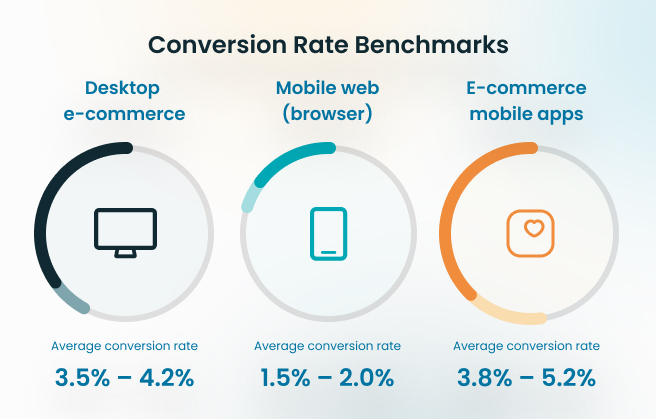
Conversion Rate Benchmarks

Conclusion

E-commerce mobile app development in 2026 is defined by intelligence, intent, and trust rather than feature volume. Winning apps are no longer reactive storefronts but proactive ecosystems that anticipate needs, reduce friction, and operate invisibly in the background of users’ lives. From vertical-specific experiences to agentic AI, zero-click personalization, and privacy-first design, the shift is clear: performance now comes from relevance, transparency, and architectural flexibility.

For brands, the real differentiator lies in how thoughtfully these capabilities are prioritized and implemented. A future-ready roadmap, modular architecture, and outcome-driven metrics separate scalable platforms from short-lived apps. Teams that approach app development as a long-term growth system rather than a one-time launch are the ones positioned to lead.

This is where experienced digital partners like ZealousWeb quietly add value by aligning strategy, technology, and user behavior into a single, evolving e-commerce app ecosystem built for 2026 and beyond.

Build the Right Features Before You Build the App

Get Expert Insight
E-commerce Apps

FAQs

Related Blog Posts

ZealousWeb

Revenue Impact: How Apps Drive 3X Higher Customer Lifetime Value

February 16, 2026
Digital TransformationeCommerce App DevelopmenteCommerce GrowthRetention Strategy
ZealousWeb

Top 2026 Trends Impacting E-commerce Mobile App Development Cost

February 11, 2026
AI in E-commerceE-commerce App DevelopmentE-commerce Trends 2026Mobile App Development Cost
e-commerce mobile app development

Native vs Cross-Platform: E-commerce App Development Build Options

February 03, 2026
AI in Mobile AppsE-commerce Mobile AppsE-commerce TechnologyNative App Development
ecommerce app scaling costs

Hidden Costs in E-commerce App Development Services Projects

January 28, 2026
App Development CostsApp MaintenanceeCommerce App DevelopmentHidden Costs
ecommerce application development timeline

E-commerce Application Development Timeline: Idea to App Store 2026

January 26, 2026
App Development TimelineeCommerce App DevelopmentEnterprise App DevelopmentMobile App Development Process
ecommerce app development costs

What Drives E-commerce App Development Costs? Key Pricing Factors

January 23, 2026
App Development Cost FactorseCommerce App DevelopmentEnterprise App DevelopmentMobile App Pricing
e-commerce mobile app development

E-commerce Mobile App Development Cost 2026: Complete Budget Guide for Companies & Brands

January 22, 2026
App Development StrategyeCommerce App DevelopmentEcommerce App PricingShopify App Development
Professional Mobile App Development Services

Why Your Business Needs Professional Mobile App Development Services Now More Than Ever

March 01, 2024
App Development ServicesBusiness StrategyMobile apps
Mobile App Development Company For Your Business

The Ultimate Guide To Choosing A Mobile App Development Company For Your Business Needs

February 01, 2024
App Development ServicesMobile appsTechnology Solutions