
AI search visibility measures whether a client’s brand, expertise, products, or content appears inside AI-generated answers-not only where its pages sit on a traditional search results page.
Rankings still matter. But they have stopped being the whole story.
A client can rank well in traditional search and still be missing from ChatGPT Search, Perplexity, or Google AI Overviews. These platforms may use different systems, sources, queries, and citation methods when building answers. So yes, another first-page ranking report is nice. It just may not answer the question clients will soon ask: “Why is our competitor mentioned by AI, but we are not?”
For agencies managing SEO strategy in 2026, generative search visibility is no longer a shiny add-on for pitch decks. It is becoming part of how clients judge brand visibility, authority, and digital performance.
The following six-pillar AEO and GEO framework helps agencies improve client visibility across AI-powered search, earn more relevant LLM citations, and build a service they can confidently sell, deliver, and report.
From Agency Bottlenecks to AI Citations: Why Partner Agencies Hand Off Their Toughest AEO & GEO Clients to Us
Partner agencies hand off their toughest AEO and GEO clients because the hard part isn’t strategy, it’s execution. The technical cleanup, the entity untangling, the off-site authority building, and the platform-by-platform reporting all take specialized hours most account teams don’t have sitting around. So instead of billing for a skill set they’d have to build from scratch, agencies quietly route the messy accounts to us.
Why Do Agencies Outsource Their Hardest AEO and GEO Clients?
Every agency has that one account. The site’s a JavaScript mess, the brand name shows up four different ways across the web, and the client wants to know why they’re not “in the ChatGPT thing” yet. None of that is a strategy problem. It’s an hours problem. Agencies that try to solve it in-house end up with a strategist doing crawler diagnostics between client calls, which is a bad use of a good strategist.
What Kind of Clients End Up Getting Handed Off?
Usually the same three types: accounts with tangled technical debt, brands with a scattered entity footprint across directories and profiles, and clients asking for AI visibility reporting nobody on the team has built before. None of these are impossible. They’re just slow, specialized, and expensive to solve one-off.
How Does the Handoff Actually Work?
Quietly. We run the audit, rebuild the priority content, clean up the entity signals, and report back in language the account team can hand straight to the client. The agency stays the face of the relationship. We stay the reason the retainer doesn’t get questioned at renewal.
We understand these frustrations firsthand-and it is precisely why we operate as a specialized, silent execution engine for agency partners. We don’t offer generic consulting or hand you back a list of recommendations for your team to implement. We handle the deep technical, structural, and off-site execution when standard SEO strategies hit a wall.
The six-pillar guide detailed below is not theoretical advice; it is the exact operational playbook our specialist team uses daily to diagnose, repair, and scale LLM visibility for partner agency clients.
Pillar 1: How To Uncover the AI Search Prompts Your Clients Are Missing
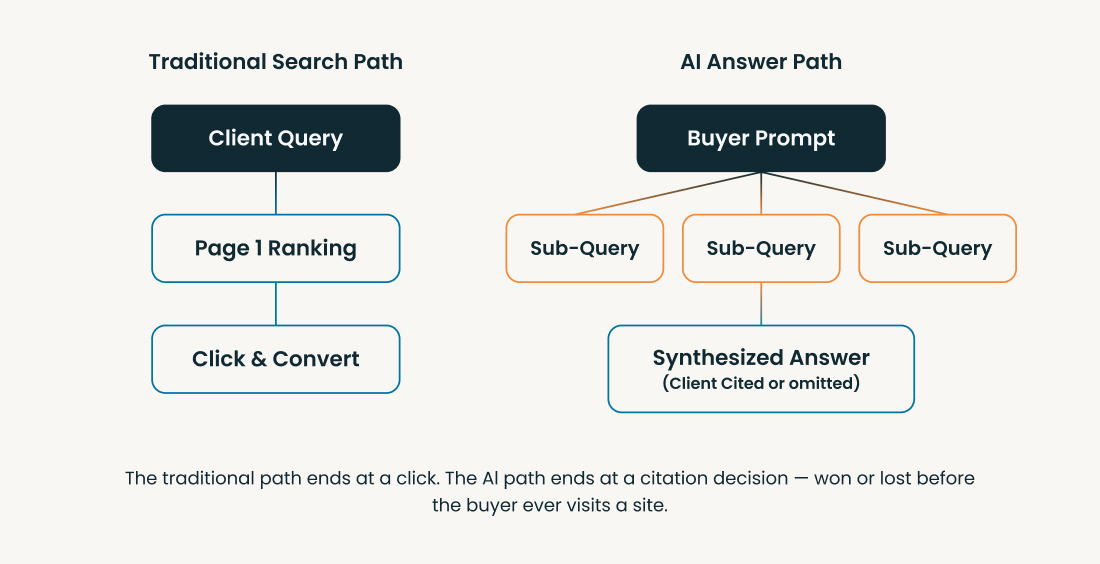
Traditional keyword tools only measure static search volumes (e.g., “best enterprise ERP”). However, prospective buyers type multi-layered, conversational prompts into LLMs (e.g., “Compare top enterprise ERPs for manufacturing with fast deployment under $100k”).
When an LLM evaluates a complex prompt, it triggers query fan-out-breaking that single prompt into 3 to 7 background sub-queries to gather context before synthesizing an answer. If an agency only tracks standard keywords, they remain blind to where competitors are winning LLM citations.
How We Execute Prompt Intelligence for Agencies
- Query Fan-Out Mapping: We reverse-engineer the sub-queries LLMs generate when evaluating your client’s specific niche.
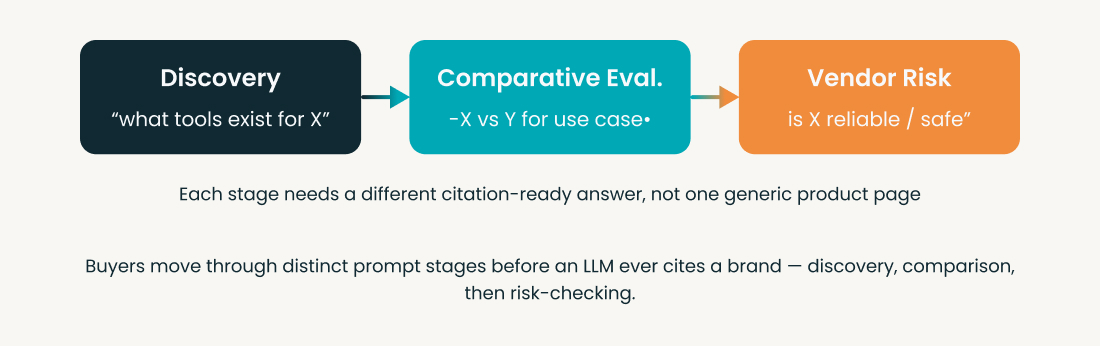
- Intent Categorization: We group prompts into Discovery, Comparative Evaluation, and Vendor Risk stages rather than rigid match types.
- AI Content Gap Audits: We run commercial prompts across ChatGPT, Perplexity, Gemini, and Copilot to pinpoint which competitor domains are cited-and why your client was omitted.
Agency Deliverable: A clear “AI Prompt Gap Report” you can present to clients to justify AEO/GEO retainer budgets without spending internal team hours running manual prompts.
Pillar 2: Why The Client Pages Are Not Being Indexed or Retrieved by LLMs?
Before debating whether an introduction needs 40 or 60 words, confirm that search systems can actually access the page. Groundbreaking, we know.
A technical AI search audit should check:
- Robots.txt directives
- Noindex and snippet controls
- Canonical tags
- XML sitemaps
- Internal linking
- JavaScript rendering
- Mobile usability
- Page performance
- Duplicate pages
- Broken redirects
- CDN or firewall restrictions
- Structured data errors
For Google AI Overviews and AI Mode, a page must be indexed and eligible to appear in standard Google Search with a snippet. Google does not require a special AI file, AI-specific text markup, or a secret schema type reserved for generative search.
JavaScript-heavy pages also need careful testing. Google can process JavaScript, but essential answers should not depend on clicks, complex user interactions, delayed rendering, or unsupported client-side actions. When critical content is difficult to load or missing from the rendered page, search and retrieval systems may struggle to access it consistently.
Technical optimization will not make weak content worth citing. It simply prevents strong content from being rejected before the selection process begins.
A brand cannot earn AI citations if search and AI systems cannot fetch, render, parse, or index its core pages. Google Search Console can help confirm whether pages are indexed, crawlable, and eligible to appear in Search, but it does not provide a separate AI citation eligibility score. The underlying requirement remains straightforward: the page must first meet standard Google Search indexing and snippet-eligibility requirements before it can appear as a supporting source in AI Overviews or AI Mode.
Technical Bottlenecks We Fix Behind the Scenes
- AI Crawler Directive Optimization: We configure robots.txt and header parameters so agents like GPTBot, PerplexityBot, ClaudeBot, and Google-Extended have structured access.
- Server-Side Rendering Fixes: Client-side JavaScript often hides text from fast-scanning LLM bots. We ensure critical answer text is pre-rendered server-side.
- Nested JSON-LD Schema Engineering: We deploy advanced schema (Organization, Product, TechArticle, FAQPage) with explicit parent-child nodes to build clear data paths for LLM parsers.
Pillar 3: How To Format Content So AI Search Engines Cite It?
LLMs operate on answer-first extraction. When an engine scans a web page during the retrieval step, it looks for concise, standalone answers that require zero reformatting or interpretation.
Citation-ready content provides a clear answer immediately and supports it with facts, examples, expert insight, and relevant context.
The most useful answer-first structure is simple:
- Ask a clear question in the heading.
- Answer it in the opening sentence.
- Explain why the answer matters.
- Add evidence, steps, examples, or comparisons.
- Address limits and likely follow-up questions.
This format improves human readability while creating self-contained passages that AI systems can more easily interpret.
Citation-Ready Content Standards
- 30-50 Word Direct Lead Injections: We format precise, definitive answers directly under target subheadings so LLMs extract the block intact.
- Data-Dense Tables & Bullet Structures: Generative models prioritize structured visual elements when compiling product comparisons or feature lists.
- Proprietary Insight Injections: Generic content is ignored. We extract unique client data, original statistics, and SME quotes that LLMs treat as primary sources.
Pillar 4: How To Build Brand Entities in Google Knowledge Graph & LLMs
Entity optimization ensures AI models recognize who your client is, what they specialize in, and which market concepts they own. Without a clean entity profile, LLMs view the brand as unverified and default to better-known competitors.
Our Entity Disambiguation Process
- SameAs Schema Mapping: We link client web assets to authoritative entities across Crunchbase, Wikidata, official registries, and trade databases.
- Brand Consensus Alignment: Inconsistent NAP (Name, Address, Phone) data or conflicting brand descriptions across the web dilute LLM confidence. We audit and standardize brand details web-wide.
- Author & SME Profiling: We build structured Person schema with knowsAbout properties to align client authors with recognized topical authority.
Pillar 5: Which Third-Party Signals Drive Citations in ChatGPT & Perplexity?
LLMs do not rely solely on a client’s owned website. To prevent hallucinations and confirm accuracy, models validate claims by checking off-site consensus across news outlets, review directories, and industry forums.
Off-Site GEO Execution
- Digital PR & Unlinked Mentions: We secure authoritative mentions in industry publications that pair your client’s brand name with target market keywords.
- Review Platform Optimization: For B2B and SaaS clients, LLMs weigh sentiment and feature matrices on platforms like G2, Capterra, and Trustpilot.
- Forum & Community Presence: We monitor and optimize brand discussions across Reddit and niche forums, which heavily feed real-time LLM retrieval vectors.
Pillar 6: How To Measure AI Share of Voice and LLM Citations?
Legacy rank tracking fails in AI search because prompt responses are dynamic, synthesized, and personalized. Agency leaders need concrete metrics that prove pipeline value to demanding CMOs.
| Performance Metrics | How Specialization Execution Measures It | Agency Reporting Value |
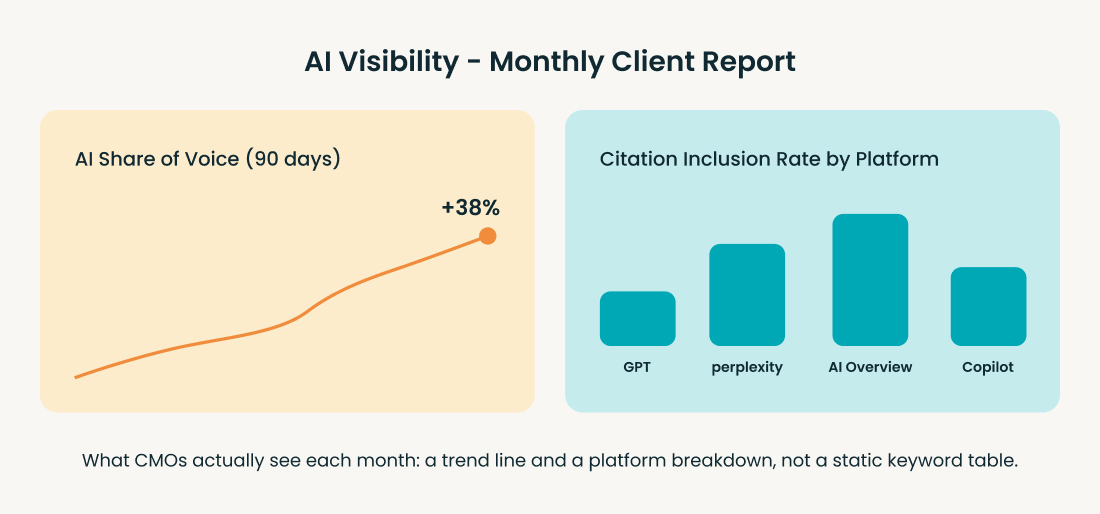
| AI Share of Voice (SoV) | % of target prompt runs citing the client vs. top 5 competitors | Proves market share expansion across LLMs |
| Citation Inclusion Rate | Frequency of domain links in ChatGPT, Perplexity, & Google AI Overviews | Replaces legacy “Page 1 Ranking” updates |
| Brand Sentiment Score | Natural language analysis of how LLMs describe client offerings | Protects brand equity in AI recommendations |
| Generative Referral Traffic | Custom GA4 segmentation tracking traffic from AI engines | Direct attribution connecting GEO to pipeline ROI |
How Specialized Execution Helps Agencies Deliver AEO & GEO
Specialized AEO and GEO execution helps agencies deliver results without training every strategist on entity graphs and crawler diagnostics. A fulfillment partner runs the technical audit, content rebuild, and citation tracking quietly behind the account team, who stays the face of the relationship.
Why Handling Edge-Case AI Search Clients In-House Drains Agency Margins
The edge cases are the expensive part: a client with a JavaScript-heavy rebuild, a brand with entity data scattered across a decade of directory listings, a client asking for platform-specific reporting nobody on the team has built before. Each one eats hours that never show up on the original scope.
The Step-by-Step Audit and Execution Process for Partner Agencies
- Audit existing AI visibility and technical health
- Map commercially relevant prompts for the client’s category
- Fix crawlability, indexing, and schema issues
- Rebuild priority content into answer-first format
- Strengthen entity and off-site authority signals
- Track citations and report in plain, client-facing language
How Specialized Execution Sits Silently Behind Your Account Team
The client sees the agency. The agency sees a partner who handles the technical audit, the content rebuild, and the citation tracking without ever appearing on a call. That’s the entire model behind white-label AEO and GEO delivery, and it’s the reason it scales without hiring.
Specialized execution handles the “how.” Plenty of clients still show up already stuck, and the reason is usually one of a short list of repeat offenders.
How Long Does It Take to Improve Client Visibility in AI Search?
There’s no fixed timeline. It depends on existing domain and entity authority, technical health, historical content depth, off-site brand consensus, and how often the AI platforms themselves update their index and training data. Anyone promising an exact citation date is guessing.
What agencies can promise is a process, not a date. Technical fixes and answer-first rebuilds often show movement within a 90-day cycle. Entity and authority gains, the kind built on repeated third-party validation, usually take two to three quarters to fully compound.
Given the effort involved, it’s fair to ask whether every client actually needs this treatment right now.
Is AEO and GEO Services Right for Every Agency Client?
Specialized execution pays off fastest for businesses with real expertise, some existing evidence, and buyers who genuinely use AI tools during research. A client with broken foundational SEO should fix that first.
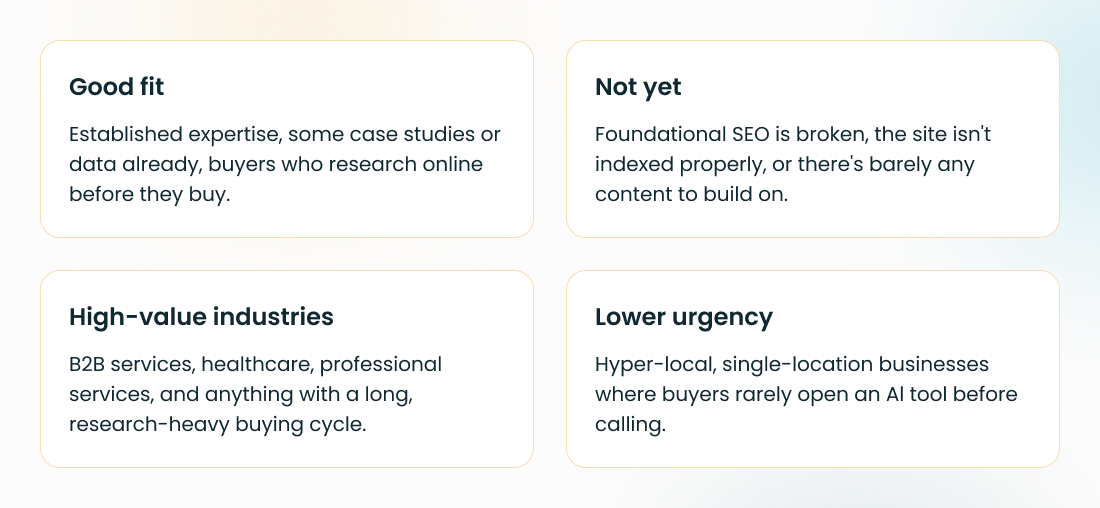
Before approaching for AEO & GEO services, as a new line item, check whether foundational technical SEO is even solid. A client with a broken indexing setup doesn’t need a GEO campaign yet. They need the basics fixed first, then GEO layered on top once there’s something worth citing.
Conclusion
Agencies don’t need six disconnected AEO or GEO tactics scattered across different retainers, or a strategist quietly drowning in edge cases nobody scoped for. They need one repeatable execution framework connecting buyer demand, technical access, answer-first content, entity clarity, third-party authority, and honest measurement, run the same way for every client, every quarter.
That’s exactly the gap ZealousWeb was built to close. As a digital agency based in Ahmedabad, India, specializing in AI search visibility and GEO strategy, ZealousWeb runs this framework as white-label execution behind partner agencies, handling the AEO content rebuilds, the technical crawlability fixes, the entity and knowledge graph cleanup, and the off-site authority work that turns a client from an occasional AI mention into a consistent LLM citation. Whether it’s handled in-house or handed to ZealousWeb standing quietly behind the account team, the outcome is the same: a client that shows up in ChatGPT, Perplexity, and Google AI Overviews on purpose, not by accident.
Ready to hand off your toughest AEO & GEO accounts?
Talk to Our Growth Experts

FAQs
Will our clients know the work is being outsourced?
No. We work entirely white-label. Reports, audits, and content all go out under your agency's name, and we stay off every client call unless you specifically want us on it.
How fast can a partner actually ramp up on an existing client account?
We typically run the technical and entity audit in the first one to two weeks, which gives your team a clear before-and-after to show the client early, instead of asking them to wait a full quarter for proof of movement.
What if our team already handles some AEO and GEO work in-house?
That's common, and it's fine. We slot in around whatever your team already owns, whether that's just the technical cleanup, just the content rebuild, or the full six-pillar execution.
What happens if a client's visibility doesn't improve on the timeline we promised?
We flag that early rather than let it surprise anyone at a QBR. AI citation timelines depend on factors outside anyone's full control, so we build in monthly check-ins specifically to catch and explain any slower-than-expected movement before the client does.
Is this a short-term project or an ongoing retainer relationship?
Ongoing, in almost every case. AI search visibility isn't a one-time fix, it needs the same monthly and quarterly cadence as any SEO program, so we're built to sit behind an account for the long haul, not just the initial audit.
What does a specialized AEO and GEO partner actually handle for an agency?
A specialized partner typically runs the technical audit, prompt research, content rebuild, entity and authority work, and citation reporting, delivered white-label so the agency stays the client-facing brand.
How do specialized agencies get stubborn clients cited by LLMs?
Specialized teams start with a technical and entity audit to find the specific blocker, then rebuild the priority content and off-site signals around it instead of applying a generic content refresh.