

Around 67% of B2B buyers begin their purchasing journey online, making digital experiences a critical part of how companies evaluate solutions and vendors. Yet, many WordPress sites still function as static pages, missing key opportunities to engage visitors and convert early interest into meaningful interactions.
By combining AI with Advanced Custom Fields (ACF), developers can transform WordPress sites into intelligent, automated B2B marketing engines that deliver the right content to the right visitor at the right moment. Field-level personalization integrates seamlessly with existing workflows, giving developers precise control while enabling highly targeted, conversion-ready funnels.
The ACF Synergy: Personalization at the "Field Level"
For developers, personalization works best when it fits naturally into the tools they already know. The AI Content Personalizer integrates directly with Advanced Custom Fields (ACF), enabling field-level personalization without adding new interfaces or workflows.
Developers can define conditional logic for ACF fields or groups based on visitor segments, engagement signals, or lead scores. This approach allows agencies to build automated, high-converting funnels while keeping full control over content structure and theme integrity.
How Field-Level Personalization Works
Field-level personalization gives developers precise control over how content adapts to different visitors. Instead of serving the same static elements to every user, developers can dynamically adjust text, images, or call-to-action buttons based on behavioral signals such as engagement level, browsing activity, or lead score.
For example, new visitors might see broad messaging that introduces your services, while returning or highly engaged users receive more targeted content aligned with their demonstrated interests. Because this logic is embedded directly within Advanced Custom Fields (ACF), developers can manage dynamic content using familiar workflows—without learning a new interface or adding unnecessary complexity to their stack.
In practice, this flexibility enables powerful B2B personalization scenarios such as:
- Segment-based messaging: Show introductory messaging to new visitors while displaying consultation or demo CTAs to returning prospects.
- Lead-intent targeting: Highlight case studies, pricing pages, or strategy session offers when a visitor’s engagement signals indicate high buying intent.
- Behavior-driven content: Display different banners or recommendations based on previously viewed services or pages.
- Geo or role-based personalization: Tailor promotional sections or offers depending on the visitor’s location, industry, or user role.
Developer Benefits: Familiar Tools, Smarter Funnels
For developers, the biggest advantage of this approach is workflow continuity. Since personalization logic is embedded directly within Advanced Custom Fields (ACF), teams can build dynamic, targeted content using the same structures and workflows they already rely on. There’s no need to adopt new interfaces, manage external dashboards, or restructure existing themes.
This developer-first approach keeps personalization closely aligned with your existing site architecture, reducing complexity while preserving full control over themes, structured content, and performance. As a result, agencies can build scalable, automated B2B funnels without disrupting established development processes.
Within this familiar workflow, developers can implement personalization in several practical ways, including:
- Building field-level rules within existing ACF groups to deliver targeted messaging or dynamic content blocks
- Managing dynamic CTAs or content sections directly within templates without relying on external dashboards
- Streamlining personalization workflows for teams already comfortable working with ACF structures and logic
By leveraging field-level personalization in ACF, developers can deliver relevant, context-aware content while keeping their workflows intact. With this foundation in place, the next step is understanding how AI can intelligently prepare and optimize visitor data to power even smarter, automated B2B funnels.
Scaling with the AI Data Preparation Layer
Intelligent B2B funnels require more than just displaying personalized content—they demand clean, structured, and meaningful data powering the AI behind the scenes. The AI Data Preparation Layer bridges raw user activity and AI-driven personalization, aggregating, normalizing, and optimizing data such as lead scores, page visits, and time on page.
With this foundation, GPT-4o or Gemini can generate highly accurate, context-aware content, allowing developers to build scalable, high-performing funnels without disrupting existing ACF workflows.
Turning Raw Data into Actionable Insights
The AI Data Preparation Layer collects visitor and lead data from multiple sources—form submissions, page activity, and engagement signals—and transforms it into a structured, standardized dataset. Instead of sending fragmented or inconsistent data to AI, it applies lead scoring, tags visitor segments, and normalizes metrics, providing a clear, actionable dataset.
For developers, this means that ACF field-level personalization can rely on ready-to-use, accurate data, eliminating manual data cleanup and keeping workflows seamless. The layer essentially converts raw analytics into actionable insights that can drive dynamic content and automated funnels.
Delivering Precision in Every Interaction
Accuracy is critical. Sending unstructured data directly to AI can result in irrelevant outputs or inconsistent personalization, which undermines conversions. The AI Data Preparation Layer ensures that all data is organized, scored, and interpreted correctly, improving the relevance of every piece of content delivered to visitors.
With this layer in place, developers can confidently build dynamic, context-aware funnels, knowing that content aligns precisely with visitor behavior, engagement, and lead status—without disrupting existing workflows or adding complexity.
Powering Scalable, High-Performance Funnels
Beyond accuracy, the AI Data Preparation Layer also optimizes the way data is sent to the AI, reducing token usage and improving efficiency. This results in faster AI responses, lower costs, and scalability, even for sites handling hundreds or thousands of visitors simultaneously.
By combining data preparation with token optimization, agencies can build high-performance, automated funnels that scale seamlessly, while developers maintain full control over personalization logic and site performance.
With data structured, normalized, and optimized, the AI Data Preparation Layer enables developers to deliver personalization that is precise, scalable, and cost-efficient. This sets the stage for the next step: creating transparent, user-friendly funnels that enhance trust and drive conversions.
Building "Transparent" Funnels (The UX Edge)
Personalization is most effective when visitors understand why content is tailored for them. The Transparent Funnels feature lets developers show users the reasoning behind every piece of personalized content, solving the “Privacy Paradox”—where users accept personalization only if it’s clear and trustworthy.
Developers can implement this through a frontend transparency toggle, giving them full control over when and how explanations appear for personalized content. This approach strengthens user trust while giving agencies a distinct UX advantage when designing personalized B2B experiences.
The feature, its implementation, and the resulting benefits can be understood more clearly through the following overview.
| Aspect | Description | Developer / Agency Benefit |
| The Feature | Conditional Statement Transparency shows users exactly why specific content is being personalized for them. | Builds immediate clarity for visitors and enhances long-term trust in personalized B2B experiences. |
| The Implementation | A frontend transparency toggle allows developers to programmatically control when and how explanations are displayed. | Integrates seamlessly with existing ACF setups and custom themes; no external dashboards or “black box” logic required. |
| The Benefit | Solves the “Privacy Paradox” by making data-driven personalization transparent rather than invasive. | Differentiates agency UX offerings with “Ethical AI” and significantly improves user engagement and conversion potential. |
By making personalization clear and controllable, transparent funnels build user trust, enhance engagement, and give agencies a tangible UX advantage, turning every visitor interaction into a confident, conversion-ready experience.
Integration Masterclass: Forms & Profiles
Forms are the backbone of any B2B funnel, capturing critical lead and engagement data. The plugin takes this raw form data from Ninja Forms, Gravity Forms, and CF7 and converts it into structured profile insights, giving developers the tools to query, integrate, and visualize user activity. This makes it simple to create custom dashboards, automated workflows, and third-party integrations, all while keeping WordPress workflows clean and maintainable.
To make the flow of data clear, here’s a high-level visual overview:
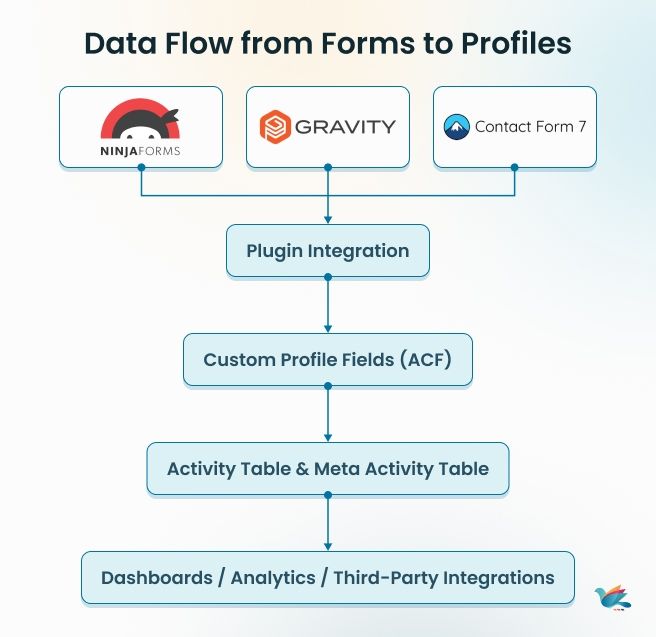
As shown in the diagram above, form submissions are seamlessly captured, structured, and stored within dedicated database tables, making the data readily available for personalization, reporting, and automation. This architecture ensures developers retain full control at the database level, allowing them to query, extend, and integrate data into advanced workflows without relying on the plugin’s interface.
Seamless Form-to-Profile Mapping
The plugin maps every submission from Ninja Forms, Gravity Forms, and CF7 into Custom Profile Fields, ensuring data is structured, accurate, and ready for use in personalized funnels. Developers no longer need to write manual syncing scripts, and all workflows stay aligned with ACF-managed content structures.
Full Developer Control with Database Access
All user activity is stored in the Activity and Activity Meta tables. This provides developers with direct access to raw data for:
- Creating custom dashboards.
- Automating personalized workflows based on user behavior.
- Integrating with third-party tools for analytics or CRM.
By mapping form submissions into structured profiles and giving developers direct database access, this integration transforms raw user data into actionable intelligence, enabling agencies to build custom dashboards, automated workflows, and seamless integrations—all while maintaining clean, scalable WordPress workflows.
Conclusion
Combining ACF, PersonalizeWP, and AI creates more than just a set of tools—it forms a proprietary tech stack that agencies can truly own, customize, and scale. This setup transforms ordinary WordPress builds into intelligent B2B engines, capable of delivering personalized experiences, optimizing lead generation, and supporting smarter client engagements, all without compromising development control or performance.
By embedding these capabilities directly into your workflows, your team can focus on strategy, creativity, and client growth rather than repetitive setup or manual customization. Exploring the right mix of purpose-built tools and AI-driven workflows is the next step toward building a stack that fits your agency today and scales effortlessly for tomorrow.
At ZealousWeb, we help businesses implement these capabilities effectively, turning WordPress projects into intelligent, scalable B2B engines that are easy to manage and deliver measurable results.
Transform Your WordPress Sites Into Lead-Generating Engines
Reach Out To Us Now

FAQs
How can personalization be implemented without disrupting existing WordPress workflows?
Embedding personalization logic directly within ACF fields and groups enables dynamic content management without altering themes or adding new interfaces. AI-prepared data keeps workflows seamless.
How can fragmented lead and engagement data be effectively used?
An AI Data Preparation Layer aggregates, normalizes, and scores data from forms and visitor activity, providing clean, actionable datasets for precise personalization—a method ZealousWeb uses to power scalable B2B funnels.
How can personalization scale for high-traffic B2B websites?
Structured, AI-prepared datasets combined with field-level ACF logic ensure dynamic, context-aware personalization remains efficient, even for hundreds or thousands of visitors.
How is user trust maintained in AI-driven personalization?
Transparent funnels clearly show why content is personalized, enhancing engagement and aligning with privacy best practices. ZealousWeb incorporates this approach to strengthen UX in personalized experiences.
How can multiple form platforms be integrated into dynamic funnels?
Submissions from CF7, Ninja Forms, and Gravity Forms are mapped into structured ACF profile fields, giving full control for automation, dashboards, and third-party integrations without manual syncing.