


The agencies that scale delivery successfully are not always the ones with the most tools, the biggest teams, or the most detailed SOPs. More often, they are the ones operating with stronger workflow clarity, calmer execution systems, and better operational support behind the scenes.
Over the years, one pattern has become increasingly difficult to ignore across growing agencies and delivery teams.
Most agencies already have project management platforms, documentation systems, QA checklists, communication channels, reporting structures, and defined workflows in place. On paper, the systems often look complete.
But the real pressure begins when those systems must survive real delivery environments simultaneously. Client revisions start overlapping. Timelines shift. Internal approvals slow down. Priorities change mid-sprint. Communication spreads across multiple channels. Teams create manual workarounds to keep projects moving. Managers spend more time coordinating workflows than improving delivery quality.
At that stage, workflow adoption challenges rarely come from a lack of process. They usually come from operational friction building quietly inside daily execution.
This is why many agencies struggle to maintain delivery consistency even after investing in better systems, better tools, and larger teams. The issue is not always capability. In many cases, it is the growing gap between documented frameworks and the operational support required to sustain them at scale.
And that gap becomes much harder to ignore as delivery complexity grows.
Why Do Well-Documented Systems Still Break During Daily Delivery?
Good systems rarely fail because the document is missing. They fail because daily delivery pressure exposes gaps in ownership, review rhythm, and execution support.
| What looks fine on paper | What breaks in daily delivery |
| SOPs are documented | Teams still ask, “Who owns this now?” |
| Workflows are mapped | Client changes quietly bend the process |
| QA steps are listed | Reviews happen late or inconsistently |
| Tools are in place | Updates scatter across Slack, emails, and sheets |
| Roles are defined | Accountability blurs when deadlines get tight |
| Systems are approved | People create shortcuts to keep work moving |
That is why teams struggle to follow systems even when everything looks organized. The real issue is not always documentation. It is workflow execution issues under pressure, which explains why SOPs fail inside growing agency operations.
Why Do Teams Start Bypassing Processes Even When Workflows Exist?
Teams bypass processes when the workflow feels slower than the pressure they are trying to manage. In agencies, why teams don’t follow processes is rarely about carelessness. It usually points to deeper workflow adoption challenges and process implementation problems that begin showing up during real delivery pressure.
When Timelines Move Faster Than the Workflow
Rushed timelines make even good systems feel optional. When delivery becomes urgent, teams naturally choose the fastest path, not always the documented one.
When Managers Become the Backup System
Overloaded managers quietly become the workflow itself. Every approval, clarification, escalation, and dependency starts routing through the same people until the process depends more on availability than structure.
When Approvals Start Slowing Delivery
Approvals are meant to improve quality. But when review layers become slow or unclear, teams begin finding side routes to keep projects moving before timelines slip further.
When Communication Splits Across Too Many Channels
The workflow starts breaking when updates live across Slack, email, meetings, spreadsheets, WhatsApp, and project tools simultaneously. At that point, teams stop following the system and start following wherever the latest update appeared.
When Shortcuts Quietly Become the Real Workflow
Most operational shortcuts begin with good intentions. A quick manual update. A skipped review step. A direct client response outside the process. Over time, those shortcuts become the actual workflow while the documented system slowly turns into reference material nobody consistently follows.
Process Bypass Checklist
☐ Do teams skip the documented workflow when deadlines get tight?
☐ Do managers become the default approval point for everything?
☐ Are updates scattered across multiple communication channels?
☐ Do team members create “quick fixes” outside the process?
☐ Are approvals delaying delivery instead of supporting quality?
☐ Does the real workflow look different from the documented workflow?
☐ Do people rely on whoever responds fastest instead of the process owner?
☐ Are repeat issues being solved manually every time?
If most answers are “Yes,” the issue is usually not discipline. It is a sign that operational pressure is growing faster than the workflow’s ability to support execution consistently.
When teams keep bypassing the process, it usually means the workflow needs more clarity, ownership, and execution support, not another reminder to “follow the system.”
Why Does Delivery Complexity Increase Faster Than Most Agencies Expect?
Delivery complexity increases when agency growth adds more clients, more services, more people, more approvals, and more moving parts to the same operating rhythm. This is where scaling team workflows, stronger operational systems for agencies, and better team process adoption become critical.
| What growth adds | What it quietly complicates |
| More Clients | More expectations to manage |
| More Projects | More timelines to protect |
| More Team Members | More handoffs to coordinate |
| More Services | More dependencies between teams |
| More Approvals | More review delays |
| More Tools | More places where updates can get lost |
| More Reporting | More time spent explaining work instead of proving it |
The Real Problem
Most agencies do not struggle because growth is bad. They struggle because growth increases coordination faster than systems evolve.
- A workflow that worked for 5 clients may start cracking at 15.
- A review process that worked with 6 people may slow down with 20.
- A manager who could personally track everything earlier cannot stay the operating system forever.
What This Means
As agencies grow, delivery does not just need more capacity. It needs clearer ownership, tighter review rhythm, stronger workflow governance, and structured execution support.
Because at scale, complexity does not ask for permission. It just starts attending every meeting. Growth does not break agency delivery by itself. The gap appears when workflows, ownership, and review systems do not mature at the same pace as the work coming in.
Why More Tools Often Create More Workflow Friction Instead of Less
More tools can make work more visible, but visibility is not the same as operational clarity. That is why workflow tools don’t solve team execution problems on their own.
- A project management tool can show what is pending. It cannot decide who owns the next move.
- A dashboard can highlight delays. It cannot create review discipline.
- A communication platform can speed up updates. It cannot prevent scattered decisions.
For agencies, this becomes a real issue when every tool starts solving one small problem while quietly creating three new handoffs. Tasks live in one place, feedback in another, approvals somewhere else, and decisions often happen outside the actual workflow.
That is how workflow execution issues grow. Not because the agency lacks tools, but because the operating rhythm behind those tools is unclear.
Tools should support the system. They become friction when agencies expect them to become the system.
Why Delivery Consistency Usually Starts Breaking Quietly
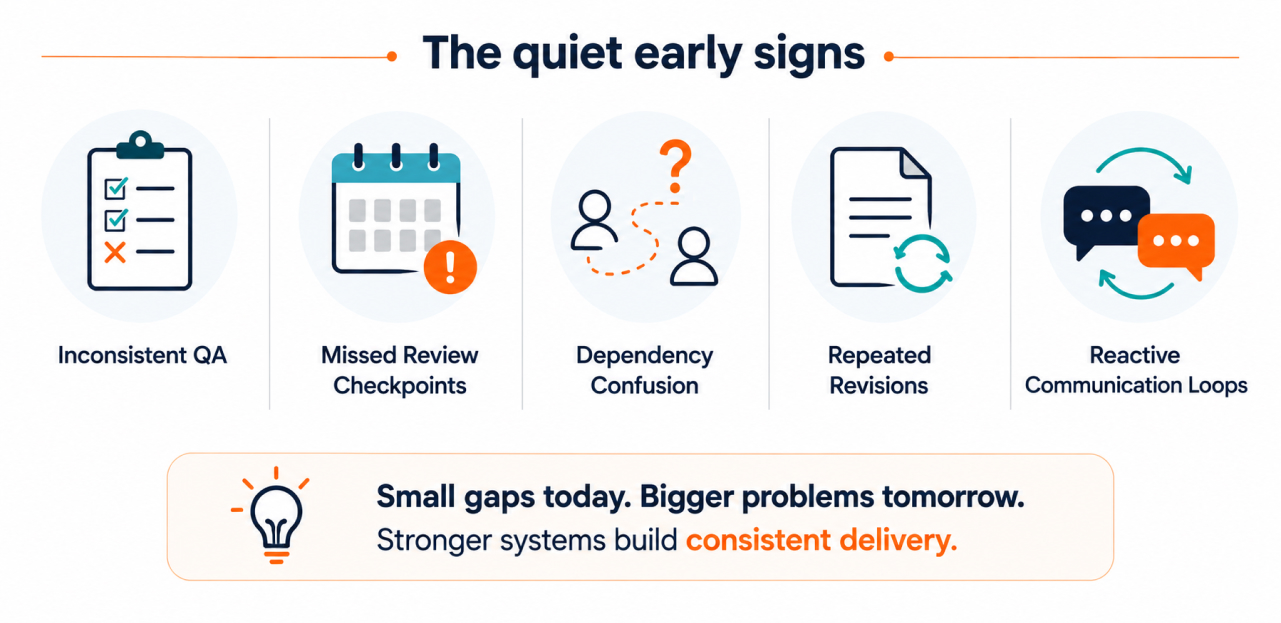
Delivery inconsistency does not show up suddenly. It usually begins with small slips that feel manageable at the moment, such as a rushed QA check, a missed review checkpoint, unclear dependency ownership, repeated revisions, or reactive communication loops. Over time, these small gaps start compounding, and what once looked like a minor execution issue begins affecting overall delivery consistency.
The illustration below shows how these small delivery gaps usually appear before they become larger workflow problems.
Why Hiring More People Does Not Always Reduce Operational Chaos
Hiring more people can increase capacity, but it does not automatically improve delivery control. In many agencies, new hires are added to solve workload pressure, but the deeper process implementation problems remain untouched. If ownership is unclear, review cycles are inconsistent, and communication already feels scattered, adding more people simply gives the chaos more participants.
This is where scaling team workflows becomes difficult. More team members mean more handoffs, more approvals, more updates, more context-sharing, and more management attention. Without strong execution systems for teams, growth can quietly increase coordination overhead instead of reducing delivery friction.
The issue is not hiring. Agencies need people. But people perform better when the system around them is clear. If the workflow is already weak, every new hire enters the same confusion, asks the same questions, waits for the same approvals, and depends on the same overloaded managers.
So the real question is not “Do we need more people?”
It is “Is our delivery system ready to support more people without creating more noise?”
When Operational Gaps Start Affecting Client Confidence
Client confidence rarely drops because of one large mistake. More often, it weakens through repeated operational gaps that quietly affect delivery experience over time. This is where stronger workflow governance, better delivery operating systems, and greater operational clarity start becoming visible to clients, even if agencies do not formally discuss them.
Here’s how small operational instability usually starts translating into client-side perception:
| Operational Gap | What Happens Internally | What Clients Start Feeling | What It Signals |
| Delayed reviews | Feedback takes too long | “Are they still in control?” | Weak review rhythm |
| Inconsistent updates | Status keeps changing | “Why do I have to ask?” | Poor communication flow |
| Unstable production rhythm | Delivery pae feels uneven | “Will this be on time?” | Weak delivery operating system |
| Frequent firefighting | Teams react instead of plan | “Is every project this reactive?” | Lack of workflow governance |
| Reactive account handling | Responses replace guidance | “Are they leading or just replying?” | Low operational clarity |
By the time clients notice delivery inconsistency, the operational gaps behind it have usually existed for much longer. The strongest agencies are not the ones avoiding complexity completely. They are the ones building systems that prevent complexity from reaching the client experience.
How White-Label Agency Support Helps Stabilize Delivery Systems
At a certain stage, agency growth stops being only a sales challenge and starts becoming an execution stability challenge. This is where white-label agency partnerships become valuable, not as “extra outsourcing,” but as structured operational support behind daily delivery.
Strong white-label execution support helps agencies strengthen the execution layer behind projects without forcing internal teams to absorb every approval cycle, production dependency, QA review, revision loop, or delivery spike alone.
The goal is not to replace the agency team.
The goal is to help the agency protect delivery consistency while growth, timelines, and client expectations continue increasing.
That support often shows up quietly through:
- stronger delivery continuity during busy cycles,
- more stable production scalability,
- better QA stabilization,
- specialized execution support across recurring workflows,
- behind-the-scenes operational support,
- and calmer scaling without constant firefighting.
The strongest delivery operating systems are rarely built on internal effort alone. They are built on workflows that remain stable even when delivery pressure increases.
And sometimes, the smartest operational decision is not adding more chaos internally just to prove the agency can “handle everything itself.”
How White-Label Partnerships Help Agencies Scale With More Stability
White-label agency partnerships help agencies scale by strengthening the execution layer behind delivery, not by replacing the agency’s internal team. As client demands grow, agencies need more than extra hands. They need structured operational systems for agencies that support workflow continuity, QA consistency, production capacity, and calmer delivery management.
A strong white-label partnership can help agencies:
- Manage delivery spikes without overloading internal teams
- Maintain workflow continuity across recurring projects
- Reduce review pressure on senior managers
- Support QA and execution consistency
- Scale production without increasing internal chaos
- Protect client-facing confidence while work happens behind the scenes
This is where scaling team workflows becomes easier. The agency keeps ownership of strategy, client relationships, and brand experience, while the white-label execution layer helps stabilize delivery in the background.
The result is not just more capacity. It is a more controlled capacity.
What Makes a Strong White-Label Execution Partnership Actually Work
A strong white-label execution partner should reduce operational pressure, not create another layer of coordination. The partnership works best when both teams operate with shared workflow governance, clear communication discipline, and defined process ownership behind delivery.
The strongest white-label partnerships usually have a few things in common:
- Clear workflow alignment instead of scattered execution expectations
- Structured communication instead of endless follow-up loops
- Defined ownership across approvals, revisions, and delivery checkpoints
- Transparent reporting that improves visibility without adding noise
- Consistent QA rhythm that protects delivery quality at scale
- Smooth workflow integration into the agency’s existing systems
- Execution support that works behind the scenes without disrupting the client experience
- Shared accountability for timelines, dependencies, and delivery continuity
- Operational maturity that reduces firefighting instead of increasing it
Because ultimately, a white-label partnership should not feel like “managing another vendor.” It should feel like strengthening the execution layer behind the agency’s delivery system.
What Makes ZealousWeb a Strong White-Label Agency for Execution Support
A strong white-label agency should reduce operational pressure, not create another layer of coordination. ZealousWeb supports agencies by strengthening workflow governance, communication discipline, and process ownership behind delivery, so teams can scale execution without losing control of quality, timelines, or client experience.
For agencies, this support works best when the white-label agency brings:
- Clear workflow alignment instead of scattered execution expectations
- Structured communication instead of endless follow-up loops
- Defined ownership across approvals, revisions, and delivery checkpoints
- Transparent reporting that improves visibility without adding noise
- Consistent QA rhythm that protects delivery quality at scale
- Smooth workflow integration into existing agency systems
- Behind-the-scenes execution support that does not disrupt the client experience
- Shared accountability for timelines, dependencies, and delivery continuity
- Operational maturity that reduces firefighting instead of increasing it
ZealousWeb’s role is not limited to task completion. As a white-label agency, we work as an execution layer that helps agencies maintain operational clarity, stabilize delivery systems, and improve workflow consistency as demand grows.
The right white-label agency should not feel like another vendor to manage. It should feel like a stronger operating layer behind the agency’s delivery system.
Conclusion
Scaling agency delivery is rarely about adding more tools or people—it’s about ensuring operational clarity, consistent workflow adoption, and structured execution support. Without systems that evolve alongside growth, even well-documented processes falter under pressure, creating hidden gaps that affect delivery quality and client confidence. Strong white-label partnerships, like those offered by ZealousWeb, act as an execution layer that stabilizes workflows, reinforces ownership, and maintains QA and delivery consistency. By integrating behind the scenes, these partnerships allow agencies to scale with control, protect client-facing confidence, and focus on strategic priorities. In essence, growth becomes manageable, execution remains reliable, and agencies can expand without letting operational friction dictate their pace.
Your Clients Expect the Best, Deliver it Every Time
Work With a White-label Team
FAQs
Will your team work under our agency brand?
Yes. Our team works quietly behind your brand, so your agency keeps full client ownership, communication control, and delivery confidence.
How does ZealousWeb report project progress?
We maintain structured reporting with clear workflow visibility, delivery updates, timelines, and communication checkpoints to keep agencies informed without creating extra noise.
How many people will we communicate with during the engagement?
We keep communication streamlined with defined points of contact, so agencies avoid scattered coordination across multiple team members.
How does ZealousWeb help protect agency brands during white-label delivery?
We work behind the scenes with strict communication discipline, workflow confidentiality, and delivery alignment to ensure your agency remains the front-facing brand experience.
How do white-label agencies usually charge?
We support flexible engagement models based on delivery needs, including monthly retainers, dedicated execution support, and project-based workflows.
Are white-label agencies more cost-effective than hiring internally?
For many agencies, yes. White-label support helps reduce hiring pressure, onboarding overhead, and workflow disruption while keeping delivery scalable.
What’s usually included in a white-label agency retainer?
Depending on the engagement, retainers can include execution support, QA, reporting, workflow coordination, recurring delivery management, and dedicated production capacity.


