

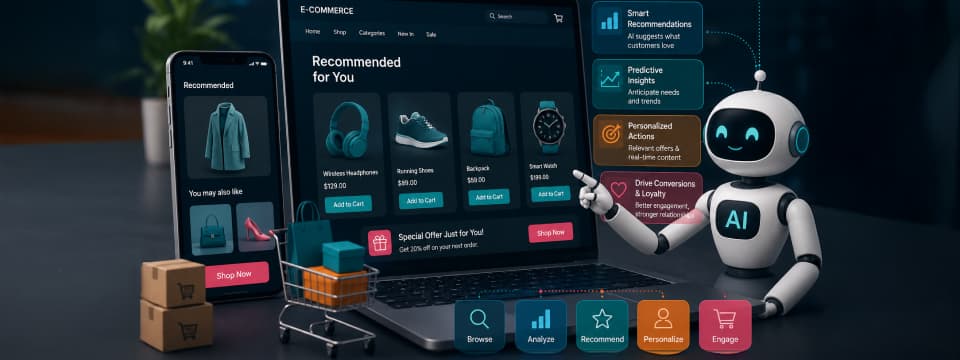
A shopper lands on your e-commerce site and within seconds, the recommendations feel almost eerily accurate. Products align with their intent, offers appear at the right moment, and the experience feels tailored without being intrusive.
How does that happen?
For many businesses investing in e-commerce app development AI, the expectation is that personalization will naturally improve with more data and smarter tools. But in reality, most systems still rely on reacting to past behavior—missing the opportunity to influence decisions as they happen.
Agentic AI changes that.
Instead of waiting for inputs, it enables systems to evaluate context and act in real time—shaping the customer experience while intent is still forming.
In this article, you’ll learn how agentic AI is redefining e-commerce personalization—and what it takes to turn it into a scalable, performance-driven system.
What Is Agentic AI in E-commerce
For most e-commerce teams, AI today operates within defined boundaries. It analyzes past behavior, identifies patterns, and produces outputs based on what has already happened. Recommendations improve, pricing adjusts, and campaigns become more targeted—but all within a system that still waits for input before it responds.
That’s where the limitation begins.
As customer journeys become more dynamic, this reactive model starts to fall behind. Customers no longer follow predictable paths. Their intent shifts in real time, influenced by context, timing, and micro-decisions that traditional systems aren’t built to interpret instantly. When AI can only respond after the fact, it’s always one step behind the moment that matters.
Agentic AI changes that equation.
Instead of waiting for triggers, it operates with autonomy. It continuously evaluates context, makes decisions, and executes decisions tied to conversion, order value, or retention goals. In e-commerce, this shifts personalization from a set of responses to a system that adapts in real time, influencing conversion decisions while the customer is still evaluating options.
How It Differs from Traditional AI
The difference isn’t just technical—it’s structural. Traditional AI supports decisions. Agentic AI makes them.
| Traditional AI | Agentic AI |
| Reacts to past behavior | Acts on real-time context |
| Follows predefined rules | Operates with autonomy |
| Produces recommendations | Takes actions across the journey |
| Works in silos | Connects decisions across systems |
| Needs constant input | Self-adjusts with feedback |
This shift changes personalization at its core.
- Instead of recommending products, it can adjust the entire experience dynamically
- Instead of segmenting users, it treats each session as unique and evolving
- Instead of waiting, it can anticipate and act within the moment
The result is not just better outputs—it’s a different system of execution.
Why Personalization Needs a Shift
Customer expectations have already moved ahead of what most systems deliver. They compare your experience to the best interaction they’ve had anywhere, raising the bar for timing, relevance, and consistency.
Traditional personalization struggles because it:
- Relies on historical data instead of present intent
- Operates within fixed rules that adapt slowly
- Treats journeys as linear instead of fragmented
This creates a gap between what your system delivers and what customers expect.
Agentic AI closes that gap by turning personalization into a decision system—one that thinks, adapts, and acts in real time. And once that shift happens, personalization stops being a feature and becomes a compounding competitive advantage.
How Agentic AI Transforms E-commerce
For most e-commerce businesses, personalization still operates as a response system. A user clicks, searches, or abandons—and the system reacts. Recommendations update, offers adjust, and journeys shift slightly, but always after the action has already happened.
That delay is where performance is lost.
As journeys become more fluid, decisions need to happen within the interaction itself—while the customer is still evaluating options. Agentic AI shifts this by enabling decisions to occur in-session, not post-event, directly influencing conversion paths as they form.
Real-Time Decision-Making
Agentic AI evaluates signals as they happen—behavior, context, and engagement—and makes decisions instantly.
- Adjusts product visibility to increase the likelihood of conversion within the session
- Modifies offers based on real-time purchase probability
- Optimizes navigation to reduce friction and drop-off points
This shifts personalization from delayed response to in-session conversion optimization.
Proactive Personalization
Beyond reacting faster, agentic AI anticipates what the user is likely to need next and acts before friction impacts the journey.
- Prioritizes products based on intent, not just history
- Intervenes before drop-offs to protect conversion opportunities
- Guides sessions toward higher-value outcomes like AOV and retention
As this compounds across interactions, personalization shifts from a feature to a decision layer directly tied to revenue outcomes.
The real value of agentic AI emerges when these capabilities translate into how decisions are executed across the customer journey.
How Agentic AI Executes Personalization: 5 Real-World Shifts
These shifts aren’t theoretical they show up in how core e-commerce functions operate in real interactions.
Shows how personalization moves from predefined responses to continuous, in-session decision execution that directly influences conversion outcomes.
Real-Time Behavioral Adaptation
User intent doesn’t follow a fixed path—it shifts within seconds. Instead of relying on static flows, the experience adjusts continuously as behavior evolves.
Imagine a shopper browsing running shoes, then pausing on performance gear. The system immediately reprioritizes products, updates filters, and surfaces higher-end options—without waiting for explicit input.
This keeps the experience aligned with intent as it develops, reducing friction and improving conversion likelihood.
Autonomous Product Curation
Beyond adapting to behavior, the next shift is how products are presented.
Traditional discovery depends on categories and filters, limiting how precisely the experience adapts. Now consider a system that builds a unique product set for every session. A user exploring minimalist styles sees a dynamically curated collection that evolves as they browse.
This shifts discovery from selection to curation—improving relevance and increasing average order value.
Dynamic Pricing and Offer Generation
Once product relevance improves, the next opportunity lies in influencing the purchase decision itself.
Predefined pricing and offers fail to capture in-session intent shifts. Imagine a user hesitating at checkout. The system detects this and introduces a contextual incentive or adjusts the value proposition instantly.
Pricing becomes responsive rather than static—helping convert decisions that would otherwise stall.
Proactive Cart Recovery
However, not every hesitation happens at checkout—many occur just before exit.
Most recovery efforts begin after abandonment, missing the highest-intent moment. Now consider hesitation being detected before exit. The system introduces reassurance—delivery details, trust signals, or targeted nudges—while the user is still active.
This enables recovery within the session, increasing completion rates without relying on follow-ups.
Cross-Channel Decision Continuity
Finally, personalization must extend beyond a single session.
Journeys often span devices, but most systems lose context across them. Imagine a user exploring on mobile and returning later on desktop. The experience resumes with aligned recommendations and consistent context.
This continuity maintains momentum across touchpoints, reducing drop-offs and improving overall conversion efficiency.
What Most E-commerce Teams Get Wrong About AI Personalization
For many e-commerce teams, adopting AI feels like progress. A recommendation engine is added, pricing becomes dynamic, and automation starts to scale. On the surface, it looks like personalization is improving.
But in most cases, the impact plateaus quickly.
Not because the technology isn’t capable—but because it’s implemented in ways that limit its effectiveness. AI gets layered onto existing workflows instead of reshaping how decisions are made. And when that happens, the system improves outputs without improving outcomes.
Moving AI from a Feature to a Business Capability
One of the most common mistakes is treating AI as an add-on rather than a core decision layer.
It gets applied to isolated functions—recommendations, search, or campaigns—without connecting how those decisions influence the full customer journey.
- Personalization remains fragmented across touchpoints
- Decisions don’t align toward conversion or revenue goals
- Optimization happens locally, not across the system
The result is better individual features, but no meaningful improvement in overall performance.
Ignoring Data Quality Foundations
AI systems are only as effective as the data they operate on. Yet many implementations move forward without addressing gaps in data structure, accuracy, or accessibility.
- Incomplete data leads to misaligned recommendations and offers
- Delayed or siloed data limits real-time decision-making
- Poor data hygiene reduces prediction accuracy and consistency
Without a strong data foundation, even advanced AI systems fail to produce reliable outcomes.
Iterative Performance Optimization
AI is often expected to deliver immediate results. But agentic systems improve through continuous feedback, not one-time deployment.
- Early outputs may require refinement before scaling impact
- Performance improves as models adapt to live user behavior
- Long-term gains depend on ongoing optimization, not static setup
Treating AI as a one-time solution limits its ability to drive sustained growth.
When AI is implemented without system-level thinking, strong capabilities translate into limited results. The shift isn’t just adopting better tools—it’s building a system where decisions, data, and outcomes are continuously aligned.
How Agentic AI Reshapes E-commerce System Architecture
What changes here isn’t just the experience—it’s how the system is built to respond in that moment.
A customer lands on a product page, browses for a few seconds, then hesitates.
In a traditional system, nothing changes until they act—click, search, or exit.
In an agentic system, the platform responds instantly—reordering products, adjusting offers, and guiding the next interaction based on live intent.
That shift isn’t a feature upgrade. It’s an architectural change.
Most e-commerce platforms today are built around features—search, recommendations, pricing, and campaigns—each operating within its own logic. Even when AI is introduced, it’s often layered onto these components, improving outputs without changing how decisions are made.
Agentic AI restructures this foundation.
Instead of isolated features, the system is organized around a decision layer—one that continuously interprets signals, aligns actions with conversion, AOV, and retention targets, and coordinates responses across the entire customer journey. This changes not just what the system does, but how it operates at every level.
From Feature-Based Systems to Decision Layers
Traditional architecture treats personalization as a collection of tools. Each function optimizes independently, often without visibility into the broader journey.
Agentic architecture introduces a centralized decision layer.
- Decisions are aligned with conversion, AOV, and retention goals
- Actions are coordinated across multiple touchpoints, not isolated features
- Optimization shifts from local improvements to system-wide performance
This ensures that every interaction contributes to a unified outcome, not fragmented outputs.
Connecting Data, Logic, and Customer Experience
In most systems, data, decision logic, and customer experience operate separately. Data is collected, processed, and then applied—often with delays.
Agentic systems connect these layers in real time.
- Data flows continuously from live user behavior and context
- Decision logic interprets signals and prioritizes next-best actions instantly
- The customer experience updates dynamically to reflect those decisions in-session
This eliminates lag between insight and action, allowing the system to respond while intent is still forming.
Designing for Real-Time, Adaptive Workflows
Traditional workflows follow predefined paths—triggered by events and executed in sequence. While structured, they lack flexibility.
Agentic workflows are adaptive.
- Actions adjust based on changing user behavior within the session
- Decisions evolve as new signals emerge, not after predefined steps complete
- The system continuously refines outcomes through feedback and performance data
This creates a system that doesn’t just execute workflows—it adapts them in real time to improve results.
At this level, AI is no longer a layer on top of the system. It becomes the system’s core—driving how decisions are made, how experiences are delivered, and how performance improves over time.
From Optimization to Autonomy: The Real Impact of Agentic AI
The shift isn’t just about doing the same things better—it’s about changing who, or what, makes the decisions.
Most e-commerce systems today are built around optimization. Teams analyze performance, identify gaps, and apply changes—refining recommendations, adjusting pricing strategies, and improving workflows over time. This approach works, but it depends heavily on manual intervention and delayed insights.
Agentic AI changes that by moving decision-making into the system itself.
Instead of relying on periodic optimization, it enables continuous, in-session decisions that directly influence outcomes as they happen. This marks a transition from improving processes to automating the decisions that drive them.
Moving Beyond Manual Optimization
Traditional optimization relies on teams interpreting data and applying changes after patterns emerge. This creates a lag between insight and action.
Agentic AI reduces that dependency.
- Decisions are made within the session, not after analysis cycles
- Adjustments happen based on live behavior, not historical trends alone
- Optimization shifts from manual updates to system-driven execution
This allows businesses to act at the speed of customer intent, not reporting cycles.
Continuous Decision Learning
Optimization is typically periodic—measured, adjusted, and repeated. But performance doesn’t improve evenly between those cycles.
Agentic systems operate continuously.
- Every interaction feeds back into decision accuracy and prioritization
- The system refines outcomes based on real-time performance signals
- Improvements compound across sessions, not just across campaigns
This creates a system that doesn’t wait to be optimized—it increases conversion efficiency and decision accuracy with each interaction.
Reducing Dependence on Human Intervention
Manual oversight has always been central to personalization—defining rules, adjusting strategies, and monitoring outputs. While necessary, it limits scale and responsiveness.
Agentic AI reduces that dependency without removing control.
- Routine decisions are automated to maintain consistency at scale
- Teams focus on strategy and goal-setting instead of execution details
- The system aligns actions with defined business outcomes automatically
This shifts the role of teams from managing processes to optimizing revenue performance and system-level outcomes.
At this stage, AI is no longer supporting optimization—it is executing it. And when decisions are automated at the system level, performance stops depending on manual effort and starts scaling with every interaction.
How to Evaluate If Your Business Is Ready for Agentic AI
The challenge isn’t whether agentic AI can deliver results—it’s whether your business is set up to capture them.
Many e-commerce teams adopt AI expecting immediate gains, only to see limited impact. Not because the models underperform, but because the systems around them aren’t built to support real-time decision-making at scale.
Before implementation, readiness needs to be evaluated across three critical areas: data, systems, and team capability.
Do You Have Structured Customer Data
Agentic AI depends on high-quality, accessible data to make accurate decisions in real time.
- Customer data is consistent, unified, and updated continuously
- Behavioral signals are captured at a session level, not just historical logs
- Data is accessible across systems to support in-session decision-making
Without this foundation, decisions become unreliable—directly impacting conversion accuracy and personalization quality.
Can Your Systems Support Real-Time Decisions
Traditional e-commerce infrastructure is often built for batch processing, not instant execution.
- Systems can process and respond to live user signals without latency
- Decision outputs can be applied instantly across frontend experiences and workflows
- Architecture supports continuous interaction between data, logic, and execution layers
If systems cannot operate in real time, the ability to influence conversion within the session is lost.
Is Your Team Ready to Work with AI Outputs
Even with the right technology, teams need to adapt how they operate.
- Teams define clear business goals (conversion, AOV, retention) for AI systems
- Decision oversight focuses on performance metrics, not manual adjustments
- Processes support continuous iteration based on system outputs
This shifts the role of teams from executing changes to managing performance at a system level.
Readiness isn’t about adopting new tools—it’s about ensuring your data, systems, and teams can support continuous, decision-driven execution. Without that alignment, even advanced AI capabilities struggle to translate into measurable business impact.
Implementation Framework: From Pilot to Scale
The value of agentic AI isn’t realized at deployment—it’s realized in how it’s scaled.
Most implementations fail not because the technology underperforms, but because they move too quickly from experimentation to full rollout without proving impact. A structured approach ensures that early wins translate into measurable, scalable performance.
This progression isn’t linear—it’s designed to validate outcomes at each stage before expanding scope.
Starting with Controlled Use Cases
The first step is not broad adoption—it’s focused validation.
- Identify high-impact use cases such as product recommendations or pricing adjustments
- Define success in terms of conversion lift, drop-off reduction, or AOV increase
- Limit implementation to controlled environments where performance can be measured clearly
This reduces risk while establishing a baseline for decision accuracy and business impact.
Expanding Across Customer Touchpoints
Once initial performance is validated, the next step is controlled expansion.
- Extend decision-making across multiple touchpoints—homepage, product pages, cart, and engagement channels
- Ensure consistency by aligning decisions with shared goals across the customer journey
- Monitor how changes influence end-to-end conversion flow, not isolated metrics
This shifts AI from improving isolated interactions to optimizing the full customer experience.
Building Feedback Loops for Optimization
At scale, performance depends on continuous refinement.
- Capture outcomes from every interaction to improve decision accuracy over time
- Use performance signals to adjust prioritization and response strategies dynamically
- Align system outputs with business KPIs such as conversion rate, retention, and revenue per session
This creates a system that doesn’t rely on periodic updates—it improves continuously as it operates.
When implemented this way, agentic AI moves beyond experimentation. It becomes a scalable system where every interaction contributes to measurable performance growth.
What to Demand From an AI E-commerce Development Partner
Not every agency that mentions AI is building with it meaningfully. As agentic AI moves from emerging technology to competitive standard, the gap between agencies that are genuinely AI-driven and those that are AI-adjacent will become impossible to ignore.
Choosing the right development partner today isn’t just about what they can build right now. It’s about whether their architecture, their process, and their thinking are built to evolve with the technology — so your e-commerce app doesn’t need a full rebuild every time AI takes another step forward.
Before you sign with anyone, run them through this checklist.
The 5-Point Checklist
- AI-Native Architecture Experience: They’ve built systems where AI is embedded into the app’s core logic — not bolted on as a feature after launch. The difference shows up immediately in performance, scalability, and the ability to evolve the system without starting over.
- Mobile-First Delivery Track Record: They design and deploy AI personalization for mobile e-commerce first. An agency without a demonstrable mobile-first approach is already behind.
- E-commerce Domain Knowledge: They understand conversion funnels, cart behavior, and retention mechanics — not just model training and API integration. AI built without e-commerce context produces outputs that look impressive in demos and underperform in production.
- Model Training & Iteration Support: They don’t hand over a finished app and disappear. Customer behavior evolves — your AI needs to evolve with it. An agency that supports ongoing model refinement is an agency that’s invested in your outcomes, not just your launch date.
- Transparent Integration Approach: They can clearly explain how the AI layer connects to your existing stack — CRM, OMS, CDP, marketing tools — without locking you into a proprietary ecosystem. Opacity at the integration stage is a red flag, not a feature.
At ZealousWeb, we build AI-driven e-commerce experiences that combine storefront design, platform development, mobile commerce, marketing automation, analytics, and conversion optimization — helping brands perform today while staying ready for the next stage of digital commerce.
Where Agentic AI Implementations Break Without System Alignment
The value of agentic AI is clear—but the risks emerge when implementation moves faster than system readiness.
Most challenges don’t come from the technology itself. They come from how it interacts with existing data, systems, and decision-making processes. If these layers aren’t aligned, even well-built AI systems can produce inconsistent or unpredictable outcomes.
Addressing these challenges early is what separates controlled scaling from operational disruption.
Data Privacy and Ethics
Agentic AI relies on continuous data flow and real-time decision-making, which increases exposure to data sensitivity and compliance risks.
- Customer data must be handled with clear governance, access control, and compliance standards
- Decision logic should remain transparent enough to audit and explain outcomes
- Personalization strategies must avoid overreach that impacts trust or user comfort
Without these safeguards, attempts to improve conversion can lead to long-term trust and compliance issues.
System Integration
Agentic AI does not operate in isolation—it depends on how well it integrates with your existing ecosystem.
- Legacy systems may not support real-time data processing or decision execution
- Disconnected tools create gaps between data, logic, and customer experience layers
- Poor integration limits the system’s ability to influence conversion within the session
If integration is not addressed, AI remains a layer on top rather than a system that drives performance.
These challenges are not barriers—they are indicators of where system alignment is required. When addressed correctly, they ensure that AI decisions are not only intelligent, but also reliable, scalable, and aligned with business outcomes.
What the Future of E-commerce Looks Like with Agentic AI
The shift isn’t about adopting more advanced tools—it’s about how decisions will be made moving forward.
As agentic AI becomes more embedded into e-commerce systems, the competitive gap will no longer be defined by features or technology access. It will be defined by how effectively businesses operationalize decision-making at scale.
The question is no longer if AI will shape e-commerce—but how prepared your systems are to keep up with that shift.
What Businesses Should Prepare For
The next phase of e-commerce will be driven by systems that can act, adapt, and improve continuously—without waiting for manual intervention.
- Decision-making will move closer to the customer, happening within sessions where conversion opportunities are created or lost
- Personalization will shift from segmented strategies to context-driven execution tied directly to revenue outcomes
- Competitive advantage will depend on how well systems connect data, logic, and execution layers in real time
This means businesses will need to rethink how their infrastructure, data, and workflows are designed.
Beyond technology, the shift will impact how teams operate.
- Teams will move from managing campaigns to defining performance goals and system behavior
- Success will be measured by conversion efficiency, retention, and customer value—not activity metrics
- Growth will depend on system reliability and decision consistency, not manual optimization cycles
The future of e-commerce isn’t more automation—it’s better decision execution.
And businesses that prepare for this shift early will be able to scale performance predictably, while others continue to rely on systems that react too late to influence outcomes.
Conclusion
Agentic AI is no longer a distant concept. It is already moving from research environments into real-world applications, and the e-commerce brands that understand its potential early will be better positioned as intelligent commerce becomes the norm.
But businesses do not need to wait for agentic AI to fully mature before taking action. The brands that will lead are unlikely to be those that simply adopt the latest technology first. They will be the ones that invest early in the right digital foundations, making future advancements easier to integrate and scale.
The gap between e-commerce apps that convert and those that struggle is no longer defined solely by design, pricing, or product selection. Increasingly, it is shaped by how intelligently the experience responds to customer behavior, how efficiently decisions are automated, and how seamlessly the platform adapts to changing expectations.
That is where the right development partner makes a difference. At ZealousWeb, we help e-commerce brands build scalable, conversion-focused digital experiences while continuously exploring and implementing practical AI advancements across commerce workflows, automation, analytics, personalization, and customer engagement. The goal is not to chase trends, but to create e-commerce platforms that deliver measurable value today while remaining ready for the opportunities emerging tomorrow.
Map Your AI Decision Layer Before You Scale
Request a Consultation
FAQs
How does ZealousWeb manage security and compliance during e-commerce development?
ZealousWeb follows secure development practices and helps build eCommerce platforms with data protection, payment security, access control, and platform-level compliance considerations in mind.
How does ZealousWeb help us avoid vendor lock-in?
We focus on practical platform choices, clean development practices, documentation, and scalable architecture so your business is not unnecessarily dependent on one vendor or restricted by poor technical decisions.
Can ZealousWeb integrate our e-commerce platform with existing tools?
Yes. ZealousWeb can integrate eCommerce platforms with CRM, ERP, inventory systems, payment gateways, shipping tools, analytics platforms, and marketing automation tools based on your business requirements.
How does ZealousWeb control hidden costs and timeline delays?
We begin with clear scope definition, milestones, technical planning, and transparent communication so expectations are aligned before development starts.
Does ZealousWeb provide support after the e-commerce platform goes live?
Yes. ZealousWeb supports post-launch maintenance, updates, bug fixes, performance improvements, documentation, and technical assistance to keep your eCommerce platform stable and growth-ready.


