

E-commerce mobile app development in 2026 does not come with a neat price sticker, and pretending it does is how brands end up delaying decisions year after year.
While customer behaviour has clearly moved to apps, many businesses are still hoping their mobile website will somehow carry the load. Spoiler alert: it usually does not. App costs vary because apps are not all built to do the same job. Some start as lean builds, others quickly grow into six-figure investments once features, integrations, and scalability enter the picture. The real risk is not the cost itself, but waiting too long, budgeting on guesswork, and playing catch-up while competitors quietly lock in loyalty through their apps.
Understanding what actually drives app development costs is the first step to deciding whether it is time to build or keep postponing the inevitable.
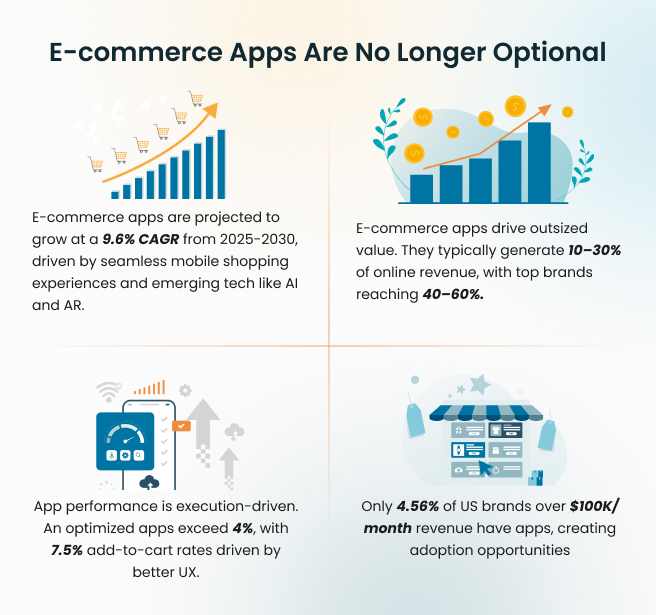
How E-commerce App Development Costs Add Up Beyond the Initial Build
For e-commerce brands planning a mobile app, the development cost is rarely a single number. It is a layered business investment shaped by strategy, timelines, and long-term ownership.
Many brands encounter wide variations in quotes, unclear scopes, and cost comparisons that focus only on launch pricing. This often leads to rushed decisions, feature compromises, or unexpected post-launch expenses. Understanding how these cost layers build over time brings clarity to budgeting, improves alignment with development partners, and helps brands plan with confidence rather than assumptions.
Let’s break this down by looking at where app costs actually begin and where they continue over time.
One-Time Development Cost vs Total Cost of Ownership
At first glance, most brands focus on the one-time e-commerce app development cost, but this only reflects the initial build, not the full financial commitment.
- One-time costs typically include discovery, UI UX design, front-end and back-end development, integrations, testing, and app store deployment
- Total cost of ownership includes maintenance, OS updates, performance optimization, security updates, hosting, cloud infrastructure, and feature enhancements
- Brands searching “how much does it cost to build an e-commerce app” often overlook long-term expenses that directly impact profitability
Understanding this difference early helps brands avoid underbudgeting and prepares them for realistic cost planning as they move into detailed estimates.
Build Cost vs Growth and Scalability Cost
Many e-commerce apps are built for launch, not for growth, which is where hidden costs surface later.
- Build cost focuses on getting the app live with core features such as product listings, cart, checkout, and payments.
- Growth and scalability cost covers traffic spikes, catalog expansion, multi-region support, integrations with CRM and ERP systems, and performance tuning.
- Long-tail searches like “e-commerce app scalability cost” and “future-ready mobile commerce app cost” often stem from brands learning this lesson after launch.
Separating these two cost layers allows brands to plan phased investments instead of reacting to unexpected spending.
Why Low-Cost Apps Become Expensive Later
Low upfront pricing can feel appealing, especially for growing brands, but it often results in higher long-term costs.
- Limited architecture increases redevelopment expenses
- Poor UI UX design negatively impacts conversion rates and user retention
- Low-cost builds often require rebuilding instead of upgrading as the business scales
- People also ask questions such as “why e-commerce app development costs increase over time,” which usually trace back to early compromises
Recognizing this pattern helps brands evaluate proposals beyond surface-level pricing and creates a smooth transition into the cost benchmarks discussed next. The actual cost of e-commerce mobile app development ultimately depends on your business goals, required features, and overall app complexity. Since no two builds are the same, gaining clarity often requires discussing requirements with experienced e-commerce app development teams that understand both technical scope and long-term growth considerations.
For brands running on Shopify, this evaluation becomes even more critical. Decisions around Shopify API usage, custom checkout flows, app performance, and platform scalability directly influence development effort, timelines, and cost—especially when building native iOS and Android experiences designed to scale alongside your store.

What Is the Average E-commerce Mobile App Development Cost — By App Complexity
Once brands understand what actually goes into e-commerce mobile app development cost, the next question is straightforward: What should we realistically budget for? This is where clarity often starts to fade. Quotes vary widely, online numbers feel generic, and it becomes difficult to tell whether a price reflects a basic shopping app or a platform built for real growth. The smarter approach is to align app development cost with business size, operational complexity, and growth plans, rather than chasing a single average figure. With that context, the cost ranges below show how app budgets typically shift based on the level of complexity and scale a brand is building toward.
Typical E-commerce Mobile App Development Cost Ranges
| App Type | Ideal For | Estimated Cost Range |
| Basic E-commerce App | Early-stage brands, DTC startups, single-market stores | $25,000 – $45,000 |
| Growth-Stage ECommerce App | Scaling brands, multi-category stores, retention-focused businesses | $45,000 – $90,000 |
| Enterprise & Multi-Market ECommerce App | Large brands, marketplaces, global operations | $90,000 – $180,000+ |
Cost Range for Basic E-commerce Apps
Basic e-commerce apps are designed for brands entering mobile commerce or validating demand beyond mobile websites.
- Includes essential features like product listings, search, cart, checkout, payments, and basic user accounts
- Limited integrations and standard UI UX design
- Often answers queries like “how much does a basic e-commerce app cost” and “minimum cost to build an e-commerce app.”
This range works well for controlled budgets but offers limited flexibility as traffic and expectations grow.
Cost Range for Growth-Stage E-commerce Apps
Growth-stage apps are built for brands actively scaling revenue, retention, and repeat purchases.
- Advanced UI UX design focused on conversions and engagement
- Integrations with CRM, marketing automation, analytics, and logistics platforms
- Supports personalization, performance optimization, and higher traffic volumes
Search intent here often aligns with “eCommerce app development cost for scaling brands” and “mid-size eCommerce app pricing,” making this the most common investment range for 2026.
Cost Range for Enterprise and Multi-Market Apps
Enterprise eCommerce apps are built for complexity, scale, and long-term ownership.
- Custom architecture, high security standards, and performance at scale
- Multi-region support, multi-currency payments, and deep ERP CRM integrations
- Designed to handle large catalogs, heavy traffic spikes, and future feature expansion
- Brands searching “enterprise e-commerce app development cost” or “global eCommerce mobile app pricing” typically fall into this category.
Understanding where your brand fits within these cost ranges creates a natural transition into the next step: identifying the specific factors that push eCommerce app development costs up or down and how strategic choices directly influence the final budget.
How Each Development Phase Contributes to the Final Cost
Understanding the e-commerce app development process becomes clearer when costs are viewed step by step rather than as a single number. The cost breakdown of building a modern e-commerce app typically follows a structured flow, beginning with planning and moving through design, development, validation, and launch:
- Step 1: Discovery and Requirement Planning – defining scope, priorities, and technical feasibility to set a clear cost foundation
- Step 2: Design and Prototyping – shaping user journeys, UI UX flows, and interaction logic that influence both build effort and conversion
- Step 3: Core Development and Integrations – building front-end, back-end, and connecting third-party systems, where most of the budget is allocated
- Step 4: Testing, Performance, and Security – validating stability, speed, data protection, and readiness for real traffic
- Step 5: App Store Launch and Submission – preparing the app for approval and public release
The pie chart below visually shows how each of these phases contributes to the final cost, making it easier to see where investment is concentrated and why certain stages demand a larger share of the budget.
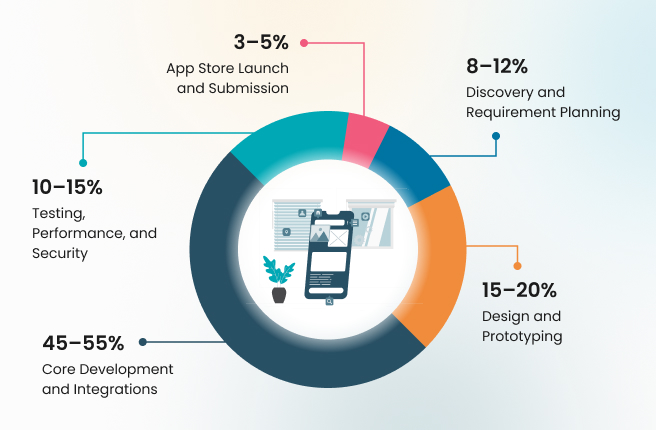
Seeing the cost split clearly helps brands engage with an e-commerce app development company from a place of clarity, not assumptions.
What Drives E-commerce App Development Costs: Budget Factors That Define Pricing Tags
Every e-commerce app budget is shaped by a few critical decisions that are often made early, sometimes without realizing their full cost impact. When these variables are unclear, estimates can feel inflated or inconsistent. When they are understood, brands gain control. Think of the factors below as cost levers. Each one can push your e-commerce app development cost up or down, depending on how intentionally it is handled.
Platform Selection and Its Cost Impact
Platform choice sets the foundation for your e-commerce app budget and influences development effort from day one.
- iOS-only apps
An iOS-first approach can reduce initial scope and development time, especially for brands targeting a defined audience or premium segment within the e-commerce market. - Android-only apps
Android apps typically require broader device compatibility and testing, which can increase development and quality assurance efforts for e-commerce mobile apps. - Cross-platform development
Cross-platform frameworks can lower upfront build costs, but performance tuning, customization, and long-term scalability may add cost as the e-commerce app grows.
The right platform choice balances reach, performance expectations, and future expansion rather than cost alone.
Feature Depth and Business Complexity
Features are where e-commerce app costs begin to scale. The closer the app mirrors real business operations, the more complexity it introduces.
- Product management and search: Advanced catalogs, filtering, variants, and search logic increase e-commerce app development cost.
- Checkout, payments, and taxes: Multiple payment methods, regional tax rules, and compliance requirements add both development and testing effort.
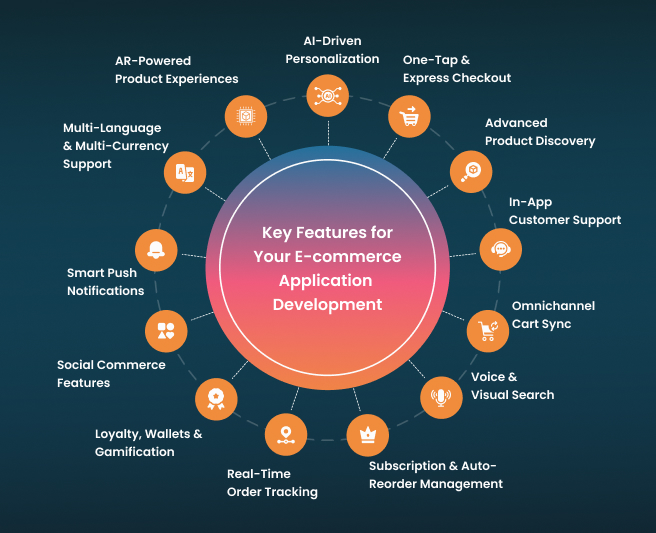
- User accounts and order lifecycle: Order tracking, returns, refunds, notifications, and account management extend the scope beyond basic shopping flows.
- Engagement features and automation: Push notifications, personalized offers, loyalty programs, and automation tools add value but also increase integration and maintenance costs.
Each feature may seem incremental, but together they define the overall budget.
UI UX Design Cost for Conversion-Led Apps
UI UX design shapes how users navigate, decide, and purchase within an e-commerce app, directly influencing conversion rates and retention.
- Custom user journeys
Tailored flows require research and iteration, increasing design effort while improving buying efficiency. - Intuitive navigation and product discovery
Clear menus, filters, and search reduce friction but demand careful planning and testing. - Optimized checkout flows
Streamlined checkout experiences require UX validation and refinement, adding to the design scope. - Design iteration and usability testing
Testing and iteration raise upfront cost but prevent conversion issues after launch.
The right UI UX design balances usability and performance, ensuring design investment supports revenue outcomes rather than visual polish alone.
Backend Architecture and Data Handling Cost
Backend architecture supports everything users do inside an e-commerce app, from browsing products to completing secure transactions.
- Scalable system design
Handling traffic spikes and growing catalogs requires architecture that supports scale without performance drops. - API and third-party integrations
Reliable APIs enable payments, logistics, and CRM connections, increasing backend complexity and development effort. - Real-time data processing
Inventory sync, order updates, and notifications require consistent real-time data handling. - Security and performance stability
Protecting user data and maintaining performance during peak sales adds testing and infrastructure overhead.
The right backend approach balances scalability and reliability, helping e-commerce brands control long-term costs as usage grows.
How Different Technology Stacks Influence App Development Cost
The technology decisions e-commerce brands make early shape not only the e-commerce app development cost, but also long-term flexibility, scalability, and maintenance. Understanding these factors helps brands move beyond surface-level estimates and into strategic planning.
These costs do not come from one decision alone. They build across multiple layers, from architecture and integrations to scalability and long-term ownership. The sections below break down these cost levers so brands can see exactly where budgets are influenced and why.
Key Cost Drivers
The biggest key cost drivers in ecommerce app development are rarely single features, but the combined complexity created across the build.
- Feature depth, integrations, scalability, and security requirements compound effort
- Complex business logic increases testing and maintenance scope
- Cost impact approx: $10,000 – $40,000, depending on complexity
Strategic Cost Optimization
Effective strategic cost optimization for ecommerce app development focuses on sequencing investment rather than cutting essential capabilities.
- MVP-first builds reduce initial spend
- Phased releases improve cash flow control
- Modular APIs reduce future redevelopment
- Potential savings: 15%–30% on total build cost
Integration and High-Tech Feature Costs
Modern ecommerce app development services increasingly rely on advanced integrations and intelligent features.
- Payment gateways, logistics APIs, CRM, ERP, analytics, and marketing tools
- AI-powered search, recommendations, and automation
- Integration cost range approx: $5,000 – $30,000+
Frontend and Backend Technology Impact
The frontend and backend technology’s impact on ecommerce app development cost is often underestimated.
- Rich frontend experiences increase development and QA effort
- Scalable backend systems raise infrastructure and engineering requirements
- Cost impact approx.: $15,000 – $50,000
Platform Architecture Choices
Platform architecture choices in ecommerce app development directly affect future adaptability and speed to market.
- Lightweight architectures reduce upfront cost
- Scalable platforms reduce rebuild risk
- Architecture-driven cost range approx: $20,000 – $60,000
Hidden and Ongoing Costs
The total cost of ownership for ecommerce apps often extends far beyond launch.
- Maintenance, OS updates, hosting, monitoring, and security patches
- Feature upgrades and performance optimization
- Annual TCO: 20%–30% of initial development cost
Architectural Choice: Monolithic vs Headless
The monolithic vs headless ecommerce architecture decision shapes both cost and growth flexibility.
- Monolithic builds cost less initially but limit scalability
- Headless commerce supports omnichannel growth with a higher upfront cost
- Cost difference approx: Headless adds $15,000 – $40,000
Geographical Impact on Hourly Rates
While your app’s features define the workload, where that work is done remains the single biggest factor influencing your final invoice. The global talent market has matured, offering distinct advantages depending on whether you prioritize proximity, cost efficiency, or high-level strategic consulting.
Choosing a development partner today is no longer just about finding the lowest hourly rate; it’s about understanding the Value-to-Cost Ratio behind those numbers. For instance, an onshore team in North America offers seamless collaboration and market familiarity, but at a premium. In contrast, eCommerce app development in India enables access to large, specialized teams that can scale efficiently at a significantly lower cost.
Beyond geography, team size and delivery structure also play a critical role in how these costs translate into real-world execution. Smaller, senior-led teams tend to drive higher hourly rates, while larger, distributed teams reduce costs through specialization and parallel development.
To help you navigate these regional differences more clearly, the table below breaks down the top six countries for eCommerce app development in 2026, including their average rates, typical team size, delivery model, and key strengths.
| Region | Approx Hourly Rate (Approx) | Typical Development Team Size | Team Location Model | Key Strength |
| US – United States | $120–180/hr | Small to mid-sized (5–15) | Onshore | Strategic consulting, domain expertise, real-time collaboration |
| CA – Canada | $90–150/hr | Small to mid-sized (5–20) | Onshore | UX-driven development, regulatory alignment |
| EE – Eastern Europe | $45–80/hr | Small to mid-sized (5–15) | Onshore | Strong engineering depth, EU time-zone compatibility |
| ANZ –Australia & New Zealand | $110–170 /hr | Small, senior-led (5–15) | Onshore | High-quality engineering, strong compliance, and APAC proximity |
| NA- North America | $100–170/hr | Small to mid-sized (5–25) | Onshore | Cross-border collaboration, mature agile practices |
| IN-India | $25–50/hr | Large, scalable (20–100+) | Offshore | Cost efficiency, rapid scaling, full-cycle delivery teams |
Custom E-commerce App Cost vs Ready-Made App Solutions
Choosing between custom development and ready-made tools shapes both cost and control.
- Ready-made solutions offer faster launch but limited flexibility
- Custom builds align with unique workflows and scale better
- App builders often add hidden subscription and scaling costs
- Cost comparison approx:
- Ready-made solutions: $5,000–$20,000/year (recurring)
- Custom e-commerce app development: $30,000–$150,000+ (ownership-based)
This is why many scaling brands eventually transition from tools to a dedicated ecommerce app development company.
Comparing e-commerce App Technologies by Cost, Scalability, and Flexibility
| Technology Area | Best Suited For | Typical Cost Range (approx) | Cost Trade-off |
| Native app development | High-performance, platform-specific apps | $50,000 – $120,000 | Premium experience, higher build cost |
| Cross-platform frameworks | Faster launch, shared codebase | $35,000 – $80,000 | Premium experience, higher build cost |
| Headless commerce and API -first architecture | Omnichannel, future-ready brands | $70,000 – $150,000+ | Higher upfront cost, long-term scalability |
| AI-Driven Features and Personalization | Advanced engagement and retention | $10,000 – $40,000+ | Increased complexity, stronger ROI potential |
With these cost drivers clearly mapped, it becomes easier to compare technology choices for ecommerce app development side by side, which brings us to the structured comparison below.
Strategy: How to Optimize Your 2026 Development Budget
For e-commerce brands, optimizing an app development budget in 2026 is less about reducing spend and more about investing in the right things at the right time. With rising expectations around performance, scalability, and personalization, e-commerce app development cost has become a sequencing challenge rather than a one-time decision. Brands that approach budgeting strategically avoid rushed builds, reduce rework, and protect long-term ROI. A strong cost optimization strategy for e-commerce app development focuses on flexibility, phased investment, and technology choices that support growth without inflating future ownership costs.
- The Modular Build approach allows brands to control the app development cost by breaking development into prioritized modules and spreading investment over a 6 to 12-month roadmap. This helps align spend with traction, feature validation, and revenue milestones instead of funding the entire scope upfront.
- Off-the-shelf vs custom development decisions play a critical role in cost efficiency. Leveraging Shopify Headless is often the right choice when brands need faster launches, CMS flexibility, and scalable commerce functionality without rebuilding core systems, while still supporting future customization.
- Avoiding technical debt is essential for long-term cost control. Low-cost builds often lead to higher e-commerce app maintenance costs, slower feature releases, and expensive rewrites within the first year. While cheap code may lower initial app development pricing, it almost always increases the total cost of ownership as the app scales.
When e-commerce brands optimize budgets with this mindset, development spend becomes a growth lever rather than a constraint, setting the foundation for smarter feature prioritization and scalable investment decisions ahead.
Final Budget Planning Checklist for Decision-Makers
Before approving an e-commerce app development budget, leadership teams need more than a final number. This checklist helps ensure the budget is realistic, scalable, and aligned with long-term business outcomes.
Budget Readiness Checklist:
| ✅ Clear app goals for launch and growth
✅ Revenue-driven core features prioritized ✅ Build cost separated from long-term ownership ✅ Budget planned for scaling and future upgrades ✅ Post-launch costs included (maintenance, security, hosting) ✅ Integrations and third-party costs scoped ✅ Scalable architecture planned upfront ✅ Partners chosen for quality, not lowest price ✅ Phased investment tied to milestones ✅ ROI metrics defined before launch |
Conclusion
E-commerce app development costs are no longer defined by a single build estimate. They are shaped by architecture decisions, technology choices, scalability planning, and long-term ownership considerations. Brands that treat app budgeting as a strategic investment rather than a one-time expense are better positioned to control costs, protect ROI, and scale without disruption.
What consistently stands out across successful app builds is clarity early in the process. When costs are broken down transparently, timelines are phased intelligently, and growth is planned upfront, budgeting becomes predictable instead of reactive. This is where experienced digital partners make a meaningful difference, helping brands translate complex cost variables into clear, actionable decisions. Teams at ZealousWeb have seen firsthand how structured cost planning transforms e-commerce app development from a financial risk into a measurable growth lever. The result is not just an app that launches on budget, but one that continues to deliver value long after it goes live.