

Let’s be honest: in 2026, most e-commerce apps are held together by digital duct tape and the frantic prayers of a caffeinated DevOps team. You probably started with a “reliable” monolithic platform because it was easy; it felt like buying a pre-furnished house. But now, you want to move the kitchen, and your platform provider is telling you the fridge is load-bearing. You’re trying to launch a hyper-personalized, AI-driven checkout, but your backend is still busy screaming at a coupon code from three Tuesdays ago.
This is the Scaling Wall. It’s that moment when your growth trajectory hits the ceiling of your architecture. You’re pouring money into marketing, but your “all-in-one” system is reacting like a Victorian child seeing a sparkler for the first time—total, unadulterated panic.
If you’re a leader, it’s tempting to look at your engineering team and ask, “Why can’t we just… add the feature?” The answer usually involves technical jargon like dependency hell, but let’s translate that into Leadership-Speak: Your technology has become a business constraint. In 2026, scaling isn’t about working harder; it’s about decoupling. It’s about moving from a “clunky box that does everything okay” to a system of specialized parts that do everything brilliantly. We’re going to talk about Headless Commerce, not as a trendy buzzword (we’ve had enough of those), but as a survival strategy for brands that want to grow without the inevitable 3:00 AM “the site is down” phone call.
The 2026 Reality Check: If your architecture requires a sacrificial ritual every time you update the homepage, you don’t have a tech stack—you have a liability.
The Architecture Shift Already Underway
We’ve moved past the era of “buying a platform.” In 2026, market leaders are building systems. The shift we’re seeing isn’t about chasing the latest JavaScript framework; it’s an operating decision to move from rigidity to composition.
Smart leadership teams have realized that being “all-in” on a single vendor is actually just “locked-in” to that vendor’s roadmap. If they don’t support the new spatial commerce interface you need, you’re stuck. The bridge between leadership vision and execution reality now looks like this:
| Feature | Legacy Monolithic | Modern Headless |
| Release velocity | Monthly (if you’re lucky/brave) | Multiple times per day |
| Risk profile | Change one thing, break everything | Isolated services; failure is contained |
| Market response | Wait for the vendor update.” | Build the integration today. |
| Cost focus | Maintenance & Keeping lights on | Innovation & Customer Experience |
The Pivot from "Suite" to "Best-of-Breed"
This shift signals a change in how we advise at the planning level. We aren’t looking for a “vibe check” on your tech stack after it breaks; we’re looking at your operating leverage.
In the old world, your execution was limited by what your suite allowed. In the 2026 shift, execution is driven by what the market demands. By decoupling the frontend (the customer experience) from the backend (the commerce engine), you turn your architecture into a competitive advantage rather than a line-item expense.
You don’t choose Headless because it’s cool. You choose it because you’ve reached a level of maturity where “standard” is no longer enough to win.
What Headless Commerce Actually Solves (And What It Doesn’t)
Let’s kill the hype for a second. If a consultant tells you Headless is a magic wand that fixes every conversion woe, they’re either lying or trying to sell you a $200k discovery phase.
True execution isn’t about choosing the “best” tech; it’s about choosing the right complexity budget. If you’re a small shop with a simple catalog, Headless is like buying a literal rocket ship to go to the grocery store—it’s expensive, overkill, and you’ll probably crash into a lamp post before you find the milk.
Here is the honest breakdown of the ROI from the floor of the warehouse to the pixels on the screen:
The Problems It Actually Solves
- The “Same-Face” Syndrome:Most monolithic platforms force you into a template “grid.” Headless solves this by giving you total creative sovereignty. If your brand needs a high-fidelity, cinematic experience, you aren’t fighting a theme engine to get it.
- Omnichannel Fragmentation: It solves the “double work” problem. One backend (your single source of truth) feeds your web app, your mobile app, your IoT kiosks, and that smart-mirror integration your VP of Marketing is obsessed with.
- Performance Bottlenecks: It solves the “bloat” issue. You only send the data the customer needs, leading to sub-second load times that monolithic “all-in-one” themes simply cannot touch in 2026.
The Problems It Definitely Doesn't Solve
- Internal Capability Gaps:Headless won’t fix a mediocre dev team. In fact, it will expose them. You are moving from a “managed” environment to an “orchestrated” one. You need conductors, not just coders.
- Immediate Marketing Agility: If you don’t implement a proper Headless CMS alongside your commerce engine, your marketing team will lose their “drag-and-drop” comfort. Without the right setup, they’ll have to wait for a developer just to change a homepage banner.
- Lowering Your Monthly Bill: Headless is rarely cheaper upfront. You’re trading lower platform licensing fees for higher specialized engineering investment.
The Reality Check: Headless commerce doesn’t simplify your business; it simplifies your growth path. It trades “easy to start” for “easy to scale.”
Headless vs Monolithic vs Composable: Choosing with Intent
In the boardroom, “Headless” and “Composable” are often used interchangeably. That is a mistake that costs millions. You aren’t just choosing a stack; you are choosing your Organization’s Operating Tempo.
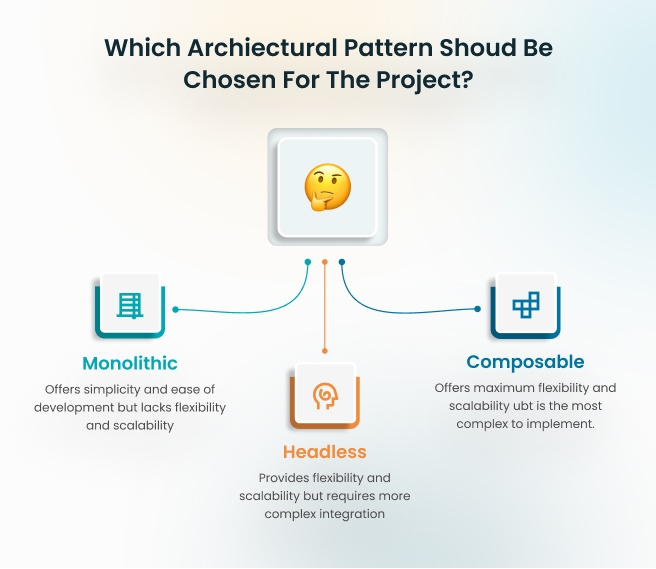
As a leader, you are essentially deciding how much of the “heavy lifting” you want to outsource to a vendor versus how much “innovation equity” you want your team to own. To make this call, you have to look at your Operational Appetite—how much complexity can your team actually digest before they start choking on the overhead?
We can map these choices not by their code, but by the organizational gravity they create:
The Decision Spectrum
- The Monolithic “Anchor”:This is for when the goal is speed-to-market over everything else. You accept a “low-ceiling” on customization in exchange for having one throat to choke when things break. It’s perfect until you want to do something the vendor hasn’t thought of yet.
- The Headless “Bridge”: This is the sweet spot for 2026. You decouple the customer-facing experience (the “Head”) from the commerce logic. You own the brand’s look, feel, and performance, but you let a proven engine handle the “boring but critical” stuff like tax logic and PCI compliance.
- The Composable “Orchestra”: Here, you aren’t buying a platform; you’re building an ecosystem. You pick a specialized vendor for search, another for checkout, and another for content. It offers infinite agility, but it requires a “Conductor” (a high-level internal team) to keep the instruments in sync.
Finding Your Efficiency Frontier
Choosing with intent means recognizing that control and responsibility are mathematically linked. If you go full Composable, you are now a software integrator. If you stay Monolithic, you are a tenant in someone else’s building.
The “Headless” middle ground is where most scaling brands find their stride—it provides the leverage to innovate where the customer actually lives without the crushing overhead of managing a dozen different micro-vendor relationships.
The Peer-Level Insight: Teams are often drawn to the theoretical elegance of composable architectures, only to discover they lack the internal systems required to manage multiple vendors and service-level agreements. The objective is not architectural sophistication, but selecting a model that enables the organization to move fastest with the resources it actually has.
Designing E-commerce App Architecture for Scale, Not Just Launch
Most e-commerce apps are built for a “Go-Live” date. Serious brands build for “Year Three.”
The “Launch-First” mentality is the primary driver of technical debt. It’s the tendency to hard-code features or use “quick-fix” plugins just to hit a calendar milestone. By 2026, we’ve seen enough cycles to know that MVP decisions are often the “future drag” that kills a brand’s momentum just as they start to gain real market share.
When we look at architecture through an Execution System lens, we aren’t just looking at the code—we’re looking at its elasticity.
The Architecture Stability vs. Agility Ratio
| Component | The “Launch” Approach (Brittle) | The “Scale” Approach (Elastic) |
| Data flow | Point-to-point hardcoded integrations. | Event-driven architecture (using a Service Bus). |
| Front end | Tied to a platform-specific theme | Framework-agnostic (React, Next.js, or Vue). |
| Logic | Business rules are buried in the UI layer. | Centralized API orchestration layer. |
| Third-party tools | Deeply embedded “Plugins.” | Decoupled “Services” connected via API. |
Optimizing for "The Pivot"
Scaling isn’t just about handling more traffic; it’s about handling more change. In a “Scale-First” architecture, we design for the reality that your business model will likely evolve.
The API-First Mandate: In a scaling system, every internal function must be an API. If your inventory system can’t talk to your future VR-shopping app without a total rewrite, you haven’t built for scale.
Decoupling the “High-Velocity” Parts: Your homepage and product pages change daily. Your checkout and tax logic might change once a year. A scalable architecture separates these “speeds,” so your marketing team doesn’t have to wait for a security audit just to update a hero image.
The Filter for Serious Buyers: If you’re asking, “How fast can we get this live?” you’re building a sprint. If you’re asking,g “How much will it cost to change our checkout provider in 24 months?” you’re building a system. Scale is the ability to swap parts while the car is moving at 100 mph.
Where Headless Commerce Fits in a Scalable E-commerce System
In 2026, commerce doesn’t happen in a vacuum. It is a single gear in a much larger machine—one that includes predictive AI, real-time inventory automation, and sophisticated data lakes. If you view headless commerce as just a “website upgrade,” you’re missing the forest for the trees.
To scale effectively today, you have to stop thinking about “features” and start thinking in system boundaries. As commerce systems mature, they move away from the “all-in-one” box and reorganize into three distinct layers of operation:
The Modern 2026 Commerce Ecosystem
| Layer | System Type | Primary Function | Business Value |
| Intelligence | The Brain | Predictive AI, CDPs, Personalization Engines. | Revenue Lift: AI personalization now drives up to 40% more revenue by adapting to real-time behavior. |
| Orchestration | The Nervous System | API Middleware, Service Bus, Data Flow. | Agility: Decouples high-velocity data (inventory) from low-velocity logic (tax rules). |
| Execution | The Face | Headless Storefront, Mobile App, IoT, AR. | Performance: Headless implementations reduce load times, where a 100ms improvement can increase conversion by 8.4%. |
From "Headless Experts" to "System Architects"
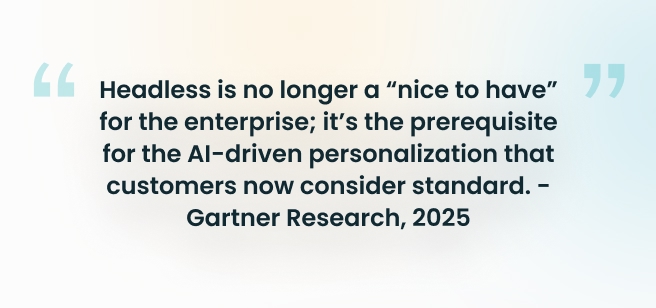
When you decouple the frontend, you aren’t just making a faster site; you are creating a “landing pad” for your Intelligence System.
In 2026, the global e-commerce market is projected to reach $6.88 trillion. Traditional monolithic systems struggle to ingest the massive, real-time datasets required for modern AI to function. Because a headless architecture is API-first by design, it allows your AI models to “plug in” directly to the execution layer.
The System Boundary Shift:
- Predictive Inventory: Instead of just showing “In Stock,” your system uses machine learning to predict regional demand. McKinsey research shows that AI in distribution can reduce inventory levels by 20–30% while cutting logistics costs by 5–20%.
- Dynamic Personalization: Your storefront is no longer a static template. It is a dynamic UI that reconfigures itself based on the Intelligence Layer’s understanding of intent.
- Omnichannel Reality: Content created once in your Headless CMS is distributed across unlimited channels. In fact, 82% of businesses now report that headless systems have simplified their content delivery processes.
The Architectural Pivot: We have moved past the era of “site building.” We are now in the era of System Orchestration. The goal is a system where your commerce engine is a utility, your data is an asset, and your frontend is a high-performance laboratory for customer experience.
The Strategic Investment: Scaling Beyond the License
If we’re being honest, the sticker price of a headless platform is simply the foundation of a much larger growth engine. In 2026, the most successful brands view headless not as a singular invoice, but as a sophisticated Total Cost of Ownership (TCO) model designed for long-term agility.
While a headless architecture can reduce operational TCO by 30% over five years, “Year One” is where elite teams differentiate themselves. The secret to scaling lies in the “connective tissue”—the intentional engineering that binds your best-of-breed services into a seamless powerhouse.
The 2026 Architectural Value Map
Instead of viewing infrastructure as a “hidden cost,” high-growth brands treat these elements as the “Intelligence Layer” of their stack.
| The Visible Foundation | The Scaling Accelerator | Impact on System Intelligence |
| Platform Licenses | Integration Orchestration | Sophisticated middleware (budgeted at $10k–$25k per service) ensures data flows without friction. |
| Frontend Development | Content Liquidity & Audit | Investing 20–30% of the migration budget into data hygiene ensures your AI and frontend are fueled by “clean” data. |
| Cloud Hosting | CI/CD & DevOps Excellence | You aren’t just hosting a site; you’re maintaining a high-velocity pipeline that deploys features 24/7. |
Eliminating "Organizational Friction"
The true hallmark of a 2026 scaling strategy is the removal of the Innovation Tax. In a headless environment, velocity is maintained by ensuring marketing teams have visual editing tools. Without this “head” autonomy, even the best backend can feel fragmented.
McKinsey research suggests that a well-integrated headless stack eliminates the “Intelligence Gap.” When your frontend and backend talk to each other efficiently, you avoid the 30% slowdown in service responses common in legacy systems, turning data into a real-time asset for the customer.
Principles of High-Velocity Scaling
To maximize your ROI and avoid common architectural bottlenecks, follow these three optimization pillars:
- Strategic Sourcing: Rather than building from scratch, scale with proven leaders. Leveraging a solution like Algolia can offer a 382% ROI, allowing your team to focus on proprietary features rather than rebuilding commodity tools.
- Infrastructure Elasticity: Architect for success by selecting platforms with transparent API scaling. By planning for high-traffic “viral” moments early, you ensure your hosting remains a predictable driver of growth, not a liability.
- Content Modernization: Moving to headless is the perfect time for a “Content Audit.” By treating your data as a liquid asset rather than “legacy debt,” you ensure your new system is built on a foundation of high-quality, structured information.
The Professional Perspective: Headless is an investment in market velocity, not a short-term cost-saving measure. It trades the predictable, rigid boundaries of a monolith for a high-leverage engineering ecosystem. By prioritizing the “connective tissue” of your stack, you aren’t just building an app—you’re building the infrastructure for the next decade of commerce.
How Mature Teams Approach Headless E-commerce Development
The “Big Bang” migration—where you flip a switch and hope your entire $100M revenue stream doesn’t evaporate—is considered a relic of reckless engineering. Mature teams don’t “replatform”; they evolve.
This approach signals a shift from reactive builds to a guided Readiness System. Leaders at this level treat architecture like a living forest, using what architects call the “Strangler Fig” pattern. Just as a fig tree grows around a host tree and eventually replaces it, mature teams build new headless services around their legacy monolith, suffocating the old system’s inefficiencies without ever taking the site offline.
The Maturity Model: Phased Evolution vs. Big Bang
| Factor | The “Big Bang” Rewrite (High Risk) | The Phased Evolution (Low Risk) |
| Business Impact | High disruption; “Freeze” on new features. | Zero downtime; continuous delivery. |
| ROI Timeline | 12–24 months (all at the end). | Immediate. ROI starts with the first module. |
| Execution Path | Total replacement in one go. | Incremental “strangling” of legacy parts. |
| Success Rate | 60% of large migrations deviate from the budget/timeline. | 93% of retail organizations achieve positive ROI. |
The "Strangler" Strategy in Practice
We guide teams to think before they act by identifying high-impact, low-risk “slices” of the business to move first. This isn’t just about code; it’s about proving the business case in real-time.
- Isolate the High-Value Head:Instead of moving the whole store, start with the Product Detail Page (PDP) or the Search Experience. Case studies show that optimizing just these “heads” can increase conversion by 8.4% for every 100ms of speed gained.
- Bridge via the API Gateway: Use a facade layer to route traffic. Your customers see a blazing-fast, headless frontend for search, but the “boring” parts like the account profile still live on the old monolith.
- Validate and Repeat: Once the search module is stable and driving revenue, you move the cart. Then the checkout. Eventually, the legacy host “dies” naturally, leaving a modern, self-sustaining architecture.
Why This Works for Leaders:
- Predictable Budgeting:You aren’t asking for a $2M “leap of faith.” You’re funding specific, high-ROI sprints.
- Speed to Market: Organizations using this modular approach outpace competitors by 80% in the speed of new feature implementation.
- Team Readiness: It gives your internal developers time to upskill on modern frameworks (React, Next.js) without the pressure of a total system failure hanging over them.
The Solution-Provider Posture: We don’t just build. We diagnose. If your team isn’t ready for the operational overhead of a full headless ecosystem, we start with a Pilot Project—perhaps a new B2B portal or a niche geography—to build muscle memory before touching the core.
What Scaling Brands Should Evaluate Before Going Headless
In a scaling ecosystem, architecture decisions compound like interest. Poor choices create “technical debt” that slows the business down, while modular choices create “Innovation Equity.” By 2026, the brands dominating the market are those that have transitioned from reactive growth to Calm Scale.
A headless architecture is the foundation of this stability. It transforms the commerce engine from a rigid box into a flexible utility that supports the entire business system.
The Compounding Effect of System Architecture
| Growth Phase | Legacy Impact | Headless Impact |
| Expansion | Adding a new country or brand takes 6–9 months. | New storefronts launch in weeks via the same API. |
| Innovation | AI features are “bolted on” and often unstable. | AI integrates natively into the Intelligence Layer. |
| Market Shock | Sudden traffic or shifts cause system-wide failure. | The system scales elastically; only the “Head” is affected. |
| Exit/Maturity | Technical debt lowers the valuation of the company. | Modular architecture is a transferable, high-value asset. |
The "Calm Control" Anchor
When the Execution System is decoupled from the Leadership System’s strategy, the result is chaos. But when they are aligned through a headless framework, the business gains a level of predictability that traditional models cannot offer.
Recent industry data indicates that companies utilizing headless architectures see a significant increase in agility, with 77% of leaders reporting that the move allowed them to pivot faster during market shifts. This isn’t just a technical win; it’s a strategic one.
- Financial Predictability: Instead of massive, unpredictable “re-platforming” costs every five years, the budget shifts to consistent, incremental improvements.
- Operational Peace: The “Launch-and-Pray” methodology is replaced by a Continuous Delivery model. Because the frontend is decoupled, updates to the customer experience happen without risking the integrity of the checkout or database.
Conclusion
To conclude, architecture is not an “engineering problem.” It is a fundamental business decision that dictates the speed at which a brand can move, the talent it can attract, and the level of personalization it can offer.
Choosing a headless approach for 2026 and beyond signals a commitment to System Leadership. It is a move away from being a “platform tenant” and toward becoming a “market architect.” This shift requires more than just a new tech stack; it requires a partner capable of navigating the “gray areas” where standard documentation ends and innovation begins.
Organizations that have spent over two decades “Solving the Unsolved”—like the architects at ZealousWeb—understand that the goal isn’t just a “site launch.” It is about engineering a “technological masterpiece” that acts as a bridge between today’s constraints and tomorrow’s growth. Whether it is a complex Strapi integration or a high-performance Shopify ecosystem, the objective remains the same: transforming digital friction into a competitive edge.
By decoupling the experience from the engine, a brand ensures that its growth is limited only by its imagination, not its infrastructure. In the 2026 landscape, the most successful brands won’t be those with the biggest platforms, but those with the most adaptable systems.
Planning To Build Your E-commerce App
Lets Connect
FAQs
When Does Headless Commerce Actually Make Sense for a Brand?
At ZealousWeb, we recommend headless when growth is constrained by architecture—not demand. If personalization, omnichannel expansion, performance, or experimentation are being slowed by platform limitations, headless becomes a strategic necessity rather than a technical upgrade.
Is Headless Commerce Overkill for Mid-Sized eCommerce Brands?
It can be if adopted too early. Headless is about operational maturity, not company size. Brands with clear growth plans, technical ownership, and evolving customer journeys benefit most, while simpler models may still perform well on monolithic systems.
How Is Headless Different From Composable Commerce?
Headless separates the frontend from the commerce core while keeping it intact. Composable breaks every function into separate services. For most brands in 2026, headless offers the best balance of agility and operational stability.
Will Headless Commerce Reduce Our e-commerce Costs?
Not in the first year. Headless replaces predictable licensing costs with higher engineering investment. Over time, mature teams often see lower total cost of ownership through faster innovation, reduced replatforming, and reusable systems.
What Internal Capabilities Are Required Before Moving Headless?
Teams need API fluency, frontend framework expertise, DevOps discipline, and clear ownership models. Headless exposes operational gaps rather than hiding them, which is why readiness must be assessed upfront.
Does Headless Slow Down Marketing Teams?
Only when implemented poorly. Without the right CMS and workflow design, agility suffers. When done correctly, headless gives marketing teams more speed, autonomy, and experimentation freedom without risking checkout or compliance layers.
Can We Migrate to Headless Without Disrupting Revenue?
Yes. Mature teams avoid full rewrites. A phased approach using the Strangler pattern allows brands to modernize high-impact areas while keeping core revenue flows stable.
How Does Headless Support AI and Personalization?
Headless architectures are API-first, making them ideal for AI integration. Personalization engines, CDPs, and predictive models can connect directly to the experience layer without being limited by rigid templates or monolithic data flows.
What Are the Biggest Mistakes Brands Make With Headless Commerce?
Common mistakes include over-engineering, underestimating integration effort, ignoring content debt, and selecting architecture before aligning operating models. Headless is a system-level decision—not a frontend refresh.
How Does ZealousWeb Approach Headless Commerce Differently?
ZealousWeb does not push platforms or unnecessary rewrites. We assess execution readiness, system dependencies, and business velocity first, then design architecture that reduces uncertainty rather than adding complexity disguised as innovation.