

Most agencies do not have a framework problem.
They have SOPs, project management tools, dashboards, timelines, review calls, delivery checklists, and enough process documents to make everyone feel responsibly organized. On paper, the agency delivery framework looks mature. Work is assigned, deadlines are visible, tasks move across boards, and reports are shared with clients.
Yet daily delivery still feels heavier than it should.
Projects move, but clarity does not always move with them. Tasks get completed, but the output still needs internal cleanup. QA happens, but often too late. Team leads keep following up because ownership is visible in the tool, but not always active in behavior. Clients receive updates, but delivery confidence quietly depends on a few people holding everything together.
That is where agency delivery chaos usually begins. Not in the absence of systems, but in the gap between documented systems and daily execution.
This is also the part many agency leaders avoid looking at too closely. Not because they do not care, but because delivery workflow mapping for agencies can reveal uncomfortable truths. The issue may not be the team’s effort. It may be unclear ownership, weak QA gates, scattered handoffs, overloaded team leads, or external support that is adding capacity without adding control.
And once those gaps become visible, they need to be fixed.
That is why agencies need to move from frameworks to workflows. A framework tells the team how delivery should work. A mapped workflow shows how work actually moves across strategy, execution, QA, reporting, and client approval. More importantly, it shows where delivery slows down, where quality slips, and where the right execution partner can help map the fix without taking control away from the agency.
For growing agencies, calm control does not come from having more tools or longer SOPs. It comes from building a delivery workflow that shapes daily behavior, protects client trust, and makes execution easier to scale.
What Is Delivery Workflow Mapping for Agencies?
Delivery workflow mapping for agencies is the process of showing how client work actually moves from request to delivery across strategy, execution, QA, reporting, and approval stages.
It does not stop at saying, “Here is the process.” It shows who owns each step, where work gets delayed, where quality checks happen, where approvals slow down, and where communication usually breaks. For agencies managing multiple clients, campaigns, websites, retainers, and delivery teams, this clarity is what turns a documented agency workflow mapping exercise into a real operating advantage.
A delivery workflow mapping template helps agencies see the full path of work instead of only looking at task status. It connects the daily movement of work with ownership, quality, accountability, and client-ready outcomes.
How Delivery Workflow Mapping Shows the Actual Movement of Client Work
Most agency workflows look clean on task boards. In reality, one client request may move through account management, strategy, content, design, development, QA, reporting, and client approval.
Workflow mapping shows where that movement is clear and where it breaks. It reveals delayed handoffs, unclear ownership, repeated follow-ups, skipped reviews, and hidden rework before these issues reach the client.
Why Workflow Mapping Is Different From SOP Documentation
SOPs explain how work should happen.
Workflow mapping shows how work actually happens.
An agency may have strong SOPs, but if ownership, QA, capacity, and approvals are not connected to daily execution, those SOPs stay on paper. Workflow mapping exposes the gap between documented process and real delivery behavior.
How It Connects Ownership, QA, Handoffs, Approvals, and Reporting
A strong agency workflow mapping exercise connects the parts that control delivery quality.
It shows who owns each stage, where QA gates should happen, how work moves between teams, where approvals affect timelines, and which reporting signals reflect real delivery health.
This helps agencies catch delivery risks before they become missed deadlines, client escalations, or margin pressure.
Why Agencies Need Workflow Visibility Before Adding More Tools or People
When delivery feels heavy, agencies often add tools, hires, freelancers, or external support. But without workflow visibility, more capacity can create more coordination.
Delivery workflow mapping helps agencies understand where delivery is breaking before they scale the team or support layer. It shows whether the agency needs clearer ownership, stronger QA, better handoffs, improved reporting, or a more reliable execution partner.
A framework gives agencies structure. A mapped workflow gives them control. When work is visible across every stage, agencies can fix the right problems instead of adding more pressure to an overloaded system.
Why Delivery Frameworks Fail Once Real Agency Operations Begin
Most agency delivery frameworks are built with the right intent. They define process, responsibilities, tools, timelines, and expected outcomes. The issue begins when real client work starts moving through pressure, urgency, changing priorities, and cross-team dependencies.
The uncomfortable truth is that delivery frameworks often fail not because teams are careless, but because the operating layer is not visible enough. What looks clear in documentation can become unclear in daily execution.
| Where the Framework Struggles | What Happens in Real Agencies’ Operations |
| Frameworks are designed for ideal delivery | Agency work runs under pressure, with shifting timelines, urgent client requests, and competing priorities. |
| Client urgency overrides process | Teams skip internal steps to move faster, but QA, review, and clarity often suffer later. |
| Tools are followed, but discipline varies | Tasks may move across boards, but ownership, accountability, and delivery standards are not always active. |
| Handoffs depend on memory | Work moves between teams through reminders, chats, and follow-ups instead of mapped accountability. |
| SOPs exist, but decisions stay informal | Teams know the process, but daily decisions still depend on availability, assumptions, or senior intervention. |
This is where agency delivery workflow needs more than documentation. It needs workflow visibility that shows how work actually moves, where control weakens, and where execution support can help map the fix.
Why SOPs Do Not Always Fix Agency Delivery Chaos
SOPs are useful, but they are not the same as an agency delivery system. They document how work should move, who should review it, and what steps should be followed. But in real agency operations, delivery pressure often changes how teams behave.
An agency may have detailed SOPs and still face rework, delays, quality issues, and client escalations because execution behavior was never mapped. That is where agency SOP implementation usually breaks. The document exists, but the workflow does not always shape daily decisions.
- SOPs document what should happen; workflows reveal what actually happens
SOPs show the intended process. Workflow mapping shows whether that process is followed when projects move across strategy, content, design, development, QA, and reporting. - Checklists cannot fix unclear ownership
A checklist may confirm that a task is complete, but it cannot answer who owns the next decision, who reviews the output, or who catches quality gaps before the client does. - Process documents fail when they are disconnected from capacity
A process may look clean on paper, but if the team is overloaded, steps get skipped, approvals slow down, and delivery quality becomes inconsistent. - QA standards weaken when timelines get tight
Most agencies do not ignore QA intentionally. It gets compressed when deadlines shift, client urgency increases, or internal ownership is unclear. - Reporting becomes cosmetic when delivery signals are weak
Reports may show completed tasks, published assets, or delivered milestones. But if they do not show rework, blockers, QA gaps, or delivery risk, they create visibility without control.
This is why agency process optimization cannot stop at writing better SOPs. Agencies need mapped workflows that connect ownership, capacity, QA, approvals, and reporting to how work actually moves every day.
What Delivery Workflow Mapping Reveals That Dashboards Usually Miss
Dashboards are useful for tracking activity, but they do not always explain delivery health. They may show completed tasks, open tickets, timelines, and campaign status, but many delivery visibility gaps stay hidden until they affect quality, margins, or client confidence.
Delivery workflow mapping helps agencies see what agency performance reporting often misses:
- Rework loops between strategy, content, design, development, and QA
It shows where work keeps moving backward because briefs are unclear, reviews are late, or expectations were not aligned early. - Capacity pressure before it becomes missed deadlines
It reveals where certain roles, teams, or approval points are overloaded before delays start showing up on reports. - Client escalation patterns before they become retention risks
It helps identify repeated friction points that create dissatisfaction, even when the dashboard still shows work as “on track.” - QA friction before it reaches the client
It shows where quality checks are compressed, skipped, delayed, or happening too close to handoff. - The gap between task completion and client-ready delivery
A task may be marked complete, but still needs cleanup, review, context alignment, or final quality control before it is truly ready for the client.
For stronger agency delivery management, workflow mapping gives leaders a clearer view of how work actually moves. It helps identify hidden workflow gaps before they affect client confidence, delivery margins, and the quality standards agencies are expected to protect.
Where Agency Delivery Workflows Usually Break
Agency delivery rarely breaks at one obvious point. It usually weakens across small handoffs, delayed reviews, unclear ownership, and informal coordination that no dashboard fully captures.
Agencies often do not fear workflow mapping itself. They fear discovering how much of their delivery depends on reminders, follow-ups, senior intervention, and people “just knowing what to do.”
- During strategy-to-execution handoffs
The brief may be approved, but context, priorities, client expectations, and success criteria do not always transfer clearly to the execution team. - Between content, design, development, and QA teams
Each team may complete its part, but the agency handoff process breaks when dependencies, review points, and ownership are not mapped. - When approvals depend on one overloaded team lead
Delivery slows down when every decision, review, or clarification waits for the same person to respond. - When recurring work is treated like one-off execution
Monthly SEO tasks, reports, website updates, content workflows, or campaign assets become harder to scale when they are not converted into repeatable delivery systems. - When reporting does not reflect delivery health
Agency performance reports may show progress, but not rework, QA pressure, missed dependencies, or internal delivery risk. - When external support is used without mapped workflows
Adding support can help capacity, but without a clear agency project delivery workflow, it may also create more briefing, checking, and correction work.
This is why workflow mapping matters. It helps agencies see where the agency QA workflow, handoffs, approvals, reporting, and support layers need structure before delivery pressure turns into client-facing friction.
When Delivery Workflow Mapping Becomes Critical for Agencies
Agencies should map delivery workflows when delivery depends on follow-ups, unclear ownership, missed QA checks, delayed approvals, or weak leadership visibility.
| Checklist question | What it signals |
| Are projects moving, but outcomes still feel unclear? | Activity is visible, but delivery impact is not. |
| Does delivery depend on specific people? | The workflow is person-dependent, not system-dependent. |
| Do QA issues reach clients first? | Handoffs and approvals are not clearly mapped. |
| Is retention or account growth being affected? | Internal review is too late or inconsistent. |
| Does scaling feel like it will create more chaos? | Delivery friction is weakening client confidence. |
| Does scaling feel like it will create more chaos? | The agency needs workflow optimization before adding more people or support. |
If these signs appear repeatedly, the agency does not just need more capacity. It needs clearer workflow visibility before scaling further.
How the Right Execution Partner Helps Agencies Map the Fix Without Taking Over Control
The right execution partner for agencies does not replace internal teams or take ownership away from the agency. Their role is to strengthen the operating layer behind delivery so work moves with more clarity, consistency, and control.
A capable agency delivery partner helps identify where delivery slows down, where ownership becomes unclear, where QA gets missed, and where support can reduce pressure without creating more coordination. This is where outsourced delivery support for agencies becomes valuable, not as extra hands alone, but as a structured execution layer working within the agency’s standards.
Reviews How Delivery Actually Moves Across Teams
Before suggesting fixes, the execution partner studies how work moves across strategy, content, design, development, QA, reporting, and approvals.
What this improves:
- Reveals the real workflow, not just the documented process
- Shows where work slows down between teams
- Helps agencies see hidden delivery friction earlier
- Creates a clearer starting point for workflow improvement
Identifies Ownership Gaps, QA Gaps, and Handoff Friction
The partner helps spot where tasks lose clarity, where reviews happen too late, and where handoffs depend on repeated follow-ups.
What this improves:
- Reduces confusion around who owns what
- Makes QA gaps visible before they reach the client
- Improves handoff clarity between internal and support teams
- Helps reduce rework, delays, and last-minute corrections
Builds Workflow Clarity Around the Agency’s Definition of Done
A strong partner aligns delivery with the agency’s quality standards, approval rules, client expectations, and internal definition of done.
What this improves:
- Ensures outputs are not just completed, but client-ready
- Keeps quality standards consistent across delivery stages
- Reduces internal cleanup after support-side execution
- Helps the agency maintain delivery control while scaling support
Supports Execution Without Disturbing Agency-Client Relationships
The right support layer stays aligned with the agency’s communication model and works behind the operating layer.
What this improves:
- Protects the agency’s client ownership
- Keeps delivery support discreet and structured
- Reduces internal pressure without changing the client-facing model
- Allows the agency team to stay focused on strategy and relationship management
Creates a Structured Delivery Support Layer Without Increasing Dependency
The goal is not to make the agency dependent. It is to create repeatable workflows, clearer ownership, and better visibility.
What this improves:
- Makes external support easier to manage
- Prevents support from becoming another coordination burden
- Builds repeatable delivery habits instead of ad hoc task handling
- Helps agencies scale execution without losing operating control
Helps Agencies Move From Scattered Support to Controlled Execution
Instead of relying on ad hoc freelancers, rushed internal fixes, or disconnected task support, agencies gain a more structured execution layer.
What this improves:
- Reduces scattered task management
- Creates consistency across recurring delivery work
- Improves delivery predictability across clients
- Supports calm control as the agency scales execution
The Delivery Workflow Mapping Template Agencies Can Use
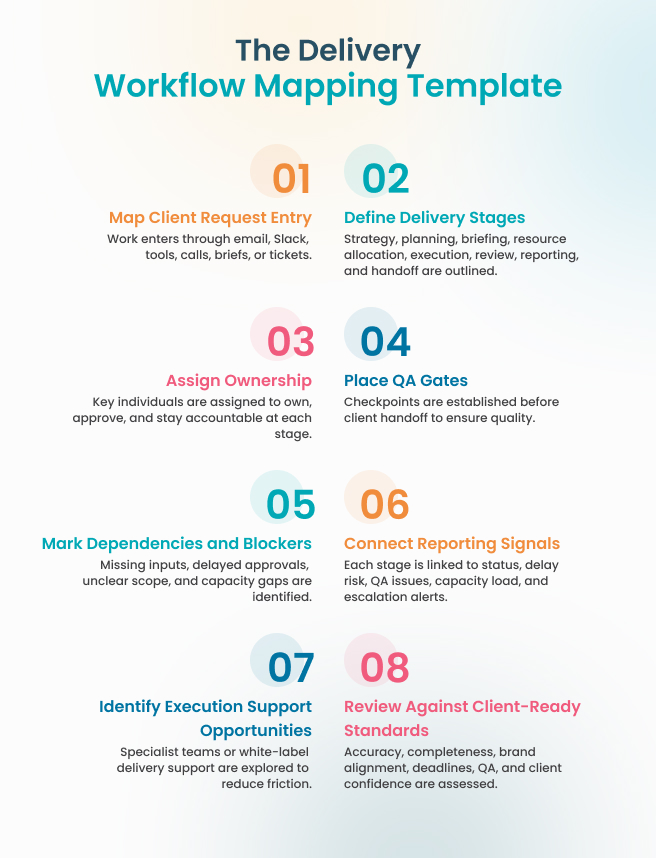
Workflow Mapping Use Cases for Digital and Performance Agencies
Agency workflow mapping becomes more useful when it is applied to real delivery environments, not kept as internal documentation. For digital and performance agencies, workflow mapping helps convert scattered execution into clearer agency delivery workflows that teams can actually follow.
| Use Cases | Where Workflow Mapping Helps | What It Improves |
| Website Development and Maintenance Delivery | Strategy, design, development, content, QA, approvals, launch, and maintenance requests | Clear ownership, fewer missed requirements, stronger QA gates, and smoother post-launch support |
| SEO Execution and Content Production Workflows | Keyword research, content briefs, writing, SEO review, publishing, and reporting | Less rework, clearer approvals, stronger publishing flow, and better reporting signals |
| Paid Media Creative and Landing Page Delivery | Ad strategy, creative, copy, landing page development, tracking, QA, and launch approvals | Faster asset readiness, better campaign coordination, fewer tracking gaps, and quicker response to performance changes |
| eCommerce Support and Optimization Workflows | Product updates, CRO tasks, platform fixes, integrations, analytics, and ongoing support | Better prioritization, smoother UX-dev-QA coordination, less delivery friction, and clearer visibility into revenue-impacting tasks |
| SaaS Product Sprint Support and QA Cycles | Product planning, sprint execution, development, QA, release support, and feedback loops | Clear sprint ownership, stronger QA before release, fewer dependency gaps, and better alignment with product priorities |
| Client Reporting and Recurring Delivery Reviews | Task progress, blockers, rework, QA gaps, capacity pressure, and client review cycles | More meaningful reviews, stronger delivery visibility, earlier risk detection, and better client confidence |
These agency delivery workflow examples show that workflow mapping is not just a process exercise. It helps agencies build stronger agency execution systems across the places where delivery pressure shows up most often.
What Changes When Agencies Move From Framework to Workflow
When agencies turn delivery frameworks into workflows, the system stops living only inside documents, tools, or dashboards. It starts shaping how work moves every day, how teams take ownership, how QA happens, and how leadership sees delivery risk before it becomes client-facing friction.
Here is what starts changing:
- Teams stop depending on constant follow-ups — Ownership becomes clearer, so work does not need to move only through reminders, chats, and repeated status checks.
- QA becomes part of delivery, not a last-minute check — Review points are built into the workflow, making quality control more consistent before client handoff.
- Leadership sees delivery risk earlier — Blockers, rework, missed handoffs, and capacity pressure become visible before they affect timelines or client confidence.
- Client communication becomes more predictable — Updates become grounded in actual workflow status, not last-minute internal chasing.
- External execution support becomes easier to manage — Partners and support teams work inside a mapped delivery system instead of handling scattered tasks without context.
- Delivery scales with more clarity and less chaos — Execution becomes repeatable, visible, and easier to manage as the agency grows.
This is where agencies move closer to calm control. The framework stops being a reference document and becomes a daily operating rhythm that supports clearer decisions, stronger execution systems, and more predictable delivery.
How ZealousWeb Helps Agencies Strengthen Delivery Workflow Mapping
Most agencies already have AI tools, project dashboards, in-house experts, and external support. Yet delivery still becomes difficult when ownership is unclear, QA depends on individuals, reporting is manual, and every project needs senior follow-up to stay on track.
The gap is not always talent or technology. It is the absence of a structured delivery system that connects people, tools, tasks, quality checks, and client visibility into one clear operating flow.
ZealousWeb supports agencies as an operating system partner, helping them strengthen delivery workflows around ownership, QA, and reporting without taking control away from the agency.
This is especially useful across web, digital, eCommerce, AI, and automation workflows, where multiple teams often work together but not always in sync. With structured delivery support, agencies can reduce coordination noise, improve delivery visibility, and create stronger agency execution systems.
The agency continues to own strategy, client relationships, and final communication, while ZealousWeb supports the operating layer behind daily execution, partner coordination, review cycles, and delivery consistency.
Conclusion
Delivery workflow mapping for agencies becomes valuable only when it moves beyond documentation and starts shaping how work actually flows every day.
Most agencies do not need another framework sitting inside a folder. They need clearer ownership, stronger QA habits, better reporting signals, and workflows that reduce invisible friction before it becomes rework, missed deadlines, or client pressure.
This is where ZealousWeb supports agencies as an agency execution partner. By helping map delivery gaps, strengthen daily workflows, and bring more structure to execution across teams and tools, ZealousWeb helps agencies build more scalable agency operations without losing control of client relationships or strategy.
The goal is not just to add resources. It is to create a stronger operating layer where work moves with clarity, quality is protected earlier, and agency leaders gain the calm control needed to scale without turning delivery into another source of chaos.
Turn Scattered Execution Into a Clearer Agency Operating System
Discuss Your Delivery Gaps
FAQs
Will your team create more work for our account managers?
No. Our role is to reduce coordination pressure, not add another layer to manage. We work through clear briefs, ownership, review points, and delivery visibility so your team does not have to chase every task.
How will you make sure the work matches our agency’s quality standards?
We align with your brand guidelines, QA process, approval flow, and Definition of Done before execution begins. The goal is to deliver work that feels consistent with your agency’s standards, not like external support.
Will our clients know that ZealousWeb is supporting delivery?
No. We work as your white-label execution partner behind the scenes. Your agency keeps full control of client communication, strategy, approvals, and relationship management.
What happens if the work is completed but still needs internal cleanup?
Our focus is client-ready delivery, not just task completion. We build review checkpoints and QA alignment into the workflow so your internal team does not spend unnecessary time fixing work before handoff.
How do we stay in control without micromanaging your team?
We give you structured visibility into task movement, blockers, review cycles, and delivery updates. Your team stays informed and in control without having to supervise every small execution detail.