

ZealousWeb
delivery systems

Why Strong Teams Still Miss Deadlines and How the Right Execution Layer Changes That

May 20, 2026Posted By: Jalpa Gajjar
delivery supportDelivery Systemsexecution layerscalable delivery systems

Every growing agency has that one meeting where everything looks sorted on paper.

The roadmap is approved. The client is aligned. The team knows what needs to be done. The deadline looks reasonable enough to survive the calendar.

Then delivery begins.

A QA round shifts. A dependency waits. A developer gets pulled into another priority. An account manager says, “We’re checking internally,” with the confidence of someone who has said it far too many times this week.

This is not always a talent problem. Most of the time, it is an overload problem hiding inside a capable team.

McKinsey notes that 70% of transformations fail to meet their objectives, often because organizations struggle to sustain execution, engagement, and capability as complexity grows.

That reality feels very familiar for agency owners, SaaS teams, and delivery leaders managing multiple client projects. Growth does not just add revenue. It adds approvals, revisions, reporting, dependencies, context switching, and the pressure to help clients rank higher on Google and AI, while everything keeps changing around them.

At some point, asking strong teams to “manage better” becomes another way of saying, “carry more.”

And that is where delivery starts breaking quietly.

The agencies that scale with control are not simply pushing harder. They are reducing execution friction before it becomes visible to clients.

So, what actually changes when the systems around strong teams are finally fixed?

Why Strong Teams Still Miss Deadlines Despite Experience and Talent

Strong teams are often the best at hiding broken systems.

They chase, adjust, remind, explain, rescue, and somehow keep delivery moving. On the surface, it looks like the agency is managing well. Inside, the team is quietly absorbing the cost of unclear execution.

That is why experienced agencies still face recurring delivery delays. The issue is rarely talent. It is usually operational friction building around talented people.

More clients mean more approvals, more dependencies, more revisions, more reporting, and more internal coordination. At first, the team manages it. Then the small gaps start repeating.

  • A brief is approved, but one dependency is unclear.
  • A task is “almost done,” but QA catches issues late.
  • A client request looks simple, but it touches three teams.
  • A delivery leader thinks work is moving, while the team is waiting for one missing decision.

No one is careless. Everyone is busy. That is the uncomfortable part.

When leaders ask why teams miss deadlines, the real answer is often this: the team is not just doing the work. They are carrying the system around the workplace.

That is where most agency delivery challenges, SaaS team delivery issues, and operational bottlenecks in agencies begin. Not with one big failure, but with small execution gaps that keep repeating until they become normal.

And once repeated delays become normal, “working harder” stops being a solution. It becomes the delivery model. That is when the real problem becomes visible: strong teams are not failing because they lack effort. They are struggling because the system around them was never built for the scale they are now expected to handle.

So the next question is not just why projects get delayed. The sharper question is: what is actually missing inside the execution system?

The Real Problem Is Rarely Team Performance — It Is Execution Visibility

Most delivery problems do not begin when the deadline is missed. They begin much earlier, when no one can clearly see where the work is stuck.

That is the real gap: execution visibility.

Growing agencies and SaaS teams often have enough tools, enough updates, and enough meetings. What they do not always have is clean workflow visibility across ownership, handoffs, approvals, and dependencies.

Here is where teams usually look in the wrong direction:

❌ What Teams Think They Need ✅ What They Actually Need
More status meetings Clear ownership before work starts
Another project management tool Stronger project delivery systems
Faster internal follow-ups Cleaner handoff rules between the teams
More pressure on delivery teams Better operational clarity
Better reporting dashboards Real-time visibility into blockers
More people copied on updates Defined approval paths and escalation rules
Weekly delivery reviews Daily clarity on who owns what next


The tricky part is that poor visibility often looks like poor performance.

A task is delayed, so someone assumes the team was slow. A client update is vague, so leadership assumes the account manager missed something. QA catches issues late, so delivery assumes the implementation team rushed it.

But often, the real issue sits between departments.

  • The handoff was unclear.
  •  The approval owner was not defined.
  •  The dependency was not visible early.
  •  The blocker was known, but not escalated soon enough.

This is why delivery tracking tools alone do not fix execution gaps. A tool can show that something is late. It cannot automatically create ownership, remove ambiguity, or repair broken delivery workflow management.

That requires a system.

And once agencies understand that visibility is not the same as reporting, the next problem becomes even more obvious: too many tools can actually make delivery harder to control.

Why More Tools Often Increase Delivery Complexity Instead of Reducing It

Most growing agencies do not realize they have a delivery problem at first. They think they have a tool problem.

So another platform gets added. Another dashboard gets connected. Another reporting layer appears. Suddenly, the agency has project trackers, communication apps, approval systems, reporting tools, documentation platforms, and several places where “latest updates” somehow exist at the same time.

That is when too many project management tools stop improving delivery and start creating workflow chaos.

The issue is not the tools themselves. The issue is disconnected operations hiding behind connected software.

  • A dashboard may show activity, but it does not guarantee accountability.
  • A task board may show movement, but it does not explain where execution is blocked.
  • A reporting system may show delivery status, but it does not reveal hidden approval delays, dependency gaps, or fragmented communication.

This is where operational inefficiency quietly grows inside agencies and SaaS teams.

The Hidden Operational Cost of Tool Sprawl Across Agency Teams

Location / Team Structure Approx. Monthly Operational Cost  Common Delivery Complexity 
US-based agency operations $12,000–$25,000+ High coordination overhead and workflow fragmentation
UK agency teams $9,000–$18,000+ Slower approvals and dependency-heavy execution
Australia-based agencies $8,000–$15,000+ Lean teams managing excessive delivery layers
Canada-based SaaS teams $10,000–$20,000+ Cross-functional visibility gaps
Global remote teams $5,000–$12,000+ Context switching and communication fatigue
Hybrid delivery models Varies by structure Handoff confusion and duplicated workflow management


Approximate costs include coordination effort, tool subscriptions, project management overhead, reporting systems, communication layers, and delivery operations support. Actual costs vary by team size, service mix, scope, and execution structure.

The real problem is simple: tools can record work, but they cannot replace operational alignment.

Without clear ownership, approval paths, handoff rules, and escalation points, delivery management systems become digital storage rooms. Everything exists somewhere. Naturally, the most important detail is hiding in the least searchable thread. Strong agency operations management is not about adding more software. It is about creating one operating rhythm across the tools already being used. Because when systems stay disconnected, every new client increases coordination complexity faster than delivery clarity.

And that leads to the next issue most agencies notice too late: the hidden operational gaps silently breaking timelines before anyone officially calls them delays.

The Hidden Operational Gaps That Quietly Break Delivery Timelines

Missed deadlines rarely happen because one big thing goes wrong. More often, they happen because several small gaps keep getting ignored until the project has no room left to recover.

That is why the real missed project deadlines causes are usually found much earlier than the missed deadline itself.

A task starts without clear ownership. QA is treated as a final check instead of a built-in process. Approvals depend on whoever is available. One team waits for another team’s input. A key person keeps switching between three priorities. Slowly, the timeline becomes fragile.

These are the operational workflow gaps that growing agencies and SaaS teams often overlook when work is still manageable. But once more clients, campaigns, websites, and internal requests enter the system, those gaps turn into recurring delivery bottlenecks.

The most common breakdown areas include:

  • Unclear ownership structures: Everyone knows the task exists, but no one is clearly accountable for moving it to the next stage.
  • Missing QA checkpoints: Quality review happens too late, which creates rework, delays, and avoidable client-facing corrections.
  • Dependency bottlenecks: One team cannot move because another team has not completed, approved, or clarified something.
  • Delayed approvals: Decisions sit with clients, managers, or internal stakeholders without a clear escalation path.
  • Resource context-switching: Skilled people are pulled across multiple priorities, so progress happens in fragments instead of flow.
  • Delivery without standardized execution systems: Each project runs slightly differently, which makes timelines harder to predict and harder to protect.

These project execution problems do not always look serious at first. In fact, they often look normal. That is what makes them risky.

  • A late QA round becomes “just part of delivery.”
  • A delayed approval becomes “client-side dependency.”
  • A blocked task becomes “waiting for inputs.”
  • A missed handoff becomes a “minor coordination issue.”

But repeated enough, these small gaps become the operating model. And once that happens, the question is no longer why timelines slip. The question is how much delivery risk has already become invisible inside the system.
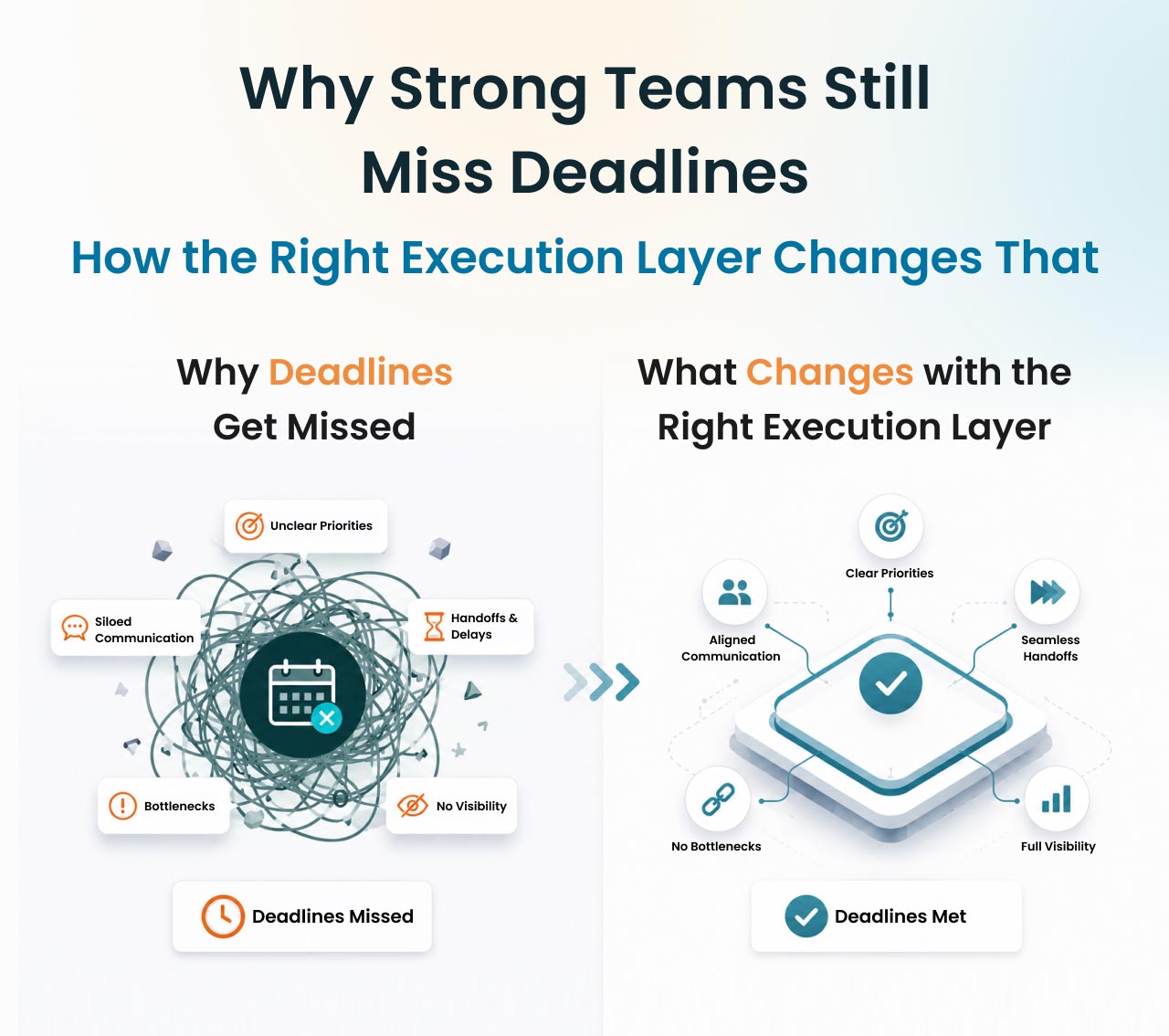
Execution Layer

Why Strong Delivery Requires Systems, Not Individual Heroics

Every agency has a few people who “just know how to get things done.”

They remember the client context, chase the pending approval, explain the blocker, fix the last-minute issue, and somehow keep the project moving. Useful? Absolutely. Sustainable? Not really.

When delivery depends on individual heroics, the agency may look efficient from the outside, but internally, the system is fragile.

Reactive Delivery Looks Productive Until It Repeats

Reactive delivery usually feels normal in growing teams.

  • Someone escalates late.
  • Someone fixes the gap manually.
  • Someone works around the missing process.
  • Someone saves the deadline.

The problem is that every rescue teaches the system nothing. The same issue returns in another project, another client account, another sprint, another Monday morning meeting that could have been an email but somehow wasn’t.

That is why scalable delivery systems matter. They reduce the need for repeated rescue work by making ownership, handoffs, QA, approvals, and escalation clear before the deadline is already at risk.

Key People Should Lead the System, Not Carry It

Founder-dependent delivery is one of the quietest risks in growing agencies.

When every major decision, client concern, delivery delay, or quality issue needs founder involvement, growth becomes expensive. The founder may still be in control, but the business is not really scalable.

The same applies to delivery heads, senior account managers, tech leads, and project managers. If the work only moves because a few experienced people remember every detail, the agency is not running on a system. It is running on memory, goodwill, and mild panic.

Strong execution systems for agencies reduce this dependency. They help teams know:

  • who owns the next step,
  • where blockers should be raised,
  • when QA happens,
  • how approvals move,
  • which risks need escalation,
  • and what “done” actually means.

Predictable Delivery Comes From Execution Design

Predictable delivery is not luck. It is designed.

It comes from repeatable workflows, defined ownership, clean handoffs, visible dependencies, built-in QA, and delivery governance that works across multiple client projects.

For SaaS teams, this becomes equally important. Strong operational systems for SaaS teams help product, design, development, marketing, and client success move in one rhythm instead of operating like five smart teams trying to solve the same puzzle from different rooms.

This is where delivery process optimization becomes more than process improvement. It becomes a growth advantage.

The Right Support Layer Reduces Pressure Without Creating Noise

At a certain scale, agencies do not only need more capacity. They need a dependable execution layer that can absorb delivery pressure without disrupting client relationships or internal control.

This is where a structured partner like ZealousWeb fits naturally. Not as a loud external vendor sitting outside the system, but as a quiet execution layer that helps agencies convert plans into implementation, delivery consistency, ROI, and stronger client retention.

For agencies, that kind of support matters because it allows internal teams to stay focused on strategy, relationships, and growth while execution continues with structure behind the scenes.

The Real Shift

Strong delivery is not built by asking talented people to keep saving the day.

It is built by designing systems that make saving the day less necessary.

And once delivery no longer depends on individual heroics, the next shift becomes visible: agencies start seeing what the right execution layer actually changes inside growing teams.

What the Right Execution Layer Actually Changes Inside Growing Teams

Most agencies do not struggle because their teams lack talent. They struggle because growth increases execution pressure faster than internal systems can absorb it.

That is where a structured execution layer changes everything.

For growing agencies, ZealousWeb works as a quiet white-label partnership layer behind delivery, helping internal teams move projects forward without carrying every dependency, follow-up, approval, revision, and implementation detail themselves.

This is where real workflow optimization starts showing up:

  • Workflow clarity improves because ownership and handoffs become easier to manage.
  • Decisions move faster because blockers surface before timelines are affected.
  • Rework cycles are reduced because QA and implementation checks happen with structure.
  • Cross-functional coordination improves because execution no longer depends on scattered updates.
  • Delivery forecasting becomes steadier because timelines are supported by process, not assumptions.
  • Operational control increases without immediate hiring pressure.

That shift matters because scaling problems rarely begin with one dramatic failure. They begin with repeated operational friction: delayed approvals, dependency confusion, missing updates, reactive QA, overloaded project managers, and constant context-switching.

Over time, those small frictions become expensive.

Strong scalable agency operations need more than effort. They need a dependable execution management framework that keeps delivery moving while internal teams stay focused on strategy, client relationships, and growth.

That is the difference between simply adding resources and building real operational efficiency systems.

Because agencies do not need more chaos wrapped in another dashboard. They need delivery systems that create predictability.

And once delivery becomes predictable, agencies start discovering something more valuable: control without slowing growth.

How Mature Teams Turn Deadline Pressure Into Delivery Control

Operationally mature teams do not avoid pressure. They structure it better.

They know deadlines will move, clients will ask for changes, dependencies will appear, and priorities will shift. The difference is that mature teams do not let every shift become a delivery crisis.

They use predictable delivery systems that make ownership, escalation, QA, and visibility clear before the project starts slipping.

Here is what that looks like in practice:

What Mature Teams Build How It Improves Delivery Control
Structured delivery governance Keeps project decisions, priorities, and delivery rules clear across teams
Standardized execution frameworks Reduces guesswork by giving teams a repeatable way to move work forward
Clear escalation systems Helps blockers surface early instead of becoming last-minute emergencies
Defined ownership mapping Makes it clear who owns the next action, approval, handoff, or risk
Integrated QA and review cycles Prevents quality checks from becoming late-stage rework
Operational visibility across teams Gives leaders real-time clarity on where delivery is moving, stuck, or exposed
Scalable operations framework Allows agencies and SaaS teams to grow without rebuilding delivery from scratch every time


This is how strong agency workflow systems create operational maturity. They do not remove every problem. They make problems visible early enough to manage.

And once delivery governance becomes part of daily execution, the conversation changes from “Why is this delayed?” to “What needs to move next?”

Why the Right Execution Partner Creates More Than Additional Capacity

Most agencies reach a stage where adding more people stops solving the real problem.

The workload grows, the client expectations increase, and delivery pressure starts spreading across account managers, project leads, developers, designers, strategists, and QA teams at the same time. Naturally, the first instinct is to increase capacity.

But more capacity without operational alignment often creates more coordination overhead instead of more delivery control.

That is why the right execution partner should do more than “support delivery.” It should reduce execution friction, strengthen workflows, improve accountability, and help teams move work forward with less operational strain.

The real value of scalable delivery support is not simply task completion. It is creating a system where internal teams can stay focused on strategy, growth, client relationships, and decision-making while execution continues with structure behind the scenes.

For agencies, the better question is no longer:
“Do we need more people?”

It becomes:
“Do we have the right execution layer supporting the people we already have?”

Quick Checklist: Is Your Delivery Support Actually Reducing Pressure?

✅Ownership is clearly defined before execution begins

✅ Handoffs between teams follow a structured workflow

✅ QA checkpoints exist before final delivery stages

✅ Blockers are escalated early, not discovered late

✅ Teams spend less time chasing updates manually

✅ Delivery timelines remain stable as client volume increases

✅ Internal leaders are not involved in every small delivery dependency

✅ Execution support improves workflow clarity instead of adding more communication noise

✅ Teams can scale output without constantly increasing operational stress

✅ Client experience remains consistent even during high delivery periods

If several of these points still depend on manual follow-ups, individual heroics, or constant internal coordination, the issue may not be capacity. It may be the absence of a strong execution system supporting delivery at scale.

Conclusion

Strong teams can carry pressure, but they should not become the system.

When delivery depends on memory, manual follow-ups, late escalations, and a few people constantly saving the day, growth starts becoming expensive in ways agencies do not always see immediately. Deadlines slip. QA becomes reactive. Client confidence gets tested. Internal teams stay busy, but not always in the places that create the most value.

That is why predictable delivery is not built by adding more pressure. It is built by fixing the execution layer around the team.

For agencies and SaaS teams, this is where ZealousWeb fits in, not as another vendor to manage, but as a structured execution partner that helps convert plans into implementation, delivery consistency, ROI, and long-term client retention. The goal is simple: reduce operational friction so internal teams can stay focused on strategy, relationships, and growth while delivery keeps moving with clarity.

Because strong teams do not need more chaos dressed as capacity. They need systems that help them scale without carrying everything alone.

Keep the Strategy. Offload the Delivery Pressure.

Partner With ZealousWeb


FAQs

Related Blog Posts

delivery workflow mapping for agencies

Why Delivery Frameworks Fail in Daily Work and How the Right Execution Partner Helps Map the Fix

May 11, 2026
Agency OperationsAgency Workflow MappingDelivery ManagementExecution Systems
agency operating systems

Why Most Delivery Frameworks Collapse in Real Operations: AI-Driven Solutions for Agency Growth

May 08, 2026
Agency GrowthDelivery DisciplineExecution SystemsOperational Maturity
agency operating systems

Systems Don’t Work Until They Shape Daily Behavior

May 06, 2026
Agency GrowthDelivery DisciplineExecution SystemsOperational Maturity
actionable workflows for agencies

Optimizing Processes: Turning Them Into Actionable Workflows Across Teams

May 04, 2026
Agency OperationsDelivery SystemsProcess ImprovementWorkflow Optimization
ZealousWeb

After 90 Days: Common Questions on System Assessment Follow-Through

April 28, 2026
Agency SupportExecution ImprovementSaaS GrowthSystem Assessment
operational chaos in agencies

The Growth Blueprint: A Practical Guide for Building Scalable Systems

April 27, 2026
Agency GrowthAgency OperationsDelivery Managementscalable systems
ZealousWeb

Building Strong Foundations: The 90-Day System Stabilization Plan

April 27, 2026
Agency GrowthDelivery ManagementExecution SystemsOperational Control
How Strategic Partnerships Bring Structured Processes That Fuel Scalable Growth for Agencies - Google Docs

How Strategic Partnerships Bring Structured Processes That Fuel Scalable Growth for Agencies

April 20, 2026
Agency GrowthBusiness DevelopmentStrategic PartnershipsWhite-label Partnerships
Agency Scaling and Systems

Why Agencies Struggle with Scaling: How Strategic Partnerships Can Solve Growth Challenges

April 17, 2026
Agency GrowthAgency OperationsBusiness SystemsScaling Challenges