
Fraud Blocker
White-Label Agency Partner

White-Label Partner vs. White-Label Service: How Each Impacts Growth, Margins, and Delivery

October 14, 2026Posted By: Jalpa Gajjar
Agency Profit MarginsDigital Agency GrowthSEO and GEOwhite-label agency

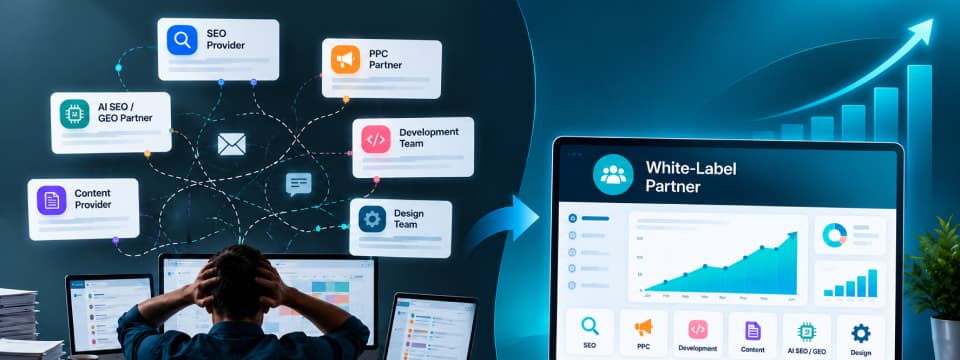
White-label services are supposed to make agency life easier. And they do-until SEO is with one provider, PPC with another, development somewhere else, and your newest AI SEO or GEO partner is waiting on three people before they can even start.

Suddenly, “flexible outsourcing” starts looking a lot like a second operations team you never meant to build.

The issue is not that individual white-label services are a bad idea. Most of them solve exactly what they are supposed to solve. The trouble starts when the agency has to connect all of them-different timelines, reporting styles, QA standards, communication threads, and a growing pile of non-billable coordination.

That matters because margins are already under pressure. Promethean Research found that the average digital agency earned a 13% after-tax net margin in 2025,while agencies with 50+ employees averaged just 8%.

At the same time, client expectations are expanding into AI SEO, AEO, GEO, AI Overviews, LLM citations, automation, and broader digital execution. A research study suggests that about one-third of agencies had already implemented AI across their businesses, with another 28% actively implementing it.

So the real question is not whether white-label services work. It is whether managing more of them separately is still helping your agency scale-or just creating more work around the work.

Should I Buy a One-Off Outsourced Service, or Do I Need an Ongoing Partner Agency to Help Me Scale?

If you need one clearly defined capability, overflow support, or a short-term delivery fix, a one-off white-label service can make perfect sense.

But once your clients need connected support across SEO, PPC, development, content, AI SEO, AEO, GEO, automation, and AI visibility, an ongoing white-label agency partner usually gives you more leverage. Instead of coordinating multiple providers, processes, deadlines, and QA standards, you work through one delivery relationship that can flex with client demand.

Why Buying More White-Label Services Does Not Always Mean You Are Scaling

Here is where agencies often get caught.

A client asks for PPC, so you bring in a white-label PPC provider. Another wants development, so you find a dev partner. Then social media, SEO, AI SEO, AEO, GEO, automation-and suddenly you are not just managing clients anymore. You are managing the people who are managing the work.

That is not necessarily scale. Sometimes it is just a more complicated way of staying busy.

  • More revenue, more leakage: A broader service mix can grow account value, but every extra handoff adds project management, QA, follow-ups, and time your team may not be billing for.
  • More vendors, more chasing: Different providers work differently. One needs Slack. Another lives in email. One sends reports on Friday. Another needs three reminders. Your account manager ends up becoming the person connecting all the dots.
  • More services, more dependencies: SEO may need dev support. GEO may need content changes. Paid media may need landing pages. Once services overlap, delays in one place start affecting delivery somewhere else.
  • More growth, less control: If every new client means another external provider, workflow, and reporting layer, revenue may be growing while delivery becomes harder to manage.

The better setup is usually not “find another provider.” It is having one partner that can absorb more of the delivery across services, fit into your workflow, and reduce the coordination your team has to carry. And if you are looking to grow existing client accounts without building every capability in-house , a broader white-label partner can give you a much cleaner path to expansion.
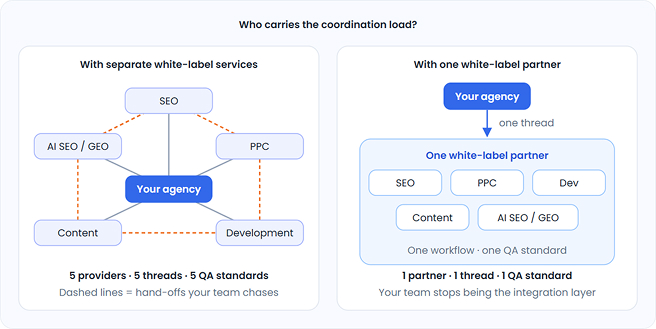
Delivery Coordination

White-Label Service vs. White-Label Partner: Where the Business Difference Starts

A white-label service can be exactly what an agency needs when the requirement is clear and contained. Need PPC support? Great. Need landing page development? Easy enough. Need overflow SEO work for a month? That model works.

The problem starts when client scopes stop being neat.

SEO needs dev support. GEO needs content changes. Paid media needs landing pages. AI SEO needs technical fixes, schema, tracking, and reporting. Now your team is not just managing the client. It is managing the gaps between providers.

That is where the difference between a service and a partner starts affecting the business.

Business Question White-label Service White-label Partner
Who connects the moving parts? Your team usually coordinates the timelines, dependencies, QA, and follow-ups The partner takes more responsibility for coordinating delivery across connected services.
What happens when the scope ends? You may need another provider, another process, and another hand-off Additional capabilities can often be added within the same delivery relationship.
Where does the non-billable time go? Into vendor coordination, status chasing, rework, and translating between teams More of that operational effort is absorbed within the partner setup.
How predictable are margins? Clear service fees can still hide margin loss in management time. Costs, capacity, and delivery are easier to view together, which makes margin planning more realistic.
What happens under deadline pressure? Multiple providers can mean multiple bottlenecks, especially when one task depends on another. One coordinated team can move connected work faster because fewer handoffs sit between tasks.
How does growth feel internally? More client work can mean more providers, more processes, and more people to manage. More work can be absorbed through the same operating relationship without rebuilding the backend every time.


The important part is this: a white-label service is transactional by design. A white-label partner becomes operational. One helps you deliver a task. The other reduces the friction around delivery itself.

For more practical insight into why clarity matters more than simply adding another AI tool, explore Businesses Don’t Need More AI Tools. They Need More Clarity .

And once an agency is juggling SEO, PPC, development, AI SEO, AEO, GEO, automation, and reporting across the same client base, that difference stops being theoretical. It starts showing up in billability, margins, deadlines, and how much time your account managers spend actually managing accounts instead of managing everyone behind them. That is usually the point where a broader partner model starts making more commercial sense.

The Margin Question: What Happens After the Service Fee?

This is where the math can look better than the reality.

Say you sell a bundled SEO + GEO engagement for $6,000/month and pay $3,000 for fulfillment. On paper, that leaves a healthy $3,000 spread.

Then the account needs six hours of management, three hours of QA and revisions, two hours coordinating dev or content, and another hour fixing a missed handoff or reporting issue. If you value agency time at around $175/hour, that is roughly $2,100 in additional delivery overhead before tools, leadership time, sales cost, or taxes enter the picture.

The research reports suggests that 29% of agencies charge between $175 and $199 per hour, which makes that a realistic benchmark for what internal coordination time can be worth.

Now the question is not:

“Which provider gave you the cheapest quote?”

It is:

“After your team manages the work from brief to client sign-off, what margin is actually left?”

That is where agencies often lose money without realizing it.

  • Non-billable coordination: status chasing, handoffs, and translating between providers all consume time your client may never see.
  • QA and rework: the cheaper the service looks, the more expensive it becomes if your team has to fix it before it is client-ready.
  • Vendor management: separate providers for SEO, PPC, development, AI SEO, AEO, and GEO can turn your account team into a permanent coordination layer.
  • Deadline slippage: one delayed dependency can hold up another service, another report, and eventually the client conversation.
  • Tool overlap: different providers often bring their own reporting, automation, or SEO platforms, which can create duplicated cost and fragmented data.

A research study found that agencies tracking project profitability averaged about 35% project margins, while average after-tax net margin was only 13% in 2025. That gap is where overhead, utilization, management time, and delivery complexity start to matter.

The takeaway is simple: the lowest service fee does not always create the highest agency margin. Sometimes the more expensive option is the one that needs the most supervision.

Why Utilization Changes the White-Label Math

This is where fixed capacity gets expensive.

Your SEO specialist may be fully booked this month and 60% utilized next month. Your GEO specialist may be essential for one launch, then barely touched for six weeks. Payroll does not care. It arrives on schedule anyway.

Parakeeto puts healthy agency-wide annual utilization around 50-60%, while delivery specialists typically need much higher utilization to support healthy margins.

What Agencies Need to Watch Fixed Internal Capacity Flexible White-label Partner
Billable time You pay for the role whether client work fills the week or not. Capacity can follow active client demand more closely.
Bench cost Gaps between projects become paid idle time. Less exposure to carrying specialist capacity between engagements.
Hiring time You may hire before enough recurring revenue exists to support the role. Add capability after demand appears, not six months before it proves itself.
Demand swings SEO, AEO, GEO, AI automation, or AI visibility work rarely arrive in equal volume every month. Different specialists can be brought in according to the account mix.
Specialist use One highly paid specialist may only be relevant to part of your client base. Use the expertise where it can actually be billed.
Cost vs. Revenue Delivery cost stays fixed while client revenue moves. Cost can stay more closely aligned with the work being sold.


That is why utilization changes the outsourcing math. A full-time hire can absolutely make sense when demand is steady enough to keep that person productive and billable.

But when demand moves between SEO, AI SEO, AEO, GEO, AI Overviews, automation, and technical work, flexible access to the right capability can be financially stronger than paying to keep every specialty permanently on standby.
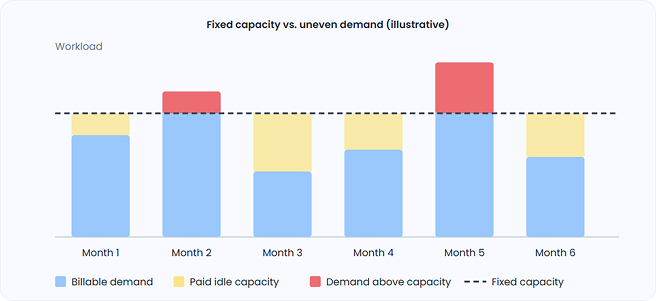
Why Utilization Changes the White-Label Math

AI SEO, AEO, and GEO Make the Partner Model More Relevant

This is where the old “one service, one provider” model starts getting awkward.

A client may ask for AI SEO, but the work rarely stays inside one lane. Improving visibility in AI Overviews or LLM-generated answers can involve technical SEO, structured data, entity clarity, content restructuring, long-tail conversational queries, People Also Ask coverage, citation tracking, and AI visibility reporting.

Google’s own Search Central documentation makes the overlap clear: AI features sit within the broader Search appearance ecosystem, and Google continues to rely on the same core foundations-crawlability, content quality, structured data, and machine-readable context-to understand and surface information.

That creates a very different delivery reality for agencies:

  • SEO connects to everything: Technical health, content structure, schema, and topical depth all influence how clearly a brand can be understood across search and AI experiences.
  • AEO and GEO need more than copy: Clear answers matter, but so do structured data, crawlability, entity signals, and supporting technical work.
  • AI visibility needs tracking: Clients increasingly want to know where they are cited, mentioned, or missing across AI Overviews, ChatGPT, Gemini, and Perplexity.
  • Automation needs context: AI automation can speed up reporting, monitoring, and workflows, but only if it is connected to the actual search strategy.
  • More specialists mean more handoffs: If each capability sits with a different provider, the agency becomes the integration layer whether it planned to or not.

That is why the partner model becomes more relevant as AI search expands. The challenge is no longer finding someone who can “do GEO.” It is getting SEO, content, technical work, data, and AI visibility to move in the same direction without turning your account team into traffic control.
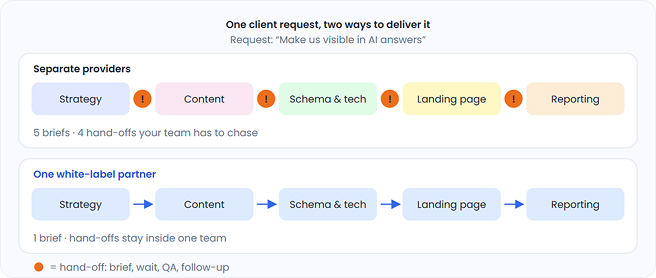
White-Label Workflow

When Multiple White-Label Services Become Costly to Manage

It usually looks harmless at first. SEO here, PPC there, development somewhere else, social with another team, and now AI SEO, AEO, or GEO gets added to the mix.

Individually, every service may look affordable. The expensive part is the agency time spent holding the whole setup together.

What Starts Happening What It Really Costs the Agency
Too many handoffs SEO needs dev support, GEO needs content changes, paid media needs a landing page update. Your team becomes the person making sure everyone actually talks to everyone.
Different workflows One provider wants Slack, another wants email, another has its own portal. Suddenly “outsourcing” comes with a small admin department attached.
More non-billable time Follow-ups, clarifications, QA, status checks, and rework all take time that usually does not appear neatly on the client invoice.
Inconsistent QA Every provider has a different version of “done,” so your internal team often becomes the final quality-control layer.
More deadline risk One delayed task can hold up content, development, reporting, or campaign launch dates downstream.
Messier reporting Different formats, metrics, and update cycles make it harder to give clients one clear story about performance.


That is where the math changes.

The services may still be reasonably priced, but managing all of them together can become expensive, slow, and surprisingly messy.

A broader white-label partner reduces the number of moving parts your team has to coordinate. Fewer handoffs, fewer status chases, and fewer “who owns this?” moments usually mean better control over deadlines, delivery, and ultimately, margin.

Where a White-Label Agency Partner Creates More Business Value

The value of a white-label partner starts showing up when the agency stops looking at fulfillment as a list of tasks and starts looking at how much revenue the delivery model can support without adding the same amount of cost, coordination, and headcount.

  • Better billability: Your senior team should be spending time on strategy, client growth, and work you can actually bill-not chasing SEO updates, checking whether the landing page is ready, or figuring out who owns the GEO changes.
  • Healthier margins: One coordinated delivery setup can reduce the little costs that rarely appear in the original quote: duplicated QA, rework, project-management hours, missed handoffs, and internal troubleshooting.
  • Capacity without the payroll gamble: A new AI SEO, AEO, GEO, PPC, or development opportunity should not automatically trigger another hiring decision. A broader partner gives you capacity when the revenue is there rather than months before it arrives.
  • More room to grow accounts: When a client asks for AI Overviews optimization, automation, technical SEO, paid media, or development, you already have somewhere to take the work. Cross-selling becomes a delivery conversation, not another vendor search.
  • More consistent delivery: One operating rhythm means fewer interpretations of “urgent,” fewer reporting formats, and fewer QA standards for your account team to police.
  • Less operational drag: When one partner can handle more of the backend, account managers spend less time managing fulfillment and more time protecting retention, spotting opportunities, and growing the account.

The real advantage is not that a partner can do “more services.” It is that more of your agency can stay focused on revenue while less time disappears into managing how the work gets done.

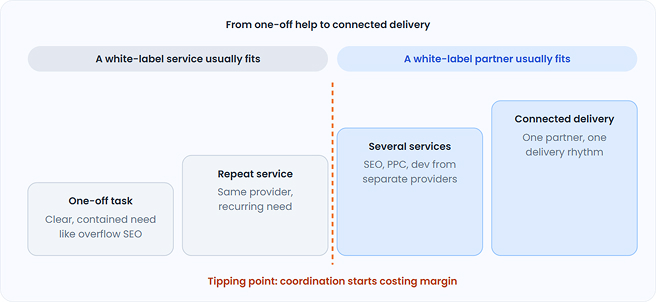
When It Is Time to Move From White-Label Services to a White-Label Partner

You usually know the setup is getting stretched before anyone officially says it.

The signs show up in missed handoffs, too many provider calls, account managers chasing updates, and margins that looked much healthier before the month actually happened.
White-Label Partner Model

What Are You Seeing What It Usually Means
Too many providers Your agency is spending more time coordinating fulfillment than managing client growth.
Clients wants bundled services SEO, PPC, development, AI SEO, AEO, and GEO are starting to overlap, but your delivery model is still split across different teams.
Coordination is eating time Your internal team has quietly become the integration layer between providers. Glamorous work, obviously.
Margins shrink after overhead The service pricing looks fine until QA, rework, meetings, and management hours are added back in.
Deadlines keep getting tighter Too many dependencies across separate providers are making delivery harder to control.
You are turning down work Demand exists, but your current setup cannot absorb it without another hiring or vendor search cycle.
AI search work crosses boundaries AEO, GEO, AI SEO, content, schema, automation, and technical work are no longer neat standalone services.
You are hiring before your revenues are steady Capacity planning is starting to outrun predictable client demand.


That is usually the point where another white-label service is not really the answer.

A broader white-label partner starts making more sense when the problem is no longer “Who can do this task?” and becomes “How do we make the whole delivery setup easier to scale?”

Where ZealousWeb Adds Value Beyond a Single White-Label Service

Sometimes you need one service. We are perfectly happy to help with that.

But the bigger value of working with ZealousWeb shows up when your clients stop asking for neat, isolated deliverables. SEO needs development. PPC needs landing pages. AI SEO needs technical fixes. AEO and GEO need content, entity optimization, structured data, AI visibility tracking, and sometimes automation behind the scenes.

Instead of adding another provider every time the scope expands, agencies can use ZealousWeb as a broader delivery partner across:

  • SEO, AI SEO, AEO & GEO: From traditional search and People Also Ask opportunities to AI Overviews, LLM citations, long-tail conversational queries, and visibility across generative search.
  • PPC, Content & Creative Support: Keep campaigns, landing pages, content, and optimization moving without coordinating separate teams for every dependency.
  • Development & Technical Execution: When SEO, GEO, analytics, schema, or campaign work needs implementation, the technical team is already part of the delivery setup.
  • AI Automation & Reporting: Connect repetitive workflows, reporting, monitoring, and AI visibility processes instead of adding yet another standalone tool and hoping everyone remembers how it fits.
  • Flexible Delivery Capacity: Add support when accounts grow, new services are sold, or deadlines tighten without rebuilding the team every time.
  • White-Label by Design: Your clients remain your clients. We work behind your agency brand, align with your processes, and support delivery without competing for the relationship.

That is the difference we want agencies to feel. You can come to ZealousWeb for one white-label service, but you do not have to start another vendor search when the client asks for the next one.

As the relationship grows, we can become the delivery layer behind more of your agency-helping you keep execution connected, costs easier to control, and growth a little less dependent on how many new people you can hire or providers you can manage.

Conclusion

White-label services will always have a place. Sometimes you need one skill, one project, or one extra pair of hands-and that is enough.

But once your agency is managing SEO, PPC, development, content, AI SEO, AEO, GEO, automation, and increasingly connected client expectations, the question changes. It is no longer simply, “Who can deliver this service?” It becomes, “How do we deliver more without adding the same amount of cost, coordination, and operational pressure?”

That is where ZealousWeb brings broader value.

We can support a single white-label requirement when that is what you need. But as your accounts grow, we can also work as the delivery partner behind more of your agency-bringing together cross-functional expertise, flexible capacity, white-label execution, and processes that fit around the way your team already works.

Your clients stay yours. Your agency keeps the strategy, relationship, and commercial opportunity. Our team helps make the delivery behind it easier to scale.

Because the real value of a white-label partner is not simply doing more work for you. It is helping you take on more work without making the business harder to run.

Expand Your Services Without Expanding Your Overheads

Book a Partner Call

Agency Growth Strategy

FAQs

Related Blog Posts

CRO model for digital agencies

From Project Revenue to Recurring Value: A Practical CRO Model for Digital Agencies

September 17, 2026
CRODigital AgenciesRecurring RevenueWebsite Optimization
Branding Services Cost Guide

How Much Do Branding Services Cost in 2026? Pricing, Packages, and ROI

September 17, 2026
Brand ROIBrand StrategyBranding CostsBranding Services
Digital Agency CRM Automation

The Lead Came In. What Happens Next? A CRM & Automation Guide for Digital Agencies

September 16, 2026
CRM AutomationDigital AgenciesLead ManagementMarketing Automation
AI Website Personalization for Agencies

What AI Website Personalization Could Actually Look Like for Your Agency’s Clients

September 16, 2026
AI PersonalizationConversion OptimizationDigital AgenciesWebsite Personalization
White-label analytics support for agencies

Why Good Campaigns Still Underperform: The Conversion Gap Agencies Can Help Fix

September 16, 2026
Conversion OptimizationCRODigital Marketing AgenciesLanding Page Optimization
Grow Existing Client Accounts

How Digital Agencies Can Grow Existing Client Accounts Without Building Every Capability In-House

September 16, 2026
Agency PartnershipsClient Account GrowthDigital AgenciesWhite-Label Services
performance marketing budget allocation

Which Performance Marketing Channel Deserves More of Your Budget?

September 10, 2026
Digital MarketingMarketing BudgetPaid MediaPerformance Marketing
Cheap Leads in Lead Generation

Why Cheap Leads Can Become Your Most Expensive Lead Generation Mistake

September 09, 2026
Google AdsLead GenerationLead QualityPerformance Marketing