
ZealousWeb
agency execution system

Team Execution Clarity for Agencies: A Use Case in Removing Founder Dependence from Daily Operations

June 15, 2026Posted By: Jalpa Gajjar
Agency GrowthAgency ManagementExecution ClarityFounder Dependence

You didn’t build a bottleneck. You built an agency.

But somewhere between your third client and your thirtieth, something shifted. The team grew. The revenue grew. And yet every morning still starts the same way — a queue of decisions, approvals, and escalations that only you can apparently resolve. A brief that needs your eyes. A client call that needs your voice. A campaign that’s sitting still because nobody wants to move without your sign-off.

Your team isn’t incompetent. They’re waiting. And the reason they’re waiting is that your agency never gave them anything else to do.

That’s founder dependence — and it’s the most expensive operating problem a growing digital agency can have. Not because it burns you out, though it does. But because it puts a hard ceiling on everything: delivery capacity, client retention, team growth, and your ability to win bigger work without immediately becoming responsible for all of it.

Team execution clarity is what breaks that ceiling. It’s the shift from an agency that runs on the founder’s judgment to one that runs on defined ownership, documented systems, and a team that knows exactly what good looks like — without asking you.

The agencies that solve this don’t announce a restructure. They don’t hire a COO or run a team offsite. They quietly build one thing an execution layer that works whether they’re in the room or not. What that looks like, how it’s built, and what it changes — that’s exactly what this piece breaks down.

Your Agency Needs Your Vision Not Your Sign-Off on Everything

Founder dependence in a digital agency occurs when the founder is the primary decision point for daily operations — approvals, client communication, delivery oversight, and quality control — creating a bottleneck that limits team autonomy, delivery speed, and sustainable growth.

That definition sounds clean on paper. Inside a live agency, it looks like this: your team lead messages you at 2 pm asking which CTA to use on a landing page. Your account manager CC’s you on every client email because the client “prefers founder involvement.” Your senior designer won’t push a deliverable to the client without your final look. And your Friday — the one you planned to spend on business development — disappears into a queue of decisions that, individually, take five minutes each and collectively consume your entire capacity to lead.

None of it feels like a crisis. That’s exactly why it compounds.

📊 Reality Check Gallup found only 23% of employees can make decisions autonomously — in agencies without an execution system, that number is even lower. The operating model never gave them the authority to begin with.

💡 The Hidden Cost Most Founders Never Calculate At just 2 hours daily on decisions your team should own, you’re losing 480 hours a year — 60 full working days — to a problem a properly built execution system would eliminate.

What Is Founder Dependence in an Agency?

Founder dependence is a structural condition — not a leadership style. It develops when an agency scales its client base and team headcount without building a parallel execution system. The founder fills every gap informally, and over time that informal gap-filling becomes the operating model.

It’s not that the founder is controlling. It’s that the agency never built anything else to rely on.

This distinction matters because most founders try to fix founder dependence by delegating harder — pushing decisions to the team and hoping accountability follows. It rarely does. Without a defined execution system, delegation without structure just creates confusion, inconsistency, and — eventually — more escalations back to the founder than before.

The real fix isn’t behavioral. It’s architectural.

Signs Your Agency Is Founder Dependent

Founder dependence rarely announces itself. It builds gradually, disguised as involvement, quality standards, and client relationship management. By the time it’s visible, it’s already expensive.

These are the seven signals worth paying attention to:

✅ FOUNDER DEPENDENCE DIAGNOSTIC How many of these are true in your agency right now?

Your team waits before moving. Briefs sit. Deliverables pause. Campaigns stall. Not because the team doesn’t know how — but because the unspoken standard is founder review before anything goes out.

Clients expect you on every call. When clients start treating your personal involvement as part of the service, the agency has accidentally positioned the founder as a deliverable — not the team.

Quality is defined by your taste, not a documented standard. There’s no QA framework, no defined output benchmark. “Good” means whatever you’d approve that day. The team knows this — so they keep asking.

Hiring doesn’t reduce your workload. Every new team member adds delivery capacity but not decision capacity. The work gets done faster, but approvals still queue at the same point — you.

You’re the only one who holds the full picture. Client history, account context, strategic direction — it lives in your head. Your team executes tasks. They don’t have the context needed to make independent decisions.

Escalations always find their way back to you. Your team has a hierarchy on paper. In practice, every real problem — client pushback, missed deadline, scope question — routes back to you because there’s no documented framework for handling it otherwise.

You can’t take a week off without things slowing down. This is the clearest signal. An agency with team-level execution clarity runs at full capacity regardless of founder availability. If yours doesn’t — the operating system isn’t built yet.

Score: If 3 or more of these are true, your agency has a founder dependence problem — not a people problem

None of these signals mean the team is failing. They mean the agency is running on founder instinct instead of a defined execution layer — and that gap quietly caps everything: revenue ceiling, team growth, client retention, and the founder’s ability to lead at the level the business actually needs.

The question isn’t whether founder dependence exists in your agency. For most agencies between $500K and $5M, it does. The question is how much it’s costing — and what replacing it actually looks like.

That’s what the next section breaks down.

Founder Dependence Isn't a Leadership Problem - It's a Systems Gap

Most founders arrive at this realisation the same way — not through a strategic review, but through a breaking point. A key client churns while the founder was stretched thin. A senior hire leaves frustrated after six months of waiting for authority that never arrived. A quarter of strong revenue produces zero breathing room because every pound of growth added weight to the same single point of failure — the founder.

The problem was never capability. The team was capable. The problem was architecture. The agency scaled its client base and headcount without ever building the operating infrastructure to support them. And in the absence of that infrastructure, the founder filled every gap — informally, repeatedly, invisibly — until filling gaps became the job.

📊 The Number That Explains Everything EOS — used by over 200,000 businesses globally — identifies the absence of a documented operating system as the primary reason businesses stall between $1M and $10M. The team didn’t fail. The operating layer was never built.
What Is Execution Clarity in Agency Management?

Execution clarity in agency management is the operating condition where every team member knows what they own, how decisions get made, what good output looks like, and what to do when something breaks — without needing to ask the founder.

It is not a project management tool. It is not a weekly standup. It is not a Notion workspace full of SOPs that nobody reads. Execution clarity is an operating condition the result of deliberately building three things inside the agency at once: defined ownership, decision frameworks, and documented output standards.

When these three things exist together, something measurable changes. Delivery speed increases. Escalations drop. Client relationships stabilise. And the founder stops being the ceiling.

What Breaks First When There's No Execution Clarity

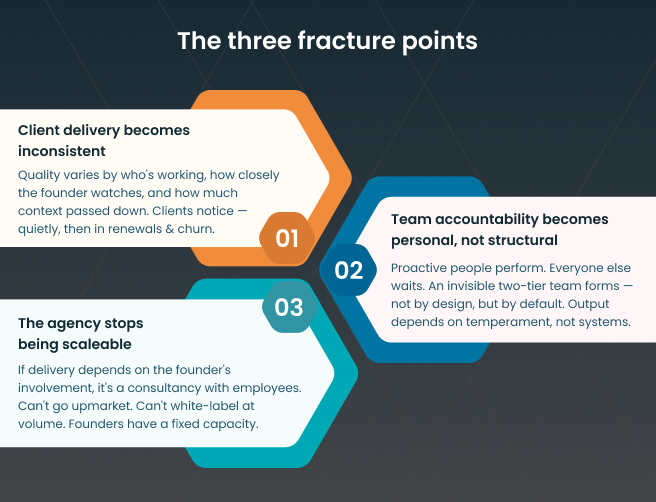
When execution clarity is absent, the agency doesn’t collapse — it compensates. And the compensating mechanism is always the same: the founder absorbs what the system should be handling. This works until it doesn’t. Three fracture points surface first, and they always arrive in the same order.

agency execution challenges

📊 FOUNDER-dependent Agency Vs Execution Clarity Agency

Operating Dimension Founder-dependency Agency Execution Clarity Agency
Decision Making Routes to founder by default — even routine approvals Defined decision rights at every level; founder handles strategic decisions only
Delivery Quality Varies by founder availability and involvement Consistent output against documented standards regardless of who delivers
Client Relationships Founder is the relationship — team executes tasks Team owns accounts; founder provides strategic direction
Team Accountability Personality-driven; strongest individuals carry the load Structural; ownership defined, not assumed
Scalability Capped by founder capacity Scales with team, systems, and white-label execution partners


The agencies that break through this ceiling don’t do it by working harder or hiring more. They do it by building what was missing the whole time — a defined execution layer the team can operate within, independently and consistently.

What that layer produces when it’s actually built — that’s what the next section walks through.

What Happens When Your Team Executes Without You in the Room

Understanding founder dependence as a concept is one thing. Seeing what the shift actually looks like inside a live agency operationally, commercially, and for the team is what makes it real. What follows is a composite use case drawn from the operating patterns of digital agencies between $800K and $2.5M in annual revenue. Names are anonymised. The conditions, interventions, and outcomes reflect patterns that repeat consistently across founder-led agencies at this growth stage.

Meet Priya. Founder of a twelve-person performance marketing agency. Solid client base. Growing revenue. And she hasn’t taken a proper week off in three years — not because she doesn’t want to, but because the last time she tried, three client escalations landed in her inbox by Wednesday, a campaign went live with the wrong targeting parameters, and her most senior account manager called on Saturday to ask whether to approve a creative revision.

Priya isn’t a micromanager. Her team isn’t incompetent. Her agency just never built the layer between her judgment and her team’s execution.

Before: The Founder-as-Hub Agency

Here is what Priya’s agency looked like operationally before execution clarity was built.

🔴 Before State- Agency Operating Snapshot 

Metric Before State
Team Size 12 people across delivery, accounts, and strategy
Annual Revenue $1.1M
Founder’s Daily Decision Load 15–20 approval touchpoints per day
Annual Delivery Turnaround 4.2 days per deliverable
Client Escalation Rate 6–8 per week reaching founder directly
Last Founder Holiday Taken 11 months ago — cut short on day 3
Team’s Biggest Frustration “We don’t know what we’re allowed to decide”
Founder’s biggest frustration “I’m the last to know when something goes wrong — and the first called to fix it”


Every morning started with Priya clearing a backlog of operational decisions. Which headline version to use. Whether to push a deliverable that was 90% there. Whether a client’s revision request fell inside or outside scope. Whether the new junior could handle a certain account unsupervised.

Her team wasn’t escalating because they were lazy. They were escalating because the agency had never told them where the escalation line was. Everything above “execute the task” was implicitly the founder’s territory. With twelve people generating work simultaneously, that territory consumed her entirely.

New business suffered. Not because leads weren’t coming in — but because Priya couldn’t give proposals the attention they needed. She was too deep in delivery to lead the agency at the level it needed. Two senior members who’d joined to grow into leadership roles were quietly interviewing elsewhere.

After: A Team Built on Execution Clarity

The shift didn’t start with a restructure. It started with one question Priya asked herself during a rare quiet Friday afternoon:

“If I wrote down every decision I made this week — how many actually needed me?”

The answer was uncomfortable. Of the 73 decisions she’d touched that week, fewer than 15 genuinely required her judgment. The rest required context, standards, and authority — none of which her team had been given in documented form. That became the project. Not delegation. Not stepping back. Building the operating system her team needed to stop asking.

🟢 After State- Agency Operating Snapshot (90 days later)

Metric After State Change
Team Size 12 people No new hires
Annual Revenue Run Rate $1.4M +27%
Founder’s Daily Decision Load 4–5 strategic touchpoints +27%
Average Delivery Turnaround 2.6 days per deliverable -38%
Client Escalation Rate 1–2 per week reaching founder -75%
Founder Holiday Taken 8 days uninterrupted First full break in 3 years
Team’s Biggest Change “We know what we own now.”
Founder’s biggest change “I’m leading the business again”


The revenue increase didn’t come from new clients. It came from capacity. With Priya out of the daily delivery loop, she had bandwidth to close two accounts she’d been nurturing for months. The team delivered them without her in every meeting. Both senior members who had been interviewing elsewhere stayed — one was promoted into a delivery lead role with a defined scope of authority, the other took full ownership of a client pod.

The Transformation in Practice: What Actually Changed

The shift from before to after wasn’t a personnel change or a tool upgrade. It was three operational decisions made in sequence over 90 days.

📋 The 90-Day Transformation Timeline

  • Weeks 1–2 — Decision Audit: Every decision routed to the founder over two weeks was logged, categorised, and assessed. Does this actually need the founder? Could a documented standard handle it? Is this an escalation because there’s no other path?

Output: A map of exactly where the operating system was missing.

  • Weeks 3–5 — Ownership Architecture: Every function, every client account, every recurring deliverable type was assigned a named owner — not a task executor, but an outcome owner with defined authority to make calls within their scope.

Output: A one-page ownership map the whole team could see and reference.

  • Weeks 6–8 — Standards Documentation The implicit quality standards living in the founder’s head were made explicit. What does a complete brief look like? What does a client-ready deliverable require? What’s the QA checklist before anything goes out?

Output: Documented standards that replaced founder taste with team-accessible benchmarks.

  • Weeks 9–12 — Escalation Framework: A decision rights matrix was built: what the team handles independently, what goes to a delivery lead, what reaches the founder. For the first time, escalation had a defined path — not a default route to the top.

Output: A decision framework that reduced founder touchpoints by 75% within 30 days of rollout.

The result wasn’t a founder who stepped back. It was a founder who finally had room to step forward — into the strategic, commercial, and leadership work the business actually needed. That operating shift has a framework. Building it is exactly what the next section covers.

Building the Execution Clarity Framework for Your Agency

An agency execution system is the combination of defined ownership, documented standards, decision frameworks, and delivery infrastructure that allows a team to operate at full capacity independently of founder availability.

This isn’t a single tool or a one-time overhaul. It’s three interconnected layers, each one building on the last. Miss one and the system doesn’t hold. Build all three and the agency operates as a system, not as an extension of the founder’s working hours.

Layer 1: Execution Systems — Agency SOPs for Client Delivery Without Founder Approval

The execution layer is the operational foundation. Without it, the other two layers have nothing to run on. This covers every repeatable function in the agency: how a brief gets written, how a deliverable gets reviewed, how a campaign goes live, how a client receives work. Every process that currently lives in the founder’s head becomes a documented, transferable standard.

The test for whether this layer is working: can a new senior hire read your SOPs and deliver client work to standard within their first two weeks — without asking the founder a single operational question? If not, the documentation isn’t finished yet.

Execution Systems Checklist

Client onboarding SOP: What happens in the first 30 days of every new engagement, who owns each step, what the client receives, and when

Brief and scope documentation standard: What a complete brief contains, who approves it, what happens when scope isn’t clear

Delivery QA framework: The checklist every deliverable passes through before it reaches the client — independent of founder review

Revision and feedback protocol: How client feedback is received, logged, actioned, and closed — with defined turnaround times at each stage

Escalation matrix: Three-tier team handles independently, delivery lead handles, founder is informed. Most issues belong in tiers one and two.

White-label delivery standards: If execution is partially outsourced, the standards governing external delivery must match internal standards exactly — no quality gap at the handoff point

Layer 2: Intelligence Systems — Replacing Instinct with Process Visibility

The reason founders stay in the loop isn’t always control. Often it’s because they’re the only ones with enough visibility to make informed decisions. They know which client is at risk. They know which campaign is underperforming. They know which team member is stretched. The team doesn’t have that visibility — not because they’re incapable of acting on it, but because the data was never surfaced to them in a usable form.

Intelligence systems fix that. They replace founder instinct with structured visibility that the whole team can access and act on — so decisions get made by the right person, with the right information, at the right time.

📊 Visibility Gaps vs Intelligence System Solutions

What Only the Founder Currently Knows  Intelligence System That Fixes It 
Which clients are unhappy Client health dashboard — sentiment, delivery timeliness, response rate, renewal proximity
Whether campaigns are on track Live performance reporting accessible to account leads, not just the founder
Who has capacity and who is stretched Resource allocation view updated in real time
Where quality issues are appearing QA scoring on every deliverable — tracked by team member, client, and deliverable type
What this specific client expects Documented client preferences captured at onboarding, accessible to anyone on the account

Layer 3: Leadership Systems — The Agency Delegation Framework That Holds Under Pressure

The first two layers handle operations and visibility. The third handles the decisions that don’t fit neatly into a checklist judgment calls, client relationship moments, and strategic choices that require real authority. Most agency delegation frameworks break down here. Not because the team lacks capability, but because authority was never clearly assigned. When a client pushes back on a proposal, who can negotiate? When a campaign significantly underperforms, who decides to pause it? Without a leadership system, every one of those moments defaults to the founder. With one, they route to the right person — with the right authority to handle them well.

📋 The Three-Tier Decision Rights Model


Tier Who Owns It What It Covers Founder Involvement
Tier 1 — Team Owns Completely Individual team members Routine delivery, day-to-day client communication, standard revisions, internal task allocation None required
Tier 2 — Lead Owns, Founder Informed Delivery leads and account leads Client relationship decisions within scope, account-level strategy, junior team performance, budget within approved parameters Notified, not consulted
Tier 3 — Founder Decision Founder only New business strategy, pricing architecture, senior hires and exits, partnerships, commercial agreements above defined thresholds Full involvement


The benchmark: In a well-built agency execution system, 80% of weekly decisions operate at Tier 1. 15% at Tier 2. 5% or fewer reach the founder.

How ZealousWeb Functions as the Execution Layer for Growing Agencies

Building all three layers simultaneously — while running client accounts and managing a live team — is where most agencies stall. Not because the framework is complicated. Because the capacity to build the system while operating inside it rarely exists without external support.

This is where ZealousWeb functions as an operating system partner rather than a service vendor. For agency clients, ZealousWeb doesn’t just deliver execution outputs. It plugs directly into the execution layer as a structured, standards-driven delivery partner that operates to documented benchmarks — without requiring founder oversight on every output.

📊 How Agencies Use ZealousWeb As An Execution Partner 

Agency Need ZealousWeb’s Role 
Consistent white-label delivery without founder QA Documented output standards matched to agency brand guidelines — delivered without revision loops
Scalable capacity without new headcount Embedded delivery team operating within the agency’s execution system — not alongside it
AI-powered reporting and visibility Intelligence systems that surface client and campaign data to account leads — reducing founder dependency on information relay
Execution without supervision A delivery partner that holds its own quality standards — freeing the founder from being the quality checkpoint

💡 What This Looks Like in Practice Agencies that partner with ZealousWeb as an execution layer typically reduce founder involvement in delivery operations by 60–70% within the first 90 days — not because the founder stepped back, but because the delivery infrastructure no longer requires them to step in.

The goal isn’t to remove the founder from the agency. It’s to remove the founder from the functions the operating system should be handling — so the founder can lead at the level the business actually needs.

Conclusion

You built something worth scaling. Now build the system that scales without you.

The agencies that break through the founder dependence ceiling share one thing. They stopped trying to fix a systems problem with a people solution — more hires, better delegation conversations, tighter project management. They built the operating layer that was missing.

Execution clarity isn’t about stepping back. It’s about building forward — a team that knows what it owns, a delivery system that holds its own standards, and a leadership structure where the founder’s judgment is reserved for decisions that actually need it.

Three layers. One operating system. The result isn’t just a less stressed founder. It’s an agency that takes on bigger clients, builds stronger teams, scales white-label delivery, and grows revenue without every new account adding directly to the founder’s workload.

That’s the shift. And it starts with one honest question:

How many of the decisions that landed on your desk this week actually needed you?

If the answer is most of them — the operating system isn’t built yet.

ZealousWeb works with digital and performance agencies to design and execute the three-layer execution system that removes founder dependence from daily operations — and replaces it with team-level execution clarity that scales.

If your agency is between $500K and $5M in revenue and founder dependence is the ceiling — let’s talk about building the operating system that removes it.

Ready to Lead Your Agency Instead of Operating It?

Schedule an Execution Strategy Call
founder leadership transition

FAQs

Related Blog Posts

Agency Operations

Why Strong Brands Fail Without Operational Clarity — And How to Fix It

June 03, 2026
Agency Operationsclient retentionDelivery ProcessOperational Clarity
Technical SEO Delivery

How Agencies Bring Predictability to Technical SEO Delivery Across Multi-Client Environments

June 02, 2026
SEO Agency GrowthSEO ImplementationTechnical SEOwhite-label SEO
agency scaling

How Agencies Turn Growth into Scale Without Overloading Their Internal Teams

May 28, 2026
Agency OperationsAgency Scalingdelivery systemDigital Agency Growth
delivery systems

Why Strong Teams Still Miss Deadlines and How the Right Execution Layer Changes That

May 20, 2026
delivery supportDelivery Systemsexecution layerscalable delivery systems
delivery workflow mapping for agencies

Why Delivery Frameworks Fail in Daily Work and How the Right Execution Partner Helps Map the Fix

May 11, 2026
Agency OperationsAgency Workflow MappingDelivery ManagementExecution Systems
agency operating systems

Why Most Delivery Frameworks Collapse in Real Operations: AI-Driven Solutions for Agency Growth

May 08, 2026
Agency GrowthDelivery DisciplineExecution SystemsOperational Maturity
agency operating systems

Systems Don’t Work Until They Shape Daily Behavior

May 06, 2026
Agency GrowthDelivery DisciplineExecution SystemsOperational Maturity
actionable workflows for agencies

Optimizing Processes: Turning Them Into Actionable Workflows Across Teams

May 04, 2026
Agency OperationsDelivery SystemsProcess ImprovementWorkflow Optimization
ZealousWeb

After 90 Days: Common Questions on System Assessment Follow-Through

April 28, 2026
Agency SupportExecution ImprovementSaaS GrowthSystem Assessment