

Something already changed. Most marketing teams just haven’t seen it in their dashboards yet — and by the time they do, a competitor will have already claimed the answer slot they should have owned.
How does answer engine optimization work in AI is not a question being asked out of curiosity anymore. It’s being asked in budget reviews where someone finally noticed organic traffic is flat despite rankings holding. The rankings are fine. The problem is that a growing share of searchers never reach the links.
When someone types “best CRM for remote teams” today, they don’t get ten links. They get a paragraph — synthesized, confident, pulled from two or three sources. If your brand isn’t in that paragraph, you didn’t lose a click. You lost the conversation. That’s not a 2027 scenario. That’s happening on queries your business depends on right now.
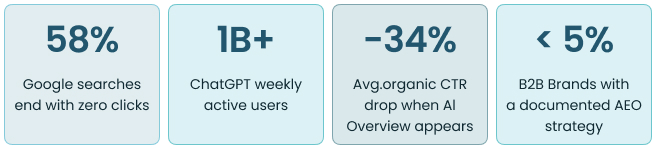
Google AI Overview is live at scale. ChatGPT crossed a billion weekly active users. Perplexity is the default research tool for a fast-growing slice of B2B buyers who have zero patience for scrolling ten links. The channel didn’t disappear — it restructured. And the brands still running a pure SEO playbook are losing ground they don’t even know they’re losing. How to optimize for AI engines is no longer a competitive edge — it’s the baseline for staying visible where your audience actually goes for answers.
Ranking on page one used to mean your business got found. In 2026 it means your business gets considered — only after the AI answer box has already told your audience what to think.
This isn’t a trend piece. It’s a working guide built by practitioners who architect top answer engine optimization strategies for agencies, brands, and SaaS companies — to show you exactly how AI engines decide what to cite, which answer engine optimization tools move the needle, and how to build an AEO system that compounds rather than chases every algorithm update.
What Is Answer Engine Optimization — And How It Is Aligned With SEO
Answer engine optimization is the discipline of structuring your content, schema, entity architecture, and authority signals so that AI-powered engines — Google AI Overview, ChatGPT, Perplexity, Gemini, Copilot — select your brand as a trusted citation source when generating responses to user queries. It’s not a rebrand of SEO. It’s a new layer that sits on top of it — and without it, your existing search investment is increasingly blind to where your audience is finding answers.
How Answer Engines Decide What to Surface — and Why the Logic Is Fundamentally Different from Google
Traditional search engines crawl, index, rank, and return a list. The user picks a link. That logic is linear — and it’s the logic two decades of SEO was built to serve. Answer engines don’t return a list. They generate a response. To do that, they retrieve candidate passages from their index, evaluate those passages for directness and credibility, check the trust level of the source, and synthesize a single answer. Your entire page doesn’t get evaluated — a specific passage does. If that passage isn’t structured for machine comprehension, the rest of your content is irrelevant to the outcome.
| . | ||||
| 01
Query Parsed AI engine identifies intent: informational, commercial, navigational, or conversational. |
02
Source Retrieval Candidate pages retrieved from index. Schema clarity and passage structure drive retrieval score. |
03
Passage Scoring Individual passages — not full pages — scored for directness, accuracy, and query alignment. |
04
Entity Trust Check Brand entity validated: Knowledge Graph, Wikidata, co-citation signals across the web. |
05
Answer Synthesized AI generates a response citing 1–3 sources. Structured, authoritative, schema-rich content wins. |
Key insight: Most brands fail at steps 02 and 03. Their content exists and ranks — but isn’t structured for passage-level retrieval. That is the gap best practices for answer engine optimization close
Why Ranking on Page One No Longer Means Your Business Gets Found
58% of Google searches now end without a click. That number isn’t driven by bad rankings — it’s driven by AI answer boxes, featured snippets, and knowledge panels that resolve the query before the user needs to go anywhere. Page-one rankings are still valuable. They contribute to the domain authority that answer engines use to evaluate source trustworthiness. But ranking without AEO means you’re building visibility in a channel your audience is using less — while leaving the channel they actually use entirely unoptimized.
| . | |
❌ Ranking Without AEO
|
✓ Ranking With AEO
|
What Changes for Your Business When Your Audience Stops Searching and Starts Asking
When a user searches, they’re navigating — they expect options. When a user asks an AI engine, they’re delegating — they expect a definitive answer. And they trust the source the AI cites with a credibility transfer that no blue link ever created. Being cited in an AI answer positions your brand as the expert who answered the question, not just a link that might have the answer. The downstream effect on brand recall, trust, and conversion is measurably different. Best answer engine optimization methods for AI visibility are built to capture exactly this trust transfer.
How AEO Is Aligned With SEO Practices
The most expensive framing error in 2026 is treating AEO and SEO as competing budget lines. They’re not. SEO builds the domain authority and topical depth that answer engines use to determine whether a source is worth citing. AEO builds the passage structure, schema layer, and entity architecture that converts that authority into actual citations. Run SEO without AEO and you rank in links a growing share of your audience never clicks. Run AEO without SEO and you have structured content with no authority behind it.
The brands that rank on Google and AI answers simultaneously aren’t running two separate strategies — they’re running one compounding system where every SEO action strengthens the AEO foundation and every AEO action extracts more value from existing SEO investment. That’s not a theory. It’s a structural reality visible in how AI engines evaluate sources at every stage of the retrieval process.
Here’s exactly how the two layers interact — and what each one contributes to the combined outcome:
| Layer | SEO Contribution | AEO Contribution | Combined Outcome |
| Authority | Domain authority via backlinks and trust signals | Entity authority via knowledge graph, co-citations | Sources trusted by AI engine at retrieval stage |
| Content | Topical depth, keyword coverage, internal linking | Answer-first structure, passage clarity, Q & A blocks | Page retrieval and passage selected for citation |
| Technical | Crawlability, Core Web Vitals, Indexation | Schema markup, llms.txt, AI crawler access | Accessible to both traditional and AI crawlers |
| Measurement | AI citation frequency, share of voice in AI SERPs | Full-funnel visibility across both search layers |
Every Day Without AEO Is Missed Opportunity
Check Your AI Presence Today
Why AEO Matters Right Now — And What Businesses Are Losing Every Day They Wait
The window for first-mover advantage in AEO is open. But it doesn’t stay open indefinitely. Entity authority compounds the same way domain authority did in 2010 — early movers build a trust foundation that becomes increasingly hard to displace once it solidifies. The brands that wait six months to start are not six months behind. The gap compounds.
How the Shift from Search Queries to Conversational Questions Changed the Rules Overnight
The shift didn’t announce itself. There was no algorithm update notification, no rank drop that tripped an alert. What happened was quieter and more structural: user behavior upstream of your website changed while your measurement infrastructure kept looking at downstream metrics. Conversational queries — “what is,” “how do I,” “which is better,” “should I” — now route heavily through AI engines. These are exactly the queries at the top and middle of every B2B and B2C funnel. If your brand isn’t in those answers, you’re not in the consideration set — regardless of what your rankings report says.
Who Is Already Winning AI Citations — and What They Did Differently from Everyone Else
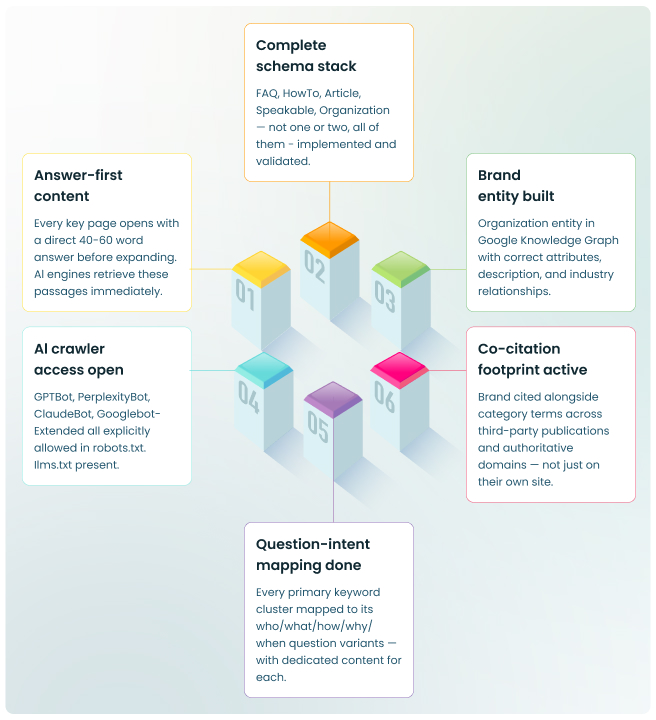
The brands showing up consistently in AI-generated answers share a pattern — and it’s not the highest domain authority or the biggest content teams. What they did differently is structural. They built the six things most brands haven’t touched yet:
Why the Businesses Acting Now Will Be the Hardest to Displace Later
AEO authority doesn’t reset quarterly like ad spend. It compounds. Every citation your brand earns reinforces the entity trust signal that makes the next citation more likely. Every structured page indexed by an AI crawler builds the passage library that increases retrieval probability for related queries. Every co-citation on a third-party domain adds a thread to the signal web that tells answer engines your brand is a reliable source on your topic. The businesses acting on best tips for answer engine optimization in AI right now are building a compounding asset. The businesses waiting are building a compounding deficit.
Where Answer Engine Optimization Is Headed — and Why Early Movers Will Win
If your organic traffic is dropping despite rankings holding, the shift has already started in your category. The queries your audience used to click through on are increasingly being resolved inside AI-generated answer boxes — and the brands learning how to rank in AI search results now are the ones who will own those slots when the expansion hits full scale.
How to optimize for generative AI search is no longer an abstract question. It’s being asked by marketing heads who opened their analytics, saw the disconnect between rankings and traffic, and realized their measurement framework is no longer telling the full story.
The window to build first is still open. What the next 18 months look like, where the biggest shifts are coming, and what winning businesses are building right now — that is what this section covers.
What the Next 18 Months Look Like for AI Search — and Where the Biggest Shifts Are Coming
The trajectory is clear to anyone watching platform behavior closely. Google is expanding AI Overview coverage to more query types — including commercial and transactional queries that have so far been largely insulated from AI answer boxes. ChatGPT’s memory and web browsing capabilities are deepening its role as a research platform. Perplexity is actively building publisher partnerships that will change how it weights sources.
The next 18 months will see AI answer surfaces expand into more of the funnel. Brands that build AEO infrastructure now will be positioned as trusted sources when that expansion hits their category.
| Timeframe | Platform shift | Impact on Businesses with AEO | AEO Response |
| Now – 6 months | Google AI Overview expanding to commercial queries | Product and service pages lose visibility before the click | Schema on product/service pages; answer-first restructuring |
| 6 – 12 months | Perplexity publisher partnerships reshaping source weighting | Unknown brands increasingly excluded from citation pools | Co-citation and digital PR to build editorial presence |
| 12 – 18 months | Multimodal AI search (image, voice, video) scaling | Brands without structured image and video metadata invisible in multimodal answers | Image alt text, video transcripts, Speakable schema for voice |
How Multimodal Search Changes the AEO Playbook — and What to Prepare For
Text-based answer optimization is the first layer of AEO. The next layer is multimodal. Google Lens, AI image search, voice queries through Gemini and Siri, and video answer synthesis are all expanding the surface area where AI engines source answers. Best answer engine optimization methods for AI visibility in 18 months will include image alt text structured for AI retrieval, video transcripts marked up for passage scoring, and voice-optimized Speakable schema on key pages.
This doesn’t mean multimodal is the priority today it means the brands building AEO infrastructure now should build it with multimodal extensibility in mind.
Why the Role of Your Website Is Changing as AI Becomes the First Point of Contact
For two decades, the website was the destination. The job of SEO was to make it findable. AEO changes the architecture: increasingly, the AI engine is the first point of contact, and your website is where users go to verify and transact — not to discover. A brand consistently cited in AI answers will see more branded search, higher direct traffic, and stronger conversion rates from organic visits — because the user who arrives has already been told your brand is the authority. Your website needs to be built for that user, not for a cold first-time visitor.
What the Businesses Winning in AI Search Are Building Right Now — and What You Can Learn from Them
The pattern across brands earning consistent AI citations in competitive categories is not complexity — it’s discipline. They picked the ten to fifteen queries that matter most. They restructured those pages for passage-level optimization. They built entity architecture around their brand. They implemented the schema stack completely. And they started measuring citation frequency, not just rankings. That’s the entire AEO playbook. The rest of this guide is the detail of how to execute each step at a level that actually produces citations.
How Answer Engine Optimization Works — The Mechanics Behind AI Citations
If you’ve been asking why your rankings aren’t converting or why organic traffic is dropping despite holding page one positions, the answer isn’t in your on-page SEO. It’s in a retrieval process happening upstream of the click — inside the AI engine, before your link ever appears.
How does AEO work at the mechanical level has noth
What Content Structure and Trust Signals Make AI Pick You Over Everyone Else
ing to do with ranked lists. There is a query, a passage retrieval stage, an entity trust check, and a citation decision. Your content either passes each stage or gets filtered out before the answer is written. Understanding that sequence is what separates businesses with a real answer engine optimization strategy from those running SEO playbooks on a fundamentally different system.
What follows breaks down each stage specifically — so you know exactly where your content is failing and what to fix first.
How AI Models Evaluate, Select, and Cite Content — What Is Actually Happening Under the Hood
When an AI engine receives a query, it doesn’t evaluate your entire website. It retrieves candidate passages — specific chunks of text from indexed pages — and scores them against the query. The scoring is based on semantic relevance, passage clarity, source authority, and structural signals that indicate the passage is a reliable, direct answer. Your schema markup tells the engine what type of content the passage is. Your entity signals tell it whether your brand is a trusted source on this topic. Your content structure tells it whether the passage starts with the answer or buries it three paragraphs in. All three have to work together.
Why Entity Recognition Determines Whether Your Business Gets Mentioned or Ignored
An entity, in the context of AI search, is a named, structured representation of your brand that AI engines can recognize, categorize, and trust independently of any individual page. When your brand entity is established in Google’s Knowledge Graph, Wikidata, and across third-party co-citations, AI engines don’t just find your pages — they recognize who is speaking. A page from an entity-verified brand is weighted differently than an identical page from an unverified domain. Top answer engine optimization strategies always start with entity architecture — it’s the foundation everything else sits on.
| Entity Signal | What It Tells AI Engine | How To Build It | Priority |
| Google Knowledge Graph | Your brand exists, is categorized, and has verified attributes | Organization schema, Wikipedia/Wikidata presence, consistent NAP | Critical |
| Wikidata Entry | Brand recognized as a structured, verifiable entity | Create Wikidata entry with accurate industry classification | High |
| Co-citation Pattern | Brand mentioned alongside category terms by authoritative third parties | Digital PR, industry directory listings, authored thought leadership | High |
| Author Entity | Content attributed to identifiable, credentialed individuals | Author schema, consistent author profiles, LinkedIn linkage | Medium |
| Consistent Brand Mentions | Name, description, and category consistent across all surfaces | Brand mention audit — correct inconsistencies across directories and indexed mentions | Medium |
What Passage-Level Optimization Is — and Why Page-Level SEO Is No Longer Enough
Page-level SEO asks: is this page relevant to this keyword? Passage-level optimization asks: does this specific block of text directly answer this specific question in a way that an AI engine can extract and cite with confidence? A page optimized at the page level might have the keyword in the title, H1, and first paragraph — and still fail passage scoring because the actual answer is buried in paragraph four, surrounded by caveats. A page optimized at the passage level opens each key section with a direct answer, uses consistent structure across all answer blocks, and marks up each answer type with the appropriate schema.
| . | |
❌ Page-level SEO Only
|
✓ Passage-level AEO
|
Why Google AI Overviews, Perplexity, and ChatGPT Each Require a Different Approach
Every AI engine looks like it’s doing the same thing — generating an answer from the web. But the sourcing logic underneath each platform is fundamentally different, and that difference determines whether your content gets cited or skipped entirely.
Google AI Overview pulls from pages already ranking in its index. Perplexity crawls the live web and shows its sources openly. ChatGPT leans on training data and brand entity recognition before it even touches a live query. Optimizing for one without understanding the others means leaving citation opportunities on the table — on platforms your audience is actively using right now.
Here’s how the three platforms diverge — and exactly what each one requires from you:
| Signal | Google AI Overview | Perplexity AI | ChatGPT |
| How it sources content | Google’s own index same crawl astraditional search | Live web crawl+ publisher index sources visible | Training data+ Bing browsing for live queries |
| What it prioritizes in sources | Top-5 organic rank+ full schema stack+ EEAT signals | Open access pages factual density citable claims | Entity recognition from training data+ Bing presence |
| Key AEO tactic to get cited |
FAQ + Speakable schema on all top-ranking page |
No paywalls, open Perplexity Bot inrobots.txt | Entity architecture+ GPT Bot open+ Bing presence |
| Citation style how it shows you |
Inline passage with source chips below the answer | Numbered source links prominently displayed inline | Woven into answer with optional footnote links |
| Difficulty to win citations | High Needs organic rank + schema |
Medium Open access + Density |
Medium- high
Entity + Bing indexing |
Each engine has different citation logic. Most businesses are optimized for none of them. ZealousWeb’s AEO audit tests your visibility across all five platforms and maps exactly which signals are missing on each.
What Content Structure and Trust Signals Make AI Pick You Over Everyone Else
Getting found in AI answers isn’t random. The brands that show up consistently have built something specific — a content architecture and trust signal stack that makes AI engines confident enough to put their name in a generated response. That confidence doesn’t come from publishing more. It comes from publishing in a way machines can read, verify, and cite without hesitation.
Brand authority in AI search is not the same as domain authority in traditional search. An AI engine isn’t counting your backlinks — it’s checking whether your brand entity is verified, whether your content directly answers the question at passage level, and whether third-party sources corroborate what you’re claiming. Get those three signals right, and you rank on Google and AI answers simultaneously, because the underlying trust architecture feeds both.
This section covers exactly what to build — and why most brands that are visible in traditional search are still invisible in AI-generated answers despite doing everything else right.
How to Structure Content So AI Can Actually Understand What Your Business Is an Authority On
The structure AI engines prefer is not the structure most marketers default to. The typical blog post opens with context, builds to a point, and concludes with the answer. AI passage scoring rewards the opposite: answer first, context second. Every key page should have an answer block — a 40–60 word passage that directly answers the primary query of that page, placed within the first 150 words, using language that mirrors the question phrasing.
This is the passage the AI engine extracts. Everything below it is context that supports the citation credibility of that block.
Why Schema Markup Is No Longer Optional — and What Happens to Your Visibility When It Is Missing
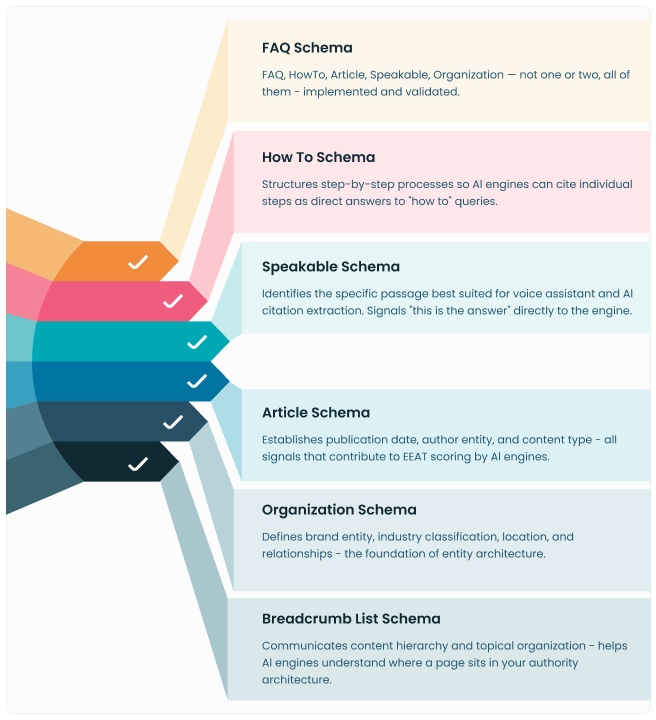
Schema markup is the structured data layer that tells AI engines what type of content a page contains and how to categorize each element. Without it, an AI engine infers content type from context — and inference is slower, less reliable, and less trusted than explicit declaration. Pages without schema are systematically deprioritized in AI passage retrieval, regardless of their content quality.
What E-E-A-T Signals Mean for AEO — and How Answer Engines Weigh Them Differently
Google’s E-E-A-T framework — Experience, Expertise, Authoritativeness, Trustworthiness — was built for human quality raters. For AI engines, E-E-A-T signals serve a different function: they’re part of the source credibility check that determines whether a passage is safe to cite. An AI engine that cites an unverified, low-authority source and generates a wrong answer loses user trust. The credibility stakes are higher than they ever were for ranking. What this means practically: author credentials need to be explicit and machine-readable. Publication dates must be current.
External citations within your content add credibility signals. First-person experience signals — observations from real practice, case data, named examples shift a page from informational to verified expertise.
Why the Entity Layer Is the One Thing Most Businesses Completely Overlook
Entity architecture is not a content task. It’s not a technical SEO task. It sits at the intersection of both — which is exactly why most businesses fall into the gap between their content team and their technical team and never build it. The brands that do build it create a trust foundation that is genuinely hard to replicate quickly. The practical steps: build or claim your Google Knowledge Panel. Create a Wikidata entry.
Ensure consistent brand name, description, and category across all indexed third-party mentions. Build co-citation through genuine editorial placements. This is the entity layer. It separates brands with consistent AI citations from brands that appear occasionally and unpredictably.
Top Answer Engine Optimization Strategies — What Moves the Needle
Most businesses struggling with AEO aren’t failing from lack of effort — they’re applying effort at the wrong layer. Optimizing page titles when the problem is passage structure. Building backlinks when the problem is entity architecture. Publishing more content when existing content isn’t structured for machine comprehension. Knowing which top answer engine optimization strategies actually drive citations is the difference between compounding authority and spinning wheels.
The best answer engine optimization methods for AI visibility work at the level where AI engines make their decisions — passage level, not page level. Question-intent level, not keyword level. Entity level, not domain level. Every strategy in this section operates on one of those three layers.
What wastes your time is equally important. Schema without entity architecture. Question mapping without pillar-and-cluster structure to support it. Content refreshes without structural changes. The best tips for answer engine optimization in AI always start with diagnosing which layer is broken — then fixing that layer specifically.
Why Your Content Architecture Determines Whether AI Cites You or Your Competitor
Content architecture — the structural relationship between your pages, topics, and entity signals — tells AI engines whether you’re an authoritative source on a topic or a site that happens to have written about it. The architecture that wins AI citations is a pillar-and-cluster model built around the specific questions your audience asks AI engines — not the keywords they used to type into Google.
Each pillar page answers the broad question comprehensively. Each cluster page answers a specific sub-question directly. Internal links between them reinforce the topical authority signal on every page in the architecture.
How Question-Based Content Mapping Captures Intent Across Every Stage of the Funnel
The most actionable shift in top answer engine optimization strategies is moving from keyword mapping to question mapping. Instead of asking “which keyword should this page target,” the question becomes “which specific question is my audience asking at this stage of their decision — and is my answer the clearest, most direct, most credible answer available?”
| . | |
🔍
Awareness questions“What is X,” “Why does X happen,” “How does X work” — queries that define the problem. AEO captures these with definition blocks and HowTo schema. |
⚖️
Consideration questions“X vs Y,” “best X for Z,” “how to choose X” — queries that shape evaluation. AEO captures these with comparison tables and FAQ schema. |
✅
Decision questions“Is X worth it,” “X reviews,” “X pricing” — queries that trigger action. AEO captures these with Review schema and entity-verified testimonials. |
🔁
Retention questions“How to use X,” “X best practices,” “X troubleshooting” — post-purchase queries. AEO captures these with HowTo schema and user-intent FAQ blocks. |
Why Internal Linking Is an Entity Signal — and How Most Websites Are Getting It Wrong
Most websites treat internal linking as a UX feature. In the context of AEO, internal linking is an entity signal — it tells AI engines which topics are related in your content architecture, reinforces the topical authority of pillar pages, and communicates the depth of your coverage on a subject. The error most sites make is linking based on what’s convenient.
The AEO-optimized approach links based on topical architecture: every cluster page links back to its pillar with consistent, descriptive anchor text that reinforces the topical relationship. Every pillar links forward to its clusters with anchor text that maps to specific sub-questions.
How External Mentions and Citations Build the Authority Answer Engines Actually Trust
Your own website can only tell AI engines so much about your authority. What tips the credibility scale is what other authoritative sources say about you. Co-citation — your brand appearing alongside category-relevant terms on high-authority third-party domains — is one of the strongest entity trust signals available. Genuine editorial placement: contributed articles on industry publications, expert quotes in news coverage, referenced research on peer sites, inclusion in authoritative category lists.
The co-citation footprint this creates is a signal no amount of on-site schema can replicate — and it’s the hardest signal to fake, which is exactly why AI engines weight it heavily. Strategy without execution is just a slide deck. ZealousWeb builds and executes your full AEO strategy — content architecture, question mapping, entity build, schema, co-citation.
Best Practices for Answer Engine Optimization — Platform-Specific Approaches and Tools
Knowing how answer engine optimization works is one thing. Knowing how to execute it differently across Google AI Overview, Perplexity, and ChatGPT is what actually produces citations. Each platform has its own retrieval logic, its own source weighting, and its own definition of what makes a page worth citing — and the best practices for answer engine optimization that win on one platform will not automatically transfer to another.
This is where most answer engine optimization agency engagements separate themselves from generic SEO retainers. The tactics are platform-specific. The answer engine optimization tools that support Google AI Overview optimization are not the same ones that close the gap on Perplexity. The content signals ChatGPT weights most heavily are different from what Gemini prioritizes. Applying the same approach across all five engines and expecting uniform results is the most common — and most costly — mistake in AEO execution.
The best tips for answer engine optimization in AI aren’t a single checklist. They’re a layered playbook one set of foundations that work everywhere, and one set of platform-specific moves that unlock citations on each engine individually. What follows covers both.
What Google AI Overviews Actually Reward and Which Tools Help You Optimize for It
Google AI Overview sources content from pages already performing well in traditional search. The foundation is not optional: if you’re not ranking in the top five organically for a query, your probability of appearing in the AI Overview for that query is significantly lower. AEO for Google AI Overview is a two-layer problem strong traditional SEO signals plus structured content and schema that make your page the most citation-friendly source in the top results. The tools that support this: Semrush for ranking gap analysis, Google Rich Results Test for schema validation, and Google Search Console’s AI Overview impressions report for direct citation tracking.
Why Perplexity Citations Work Differently Tools and Tactics That Close the Gap
Perplexity is a citation-first platform — it shows its sources prominently, and users actively evaluate which sources it draws from. This changes the AEO dynamic: being cited in Perplexity is a brand visibility event in its own right. The platform favors pages that are factually dense, openly accessible (no paywalls, no interstitial pop-ups), and structured with clear, citable claims. Tactical requirements: open PerplexityBot in robots.txt, eliminate any JavaScript-dependent content rendering on key pages, and structure your factual claims as standalone sentences that can be extracted and cited without surrounding context.
How ChatGPT Sources Business Content — What to Put in Place and What to Use to Get There
ChatGPT’s sourcing combines training data with live web browsing via Bing. For training data, the pathway to citation is entity recognition — your brand needs to appear in enough authoritative contexts that it was included in OpenAI’s training corpus as a credible source on your topic. For live queries with browsing enabled, the pathway is Bing Search Console presence, GPTBot access, and the same structured content signals that work for Google.
The key difference: ChatGPT weights brand entity recognition from training data more heavily than most practitioners realize. A brand that’s well-represented in authoritative third-party content gets cited even when its own pages aren’t the strongest technical match.
| AEO Layer | Recommended Tools | What It Does | Best Practices |
| AEO Audit | Screaming Frog, Semrush, Search Console | Crawl for schema gaps, citation blockers, AI crawler access issues | Run against all 12 AEO readiness signals — not just schema |
| Question Research | AlsoAsked, AnswerThePublic, Semrush PAA | Map every keyword to its question-intent variants | Prioritize how/what/why/which — the queries AI engines answer most |
| Schema Implementation | Google Rich Results Test, Schema Markup Validator, Yoast/RankMath | Build, validate, and deploy structured data at scale | Validate every schema type after deployment — broken schema is worse than no schema |
| Content Optimization | Clearscope, Surfer SEO, Frase | Score content for topical completeness and passage relevance | Optimize for the passage, not the page — target answer blocks specifically |
| Entity Architecture | Kalicube Pro, Google Entity API, Wikidata | Build and monitor brand entity signals across AI engine sources | Entity consistency across every indexed mention outweighs any single directory listing |
| Citation Monitoring | Manual AI engine prompting, Semrush AI, BrightEdge | Track brand citation frequency across all five AI engines | Test target queries monthly — citation patterns shift as content and entity signals change |
| AI Crawler Governance | robots.txt editor, llms.txt generator, log file analyzer | Ensure GPTBot, PerplexityBot, ClaudeBot access is open on key pages | Audit every 90 days — crawler names change as new AI platforms launch |
Where Every Tool Hits Its Limit — and Why Human Judgment Still Drives the Strategy
No tool tells you which queries matter most to your business. No tool decides how your brand entity should be positioned relative to your category. No tool understands the nuance of what makes your content credible to your specific audience versus a competitor’s. Tools audit, validate, monitor, and scale. Strategy, prioritization, and judgment are still human — which is why answer engine optimization agency partnerships that combine tool infrastructure with experienced strategic oversight consistently outperform DIY tool stacks run without a clear strategic model.
How to Measure Answer Engine Optimization — And Why SEO Metrics Fall Short
This is where most AEO strategies quietly fall apart. The work gets done — schema implemented, content restructured, entity signals built — and then the same rankings report gets pulled and the same conclusion gets drawn: nothing moved. But the measurement was looking in the wrong place entirely.
Traditional SEO metrics were built to answer one question: where does your page rank in a list? Answer engine optimization doesn’t produce a list. It produces a citation — or it doesn’t. No rank tracker, no CTR report, no domain authority score tells you whether your brand appeared in an AI-generated answer this week or whether a competitor took that slot instead.
That doesn’t make SEO metrics irrelevant — it makes them incomplete. Rankings still tell you whether your authority foundation is strong enough for AI engines to trust your pages as citation sources. What they don’t tell you is whether that trust is actually converting into visibility where your audience is getting their answers.
The measurement framework for AEO runs on two parallel tracks — the SEO foundation layer you already have, and a new proxy signal layer built specifically for AI search visibility. Both need to be in the same report.
Why SEO Metrics Remain Essential — and How AEO Advances Them for the Way Search Works Today
Traditional SEO metrics — rankings, organic traffic, CTR, domain authority — don’t disappear in an AEO world. They become the baseline that explains what’s possible in AI search. A brand with strong domain authority gets retrieved by AI engines more reliably. A brand with high organic rankings has more pages in the candidate pool for AI Overview citations. SEO metrics tell you how strong your foundation is. AEO metrics tell you how much of that foundation is being converted into AI visibility. You need both layers in the same reporting framework.
Which Proxy Signals Give You Visibility When Direct Data Is Not Available Yet
Standard SEO dashboards weren’t built to see what AI engines are doing with your content. Until purpose-built AEO measurement tools mature, these six proxy signals are the closest you’ll get to knowing whether your answer engine optimization efforts are actually moving — and which ones to watch first:
| . | |
| Branded search volume
An increase in branded queries indicates your brand is being mentioned in AI answers — users ask AI, then search your brand directly. |
Direct traffic trends
Direct traffic increase without corresponding ad spend is a reliable proxy for growing AI citation frequency. |
| Featured snippet ownership
Winning featured snippets is the strongest proxy for AI Overview citation potential — the same structure wins both. |
AI citation frequency
Manual monthly sampling of target queries across ChatGPT, Perplexity, Gemini, and Google AI Overview. Tedious but currently most direct. |
| AI share of voice
Brand citation count as a percentage of total AI answers for target query set — compared against top 3 competitors monthly. |
Search Console AI Overview impressions
Google Search Console now shows AI Overview impressions — the most direct Google-sourced AEO metric available. |
How to Build a Reporting Framework That Actually Reflects AI Search Progress
A practical AEO reporting framework combines three layers: foundation metrics (traditional SEO signals that tell you whether your authority base is strengthening), proxy signals (branded search, direct traffic, featured snippet wins that indicate growing AI visibility), and direct citation tracking (manual AI engine sampling for your target query set). The foundation and proxy layers are available in existing tools. The direct citation layer requires a structured manual process — or a platform like BrightEdge or Semrush AI that’s beginning to automate it. Run all three layers in the same monthly report — not three separate reports that no one connects.
What Realistic AEO Progress Looks Like — and the Timeline Businesses Should Expect
| . | |||||
| Week 1–2
AEO Audit Complete Gap baseline established |
Week 3–5
Schema Live Full markup deployed + validated |
Week 4–7
Content Restructured Answer-first pages live |
Week 6–10
First Citations AI citation signals appear |
Month 3
SOV Growth Citation frequency measurably up |
Month 6+
Comp-ounding Entity authority solidifying |
Schema implementation and content restructuring produce first AI citation signals within 4–8 weeks. Measurable share-of-voice growth across multiple AI engines typically appears by month 3. Entity authority compounding — which makes your brand increasingly difficult for competitors to displace — builds from month 4 onwards. The timeline compresses significantly when all implementation layers run simultaneously rather than sequentially.
AEO Challenges Every Business Hits — And How to Overcome Them
AEO doesn’t break loudly. It erodes quietly — a competitor starts appearing in answers that used to reference you, your branded search plateaus without explanation, an AI engine describes your business with outdated positioning you haven’t used in two years. By the time most businesses notice something is wrong, the compounding has already started.
The challenges ahead are predictable. What separates the brands that recover fast from the ones that lose months is knowing which signals to watch and exactly where to look when something breaks.
When AI Platforms Cite Your Competitors Instead — What Broke and Where to Look First
When a competitor is consistently cited in AI answers for queries you should own, the diagnosis usually points to one of three gaps: their content structure is more passage-optimized than yours, their entity architecture is stronger, or their schema implementation is more complete.
The fix is not a general AEO review — it’s a targeted competitive gap analysis on the specific queries where you’re losing citations. Compare passage structure, schema completeness, and entity signals between your content and theirs on those queries. The gap is almost always visible within the first ten minutes of that comparison.
Why AEO Rules Keep Shifting — What to Watch So Your Strategy Does Not Fall Behind
AI engine behavior changes faster than traditional search algorithm updates. Google AI Overview coverage expands to new query types. Perplexity adjusts its source weighting. ChatGPT modifies its browsing capabilities. Best practices for answer engine optimization in January may need revision by June. The signal to watch is not algorithm update announcements — it’s citation pattern shifts in your own target query set.
When your citation frequency drops on a stable set of queries without an obvious content change, something in the platform’s behavior changed. Run a fresh competitive citation test before changing anything in your own content.
How AI Gets Your Business Wrong — What Changes When Accuracy Becomes a Visibility Problem
AI engines occasionally generate inaccurate descriptions of businesses — wrong product categories, outdated positioning, misattributed claims. This is an entity architecture problem. When your brand entity is not clearly and consistently defined across authoritative sources, AI engines fill the gaps with inference — and inference is unreliable.
The solution is entity reinforcement: consistent brand description across schema, Knowledge Graph, Wikidata, and high-authority third-party mentions. Run a quarterly entity audit: ask ChatGPT, Perplexity, and Gemini to describe your business and compare against your intended positioning. Discrepancies tell you exactly where entity signals are inconsistent.
The Signals That Tell You Something Has Changed — and How to Respond Before It Costs You
| . | |
Branded search volume drops without ad changeOften means AI citation frequency has decreased — users who discovered your brand via AI answers and then searched directly are no longer seeing you cited. |
Featured snippet losses on previously held queriesFeatured snippet ownership and AI Overview citation use overlapping signals. Losing snippets is an early warning that passage-level optimization has degraded. |
Direct traffic plateaus despite organic growthIf organic grows but direct plateaus, brand recall from AI citations isn’t translating — entity architecture likely hasn’t been built or has weakened. |
Competitor appears in AI answers for your category termsRun a monthly target query test. If a competitor is cited where you aren’t, do a passage-level and entity comparison between their content and yours. |
How the Right AEO Partnership Gets You There Faster
Building AEO capability in-house means hiring for four distinct skill sets — technical schema implementation, content restructuring, entity architecture, and AEO reporting metrics — while the citation window in your category is still open. Most teams don’t have the bandwidth. Most agencies don’t have the specialization. And most AEO consultants in 2026 are SEO practitioners who rebranded without rebuilding their methodology.
The right AEO services for agencies and brands close that gap without the ramp-up time. Whether you need white label AEO services to add AI search to your client offering, or a dedicated partner to build and execute your answer engine optimization strategy end to end — the accelerant isn’t just execution speed. It’s knowing exactly which of the four layers is breaking your citations and fixing that layer first, before compounding works against you.
Why AEO Demands a Fundamentally Different Skill Set Than Anything Your SEO Team Currently Does
AEO requires four competencies working simultaneously: technical schema implementation, content restructuring for passage scoring, entity architecture building, and AI citation monitoring. Most in-house SEO teams are strong in one or two. Almost none have all four at production capacity. The technical and content layers require different execution skills. The entity layer requires a strategic understanding of brand positioning that sits outside most SEO practitioners’ current scope. Building all four capabilities in-house takes time that the AEO window doesn’t allow.
What a Real AEO Engagement Looks Like — Scope, Process, and What You Should Actually Expect
| . | ||
| 01
AEO Audit + Roadmap Best for: validation-first buyers A standalone AEO audit before committing to a retainer. Full picture of your current AI engine visibility, every gap, and a prioritized implementation roadmap.
|
02
Monthly AEO Retainer Best for: brands and agencies scaling AEO ZealousWeb operates as an extension of your team — executing schema, restructuring content, building entity authority, and reporting on AI citation growth monthly.
|
03
White-Label AEO for Agencies Best for: agencies adding AEO to client offer Complete AEO execution under your agency’s brand. Your clients see your reports, your branding, your relationship. ZealousWeb handles every element of execution.
|
Conclusion
The shift to answer engines isn’t a future trend you can schedule for next year’s strategy review. It’s reshaping how your audience discovers, evaluates, and chooses brands right now — on the queries that matter most at the top and middle of your funnel.
How answer engine optimization works, at its core, comes down to three things: building the structural foundation that AI engines can read (schema, passage architecture, entity signals), earning the authority signals that make your brand a trusted citation source (EEAT, co-citation, entity verification), and measuring the right outcomes — AI citation frequency, branded search trends, and share of voice in AI answers — not just the rank metrics designed for a different era of search.
The best practices for answer engine optimization aren’t exotic. The tools are available. The strategies are executable. Yet most organizations quickly discover that implementing them effectively requires more than simply publishing AI-friendly content or adding schema markup. Success depends on aligning technical SEO, content architecture, entity development, authority building, and performance measurement into a coordinated strategy that search engines can consistently understand and trust.
That’s why many brands choose to work with specialists rather than navigate this transition alone. ZealousWeb helps brands earn visibility in the new search ecosystem by combining technical AI-search readiness, authority building, and content optimization designed for both answer engines and traditional search. Our approach focuses not only on helping businesses become discoverable, but on building the credibility and relevance signals that increase the likelihood of being surfaced, cited, and recommended by AI platforms.
If you’ve read this far, you already understand what’s at stake. The question is no longer whether AI-driven search will influence how customers find information—it already does. The real question is whether your brand is sending the signals answer engines need to recognize and trust it.
Find Out Where You Rank in AI Search
Talk With Our AI Strategy Experts
FAQs
How long before we see results from AEO?
Timelines vary by baseline and implementation pace. Most engagements see early proxy signals within the first few weeks and measurable citation growth within the first quarter. Progress is visible at every stage — not just at the end.
How do you optimize content for AI answers without rebuilding everything?
We restructure, not rebuild. Existing high-traffic pages closest to earning citations get restructured first using AEO content structure best practices and schema markup for AI search. New content only where genuine gaps exist.
Can you deliver AEO as a white-label service for our agency clients?
Yes. Complete AEO execution under your brand — your reports, your client relationship, our work. Dedicated account management and reseller pricing for volume engagements.
How do we justify AEO budget internally?
The business case is a visibility gap, not a vanity metric. Our AEO reporting metrics quantify exactly what AI answer boxes are costing you in intercepted queries — before you commit to anything.
How much do AEO services cost?
Scoped after a free audit — you never pay for more than your current gap requires. Engagements range from a one-time audit to a full retainer depending on scope.