

Running a digital agency, web studio, or freelance consultancy means clients expect you to do everything. Paid ads, social media, web design, and increasingly, SEO. But building an in-house SEO team is expensive, slow, and risky. You need a specialist for technical audits, another for link building, enterprise-grade tools that cost thousands a year, and enough work to justify all of it full-time.
That’s exactly why white-label SEO services have become the operational backbone of some of the fastest-growing agencies in the world.
White-label SEO lets you offer fully managed SEO to your clients — under your own brand — while a dedicated specialist team handles every deliverable behind the scenes. Your clients see polished reports with your logo. They deal only with you. And your team never writes a single audit or ranking report.
Whether you’re a digital marketing agency looking to expand your service portfolio, a web development company wanting to retain clients after launch, a freelance consultant managing more accounts than you can handle alone, or a PR firm building a full-service digital offering — this guide covers everything you need to make the right decision.
We’ll walk you through what white-label SEO services actually include, how white-label SEO pricing works, what it costs to onboard a white-label SEO agency versus hiring in-house, how to vet a white-label SEO reseller, and what results to realistically expect. No vague promises. Just the full picture.

What Is White-Label SEO?
White-label SEO is a business arrangement where a specialist provider delivers SEO services that another business — an agency, a developer, or a consultant — resells to its clients under its own brand name. The end client never knows a third party is involved. Every report, every audit, every recommendation goes out with your logo on it.
Think of it like a supermarket’s own-brand product. The label says your name. The factory behind it is invisible. The quality is the same — often better — but you don’t need to own a factory to sell the product.
In practice, a digital marketing agency can offer full-spectrum technical SEO to its clients without a single in-house SEO specialist. The execution happens behind the scenes, handled by a dedicated white-label team, while you maintain complete client ownership, brand control, and the commercial relationship.
White-label vs outsourcing — the key distinction
Outsourcing means handing work to an external party with variable quality and no brand alignment. A true white-label partner operates inside your brand standards, uses your templates, follows your communication protocols, and delivers work that is indistinguishable from your own team’s output. The client never knows.
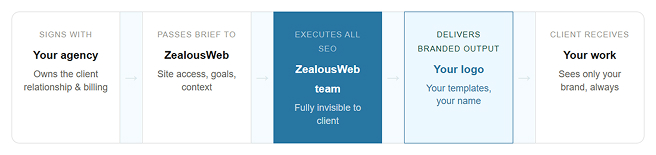
White-label SEO is not the same as outsourcing. Outsourcing means handing work to an external party with variable quality and no brand alignment. A true white-label partner operates inside your brand standards, uses your templates, follows your communication protocols, and delivers work that is indistinguishable from your own team’s output.
Who Needs White-Label SEO?
White-label SEO is primarily sought by digital marketing agencies, web developers, and freelance consultants who want to offer SEO without building an in-house team. These businesses resell the SEO work under their own brand name while the provider fulfils it behind the scenes.
The buyer profile breaks down into four main groups — each with a different entry point into the model, but a shared underlying need: they’re selling the outcome of better search visibility without doing — or wanting to do — the execution themselves.
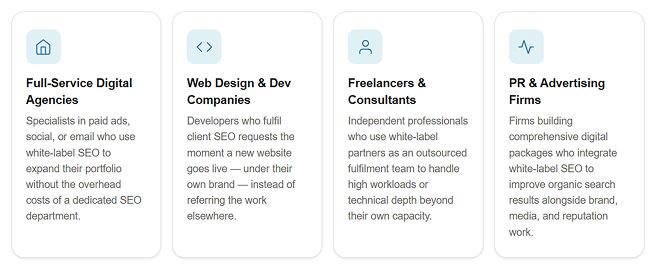
By partnering with dedicated white-label providers, all four of these business types can scale their operations while the SEO experts manage the technical execution and reporting — giving them time back to focus on what they actually do best.
Why Onboarding a White-Label Technical SEO Agency Is a Strategic Decision
Most agencies don’t go looking for a white-label partner when things are going well. They go looking when a client escalates, when a deadline slips, or when their one SEO person has just resigned and they have eight accounts to service. By that point the decision isn’t strategic it’s reactive. And reactive decisions rarely produce the kind of operational clarity that changes how an agency actually runs.
The agencies that get the most out of white-label partnerships are the ones that treat the decision as infrastructure not an emergency fix. Bringing in a dedicated white-label technical SEO partner before capacity becomes a crisis changes three things fundamentally: what you can pitch, what you can promise, and what your margins look like.
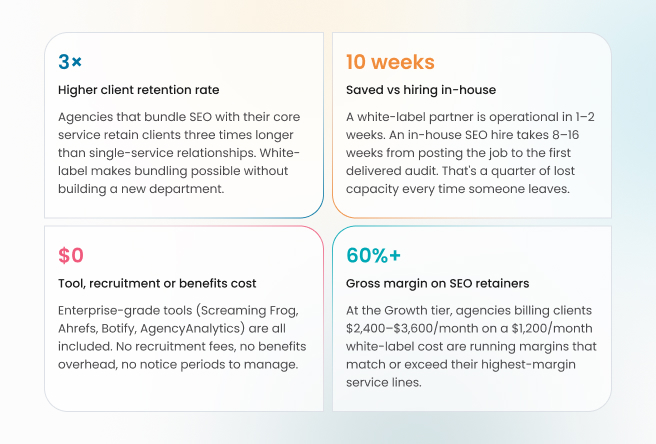
The agencies with the strongest client retention didn’t bring in a white-label partner after losing a client to technical failures. They brought one in before any client ever noticed a problem — and that timing is what made the difference.
There’s also a pitch dimension that gets overlooked. When you have a white-label technical SEO partner already in place, you can respond to RFPs and client enquiries with genuine confidence — not qualified promises about “needing to scale the team first.” You can walk into any discovery call and say yes to the SEO brief because the infrastructure to deliver it is already running.
How It Offloads Work From Your Team
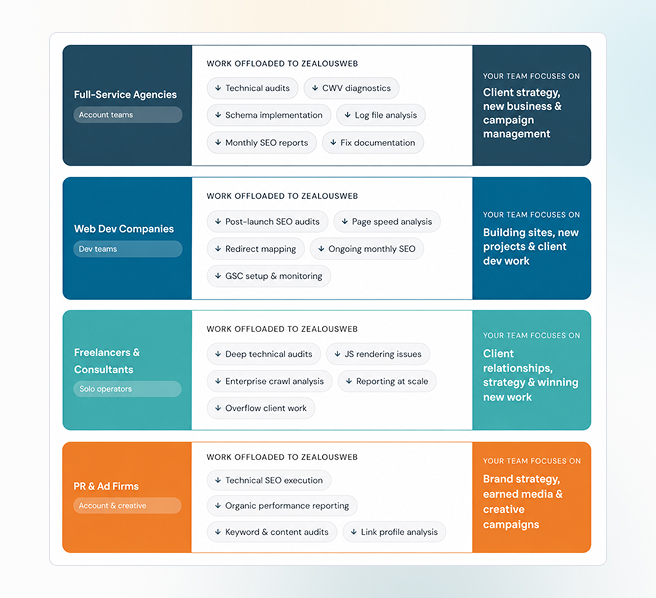
The most immediate operational impact of a white-label SEO partner isn’t the quality of the audits it’s the hours returned to your team. Technical SEO execution is time-intensive, specialist-heavy, and context-specific to each site. When that execution moves to a dedicated partner, your team stops doing the grind and starts doing the work that actually requires them.
The workload relief looks different depending on who you are:
The Real Cost Benefits of Partnering
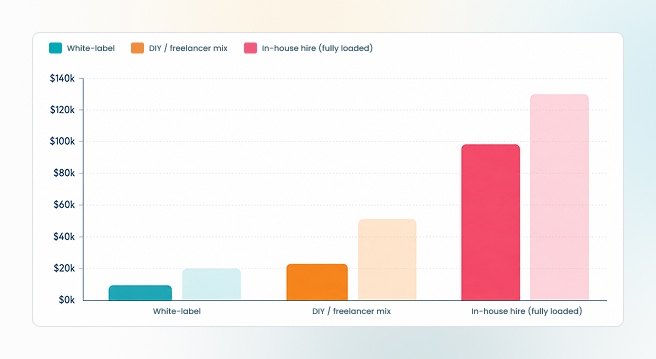
The headline cost comparison between white-label and in-house is compelling on its own but it significantly understates the full picture. Once you factor in everything an in-house hire actually costs beyond their salary, the gap widens considerably.
A mid-level technical SEO hire in a mature market costs $65,000–$95,000 annually in salary alone. Add 25–30% in employer costs (benefits, payroll taxes, pension), $4,000–$12,000 in tool subscriptions, recruitment fees of $8,000–$15,000, and 8–16 weeks of ramp-up time during which you’re still paying but not yet receiving full output. The real cost of an in-house hire in year one is often $100,000–$130,000. And if they leave after 18 months, you start the clock again.
What the margin actually looks like for resellers
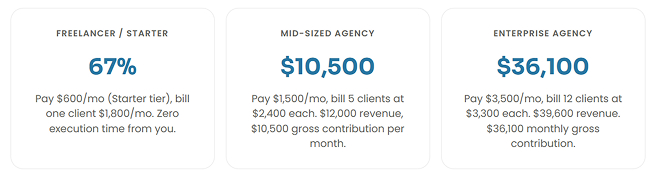
Most agencies applying a white-label model charge clients 2–3× what they pay the provider. That structure looks like this:
The compounding cost advantage
The white-label cost stays flat while your client base grows. In-house costs scale with headcount every 4–5 clients you win effectively requires a new hire. White-label pricing allows you to add clients without adding proportional cost, which is why agencies that use this model consistently run higher EBITDA margins than their in-house counterparts.
Step 1 — Onboarding & Brand Alignment
You share your report templates, brand guidelines, and preferred PM tool. The white-label team configures delivery to match — reports go out in your format, communications follow your style guide, and all documentation uses your brand identity from day one. The partner adapts to you, not the other way around.
Step 2 — Client Brief & Site Access
For each client, you pass a brief covering the site URL, business goals, known issues, target markets, and any sensitivities. GSC, GA4, and CMS access follow. Questions are asked now — not mid-execution when they delay delivery.
Step 3 — Technical Audit Execution
Full crawl, Core Web Vitals, log file analysis, schema review, redirect mapping, and indexation audit run in parallel by the specialist team. Any access issues or unusual findings are flagged within 24 hours — not saved until delivery day.
Step 4 — Internal QA Review
A senior specialist reviews the work before it reaches you — verifying that findings reference actual site data and not templated output, confirming fix prioritisation logic, and checking client-readiness throughout. If a provider skips this step, you become their QA. That is the opposite of what a white-label relationship should do for your time.
Step 5 — Branded Delivery to Your Team
You receive the full audit package in your format — PDF report, prioritised fix spreadsheet, GSC annotation notes, and dashboard access. A pre-presentation briefing call is available on request to walk through any findings before you face the client.
Step 6 — Implementation, Reporting & Iteration
Fix instructions are delivered in a developer-ready format and tracked in a shared log — flagged → in progress → implemented → GSC-verified. Monthly branded progress reports go out covering ranking movement, traffic trends, fix status, Core Web Vitals progress, and next-month priorities. New issues found mid-month are flagged immediately, not held for the next cycle.
Conclusion
You now have the full picture — how white-label SEO works, what it costs, how to vet a partner, what the delivery workflow looks like, and what results to set your clients’ expectations around. The model is proven. The economics are clear. The only variable left is who you trust to execute it.
The agencies, developers, and consultants that scale fastest aren’t the ones with the biggest internal teams. They’re the ones that made a smart decision early about where specialist execution belongs — and built their service offering around that decision rather than in spite of it.
That is exactly what ZealousWeb is built for. We work with digital agencies, web development companies, freelancers, and PR firms who want technical SEO delivered under their brand — without the overhead of building it internally. If white-label technical SEO is the right fit for your business, here is all we need from you: tell us your vision. The clients you’re servicing, the verticals you’re targeting, the deliverables your clients expect, and the brand standards everything needs to meet.
ZealousWeb scopes it, estimates it, and handles the technical SEO execution for your clients entirely — ensuring every deliverable is aligned to your brand, your timelines, and your clients’ goals. You focus on growing your agency. We make sure the SEO side never lets you down.
Scale SEO Delivery Under Your Brand with Expert White-Label Support
Share Your Requirements