

Something changed quietly between 2023 and 2026. Global businesses that had spent years building search engine visibility watched their organic traffic flatten — not because their SEO got worse, but because the game changed underneath them. Google began answering questions directly. ChatGPT started sending users to websites it trusted. Perplexity began citing specific passages from specific pages. The click, which had always been the reward for ranking well, started disappearing.
AI-referred traffic grew 527% year-over-year, and AI Overviews now reach over 1.5 billion users every month. Businesses that appear in those answers are capturing audience that never touches a traditional SERP. The ones that don’t are becoming invisible — not to search engines, but to AI systems that now mediate the first answer every user receives.
This is the problem generative engine optimization solves. And it’s now the highest-ROI visibility investment available to any agency or business operating in search.
| . | |
| What is GEO?
Generative Engine Optimization (GEO) is the practice of structuring content so AI systems — Google AI Overviews, ChatGPT Search, and Perplexity retrieve and cite it when answering user queries. What’s the fastest win? Restructure your top 5 pages so each H2 section opens with a direct answer in the first 40 words. This single change improves AI extractability faster than any other tactic. |
How long to see results?
Most websites see measurable AI citation improvements within 60–90 days of implementing structured GEO changes to their top 10 pages. |
GEO vs SEO vs AEO: Where Each One Ends and the Other Begins
Most agencies and businesses treat GEO, SEO, and AEO as interchangeable terms for the same thing. They’re not. Each one targets a different system, uses different signals, and produces a different type of visibility. Understanding where each ends and the other begins is the prerequisite for doing any of them well.
What Is The Difference Between GEO and SEO?
Traditional SEO optimizes content to rank in a list of blue links. Generative engine optimization structures content so AI systems retrieve and quote it inside a generated answer. SEO earns a position on a results page. GEO earns inclusion in the answer itself — the text that appears before the user ever sees a link.
What Is The Difference Between AEO and GEO?
Answer Engine Optimization (AEO) focuses on featured snippets and zero-click answers within traditional SERPs. GEO goes further — targeting the full generative AI layer, including ChatGPT Search, Perplexity AI, and Bing Copilot, which operate outside the traditional SERP entirely. AEO is the foundation. GEO is the next layer built on top of it.
| Dimensions | SEO | AEO | GEO |
| Primary goals | Rank in blue-link SERP | Win featured snippet/zero-click answers | Get cited in AI-generated answers |
| Ranking signal | Backlinks, on-page keywords, and authority | Structured content question-based headings | Passage extractability, entity confidence, schema |
| Output format | Ranked page link | Snippet box above organic results | Cited passage inside AI-generated response |
| Primary platform | Google, Bing | Google (AI Overviews, Snippets) | Google AI Overviews, ChatGPT, Perplexity, Bing Copilot |
| Measurements | Rankings, organic traffic | Featured snippet ownership, CTR | AI citation frequency, brand mention in LLM responses |
The practical answer: You need all three. But GEO is the layer most agencies and businesses currently have zero coverage on — which means it’s where the fastest competitive advantage is available right now.
The AI Search Market in 2026: Why the Opportunity Is Right Now
The scale of AI search adoption is not a future forecast. It’s already the present. The platforms that aggregate and answer user queries have crossed user numbers that most SEO practitioners haven’t fully processed yet — and the gap between businesses that are cited and businesses that are invisible is widening every quarter.
How big is AI search in 2026?
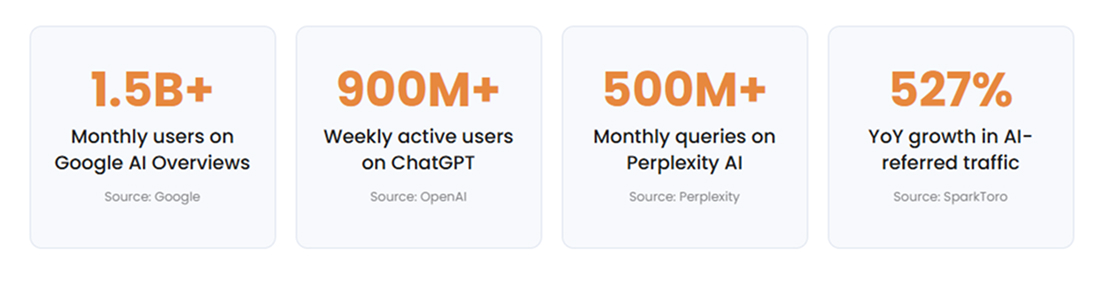
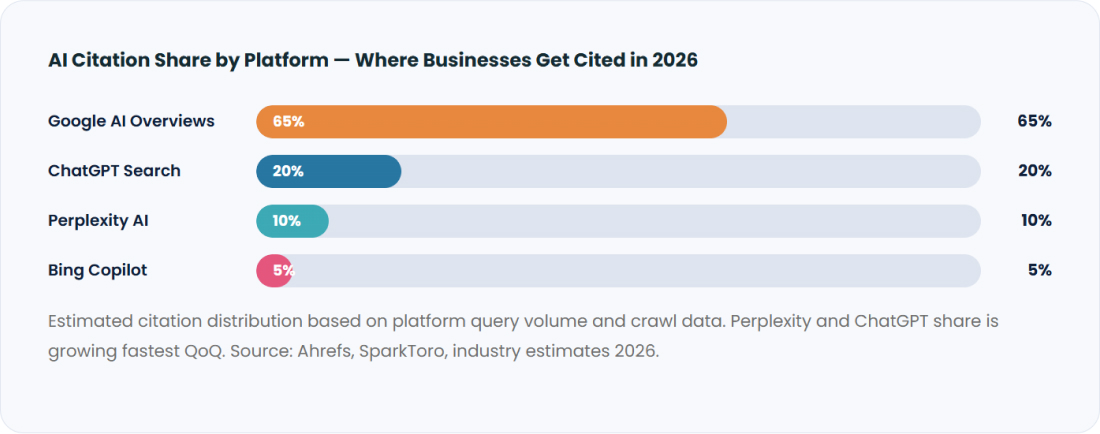
| Platform | Scale | Growth Signal | Citation Opportunity |
| Google AI Overviews | 1.5B+ monthly users | Covers 50%+ of all queries | Highest volume — passage structure and FAQPage schema are primary levers |
| ChatGPT Search | 900M+ weekly users | 527% YoY AI-referred traffic growth | Entity authority and brand consistency drive inclusion |
| Perplexity AI | 500M+ monthly queries | Fastest-growing AI search platform | High-intent queries — Reddit presence and community citations matter |
| Bing Copilot | 140M+ daily active users | Integrated into Windows and Microsoft 365 | Structured indexing and IndexNow submission accelerate inclusion |
Why is GEO important in 2025 and 2026?
According to Ahrefs, only 11% of citations overlap between ChatGPT and Google AI Overviews. That means optimising for one platform does not guarantee visibility on another. Businesses that implement GEO correctly build citation presence across all platforms simultaneously — compounding visibility that no paid search budget can replicate.
What Happens To Businesses That Don’t Optimize for AI search?
Their content gets crawled, processed, and passed over in favour of competitors with better passage structure. It’s not that their content disappears — it’s that another business’s answer appears first, every time. The compounding effect runs in both directions: early citation share grows, and businesses that start late face a growing gap.
| The benchmark: HubSpot’s AI citation Cited across 3 platforms performance | Cited across 3 platforms |
| 🌐 Domain | hubspot.com — B2B SaaS / Marketing |
| 🧩 Schema | Article, FAQPage, Organization, Person — all implemented |
| 📏 Passage length | 120–150 words per answer block |
| 🤖 LLM.txt | Implemented — full entity descriptions |
| 🚀 Platforms | Google AI Overviews · ChatGPT Search · Perplexity |
What HubSpot does that most businesses don’t: every blog section opens with a direct answer in the first two sentences. Every technical term is defined at first use. Every comparison question has a table. The content is built for retrieval — not just for ranking.
The lesson is not “be HubSpot.” The lesson is that their content structure is replicable. Any agency or business that applies the same passage architecture to their existing content can close the citation gap within 60–90 days.
Important: Generic GEO advice is everywhere in 2026 — most of it is surface-level or written by people who have never run a GEO audit. The difference between advice that sounds right and advice that actually moves citation share is in the implementation detail: passage length, entity block placement, schema type selection, and crawler access configuration. This guide covers all of it.
The GEO Competitive Landscape: Who Is Winning AI Citations and Why
The competitive map for AI citation share looks very different from traditional SEO rankings. Vertical matters. Platform matters. And the structural gap between who’s cited and who’s not is often smaller than businesses assume.
Which types of businesses are getting cited most in AI search?
| Business Type | Winning Platform | What They Do Right | The Gap Others Miss |
| SaaS/B2B Tech | Google AI Overviews | Long-form structured definitions, FAQPage schema, definition blocks per section | No direct answer in first 40 words of each section |
| E-commerce | Perplexity AI | Product comparison tables, spec data, structured product schema | No entity consistency across product pages and profiles |
| Digital Agencies | ChatGPT Search | Thought leadership content, sameAs markup, author schema with credentials | Brand named inconsistently across site and social profiles |
| Healthcare/Legal | Bing Copilot | E-E-A-T signals, author credentials visible, trust pages, medical review dates | No Person schema, no credential markup connecting author to content |
| Local Businesses | Google AI Overviews | GBP integration, LocalBusiness schema, location-specific passage blocks | No structured data connecting online presence to local entity |
The three structural differences between cited and invisible businesses: first, cited businesses write for passage retrieval — not page ranking. Second, they maintain consistent entity architecture across every platform where their brand appears. Third, they give AI crawlers clear permission and clear structure to work with. Remove any one of those three and citation share drops regardless of content quality.
How to Do Generative Engine Optimization: A Step-by-Step Process
Generative engine optimization is not a single tactic — it’s a layered implementation process. The six steps below move from technical foundation to content structure to entity authority. Each step builds on the last. Skipping to step four without completing steps one through three is one of the most common reasons GEO efforts fail.
| . | |
| 1 |
Audit AI crawler accessConfirm GPTBot, OAI-SearchBot, PerplexityBot, ClaudeBot, and Bingbot are all allowed in your robots.txt. Blocked crawlers mean zero citation chance regardless of content quality. This is the non-negotiable first step. |
| 2 |
Score your content for passage extractabilityReview your top 10 pages. Does each H2 section open with a direct, standalone answer in the first 40 words? Are technical terms defined at first use? Optimal passage length for AI retrieval is 100–160 words per answer block. |
| 3 |
Implement the core schema stackArticle schema with author and datePublished. FAQPage schema mapping every H3 question. BreadcrumbList. Organization schema with sameAs links. Person schema for every named author. These five schema types cover 80% of the GEO structured data signal. |
| 4 |
Restructure content for AI retrievalRewrite section openings to lead with the answer. Add definition blocks for every technical term. Convert all comparison questions to tables. Convert all how-to processes to numbered steps. Cite every statistic with a source name inline. |
| 5 |
Build your entity architectureImplement llms.txt with structured entity descriptions. Ensure your brand name is identical across your website, Google Business Profile, LinkedIn, and all directories. Add sameAs markup linking your Organization schema to every external profile. This is what gives LLMs confidence to cite you by name. |
| 6 |
Build external authority signalsAI systems correlate external mentions more strongly than backlinks. According to the ZealousWeb GEO skill framework, YouTube mentions, Reddit discussions, and Wikipedia presence correlate most strongly with AI citation frequency. Build presence on these platforms systematically, not opportunistically. |
What Content Formats Rank in AI Overviews?
According to Google’s published guidance and Ahrefs citation analysis, the content formats AI Overviews cite most frequently are: numbered how-to lists, definition blocks with a term followed by a plain-English explanation, comparison tables, and FAQ-structured content where the question appears as a heading and the answer follows immediately. Long introductory paragraphs, vague conclusions, and content without structured hierarchy are consistently passed over.
What Makes Content Citable by AI?
Five signals make content citable by AI systems: a direct answer in the opening passage, self-contained explanation that works without the surrounding page context, specific statistics with named sources, clear entity attribution linking the content to a trusted organisation or author, and structured data that confirms the content’s topic, author, and publication date to the crawler.
What Determines How Fast You Gain AI Citation Share
Not every website starts from the same position. Eight factors determine how quickly a business can build measurable AI citation presence — and understanding them upfront prevents unrealistic expectations and misallocated effort.
What Makes GEO Harder or Easier for Your Specific Situation?
| Factor | Easy Scenario | Hard Scenario | Why It Matters |
| Content Structure | H2/H3 hierarchy already in place | Content buried in PDFs or JavaScript | AI crawlers need structured HTML to retrieve passages reliably |
| Entity Consistency | Brand name is identical everywhere | Multiple name variants across site and profiles | LLMs drop inconsistent entities from citation consideration |
| Schema Coverage | Basic article schema already live | No schema, CMS restricts implementation | Schema is the machine-readable layer LLMs weight most heavily |
| AI Crawler Access | GPTBot and PerplexityBot already allowed | Crawlers blocked in robots.txt | Blocked crawlers mean zero citation chance regardless of content |
| External Mentions | Brand cited on Reddit, LinkedIn, YouTube | No third-party mentions anywhere | External validation is the trust signal LLMs weight most heavily |
| Content Depth | Long-form pillar articles already exist | Only thin service pages and product listings | Passage retrieval requires substantial context around the answer |
| Publishing Cadence | Regular content updates — weekly or fortnightly | Static site, last updated 12+ months ago | Freshness signals affect AI Overview inclusion probability |
| Domain Authority | Established site with backlink profile | New domain with no trust signals | Trust compounds — existing authority accelerates early GEO gains |
From what we’ve seen: businesses with solid existing content and basic schema in place typically see their first measurable AI citation gains within 30 days of foundation fixes. Businesses starting from a blank entity slate take 90–120 days to build enough trust signal for consistent citation. Neither timeline is slow — both beat the 6–12 month curve of traditional SEO authority building.
Platform-by-Platform GEO Tactics
Each AI search platform retrieves content differently. Google AI Overviews prioritises passage structure and schema. Perplexity weights community validation and technical authority. ChatGPT Search emphasises entity consistency and brand recognition. Running the same tactic on all four platforms underperforms running platform-specific optimization on each.
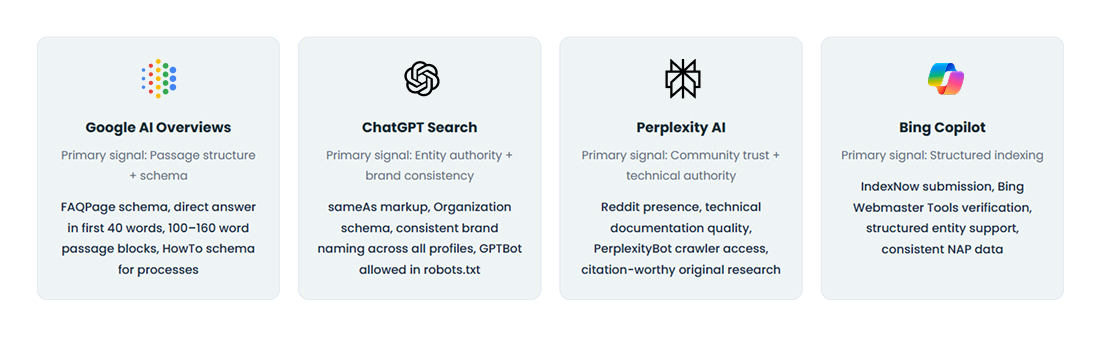
| Platform | What It Prioritizes | Primary Tactic | Secondary Tactic | Common Mistakes |
| Google AI Overviews | Passage extractability | Direct answer blocks with FAQPage schema | HowTo schema for step-by-step content | Writing for the page, not for the passage |
| ChatGPT Search | Entity confidence | sameAs markup + consistent brand entity | Organization and Person schema | Different brand name variants across platforms |
| Perplexity AI Search | Community validation | Reddit presence and community citations | Technical documentation depth | Ignoring off-site entity signals entirely |
| Bing Copilot | Structured indexing | IndexNow + Bing Webmaster verification | Structured entity support across all pages | Assuming Google optimization covers Bing automatically |
How To Optimize for Google AI Overviews
Google AI Overviews retrieve passages — not pages. The single most effective tactic is ensuring every H2 section on your key pages opens with a direct, standalone answer to its implied question within the first 40 words. Pair this with FAQPage schema mapping each H3 question to its answer, and Article schema with accurate author and publication date. According to Ahrefs research, only 11% of AI Overview citations overlap with ChatGPT citations — so Google-specific optimization is worth doing independently.
How To Appear in ChatGPT Search Results
ChatGPT Search uses a combination of Bing’s index and OpenAI’s own crawl (via GPTBot and OAI-SearchBot). The primary signal is entity confidence — does ChatGPT recognise your brand as a consistent, trusted entity? Implement Organization schema with sameAs links to your LinkedIn, Wikipedia (if applicable), Crunchbase, and social profiles. Ensure your brand name appears identically across every external platform. Then confirm GPTBot is explicitly allowed in your robots.txt.
How To Structure Content for Perplexity AI
Perplexity weights community validation more than any other major AI search platform. Businesses with active Reddit presence, cited in technical communities, and referenced in documentation-heavy content consistently outperform businesses relying on website content alone. Perplexity’s own crawler (PerplexityBot) must be explicitly allowed. Technical documentation depth — not just marketing copy — is what Perplexity retrieves and cites.
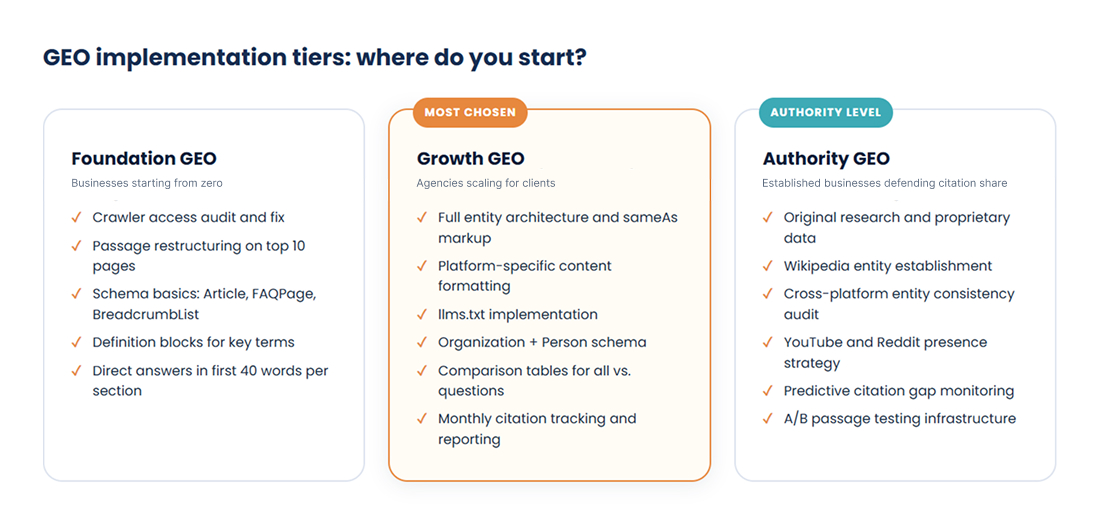
GEO Best Practices Checklist: Foundation, Growth, and Authority
The checklist below maps directly to the three implementation tiers. Foundation items must be completed before moving to Growth. Growth items must be in place before Authority signals compound. Jumping tiers is the most common reason GEO retainers stall at month three.
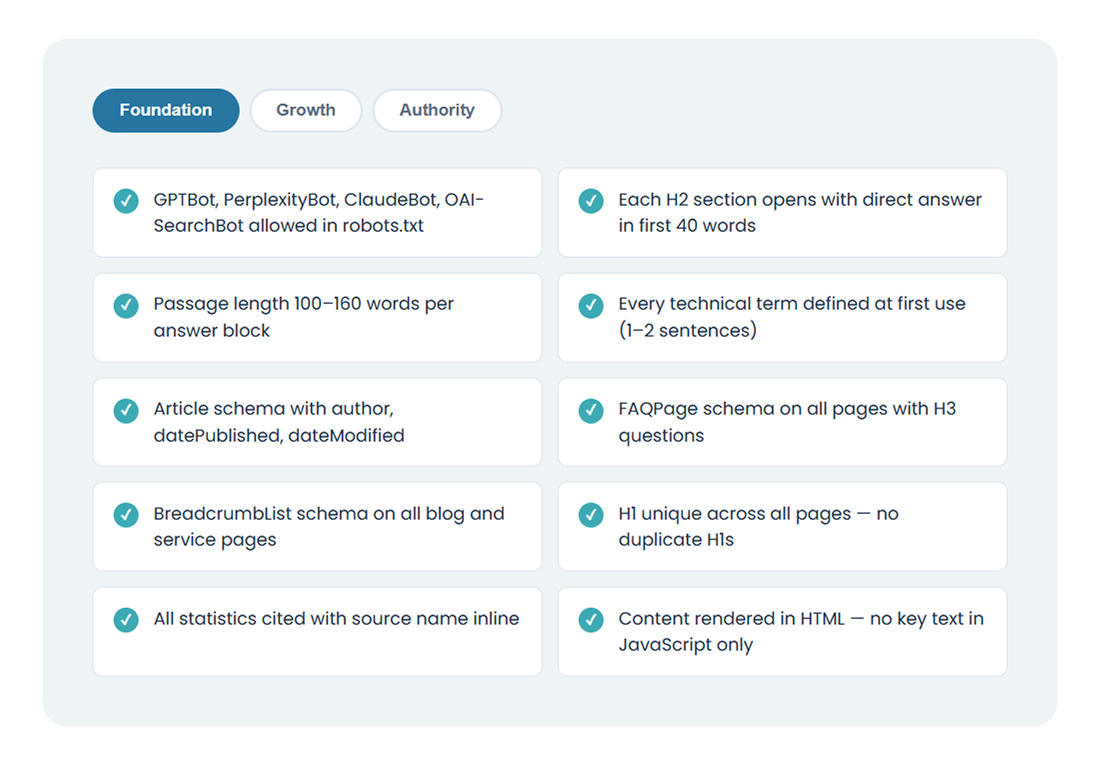
Technical GEO Signals That LLMs Actually Prioritize
Most GEO guides focus entirely on content. The technical layer is equally important — and it’s where most implementations break down. Here are the signals that determine whether an AI system can retrieve your content at all, before it even evaluates whether your content is worth citing.
Does Schema Markup Help With AI Search?
Yes — significantly. Schema markup is the machine-readable translation of your content. It tells AI crawlers not just what your page says, but what type of content it is, who wrote it, when it was published, and what questions it answers. Without a schema, AI systems must infer all of this from unstructured text — and they frequently infer incorrectly or skip the page entirely. The FAQ Page schema in particular maps directly to the question-answer retrieval pattern that AI Overviews use.
| Schema Type | GEO Impact | What It Signals to LLMs | Priority |
| Article | High | Author identity, publication date, topic classification | Implement first |
| FAQ Page | High | Question-answer pairs for direct retrieval | Implement first |
| Organization | Critical | Brand entity confidence, same as validation | Implement first |
| Person | High | Author E-E-A-T, credential attribution | Implement second |
| BreadcrumbList | Moderate | Content hierarchy and topic context | Implement second |
| How To | High | Step-by-step process structure for procedural queries | Implement on how-to content |
What Is LLMS.txt And Why Does It Matter?
llms.txt is a plain-text file placed at your domain root (yourdomain.com/llms.txt) that provides AI systems with a structured overview of your website, brand entity, key pages, and content scope. It functions like a robots.txt for LLMs — not blocking access, but actively guiding it.
A well-implemented llms.txt includes your brand description, key service pages with descriptions, team member entities, and brand authority signals. It’s one of the fastest implementations, highest-impact technical GEO actions available in 2026.
AI crawler access checklist — confirm all are allowed before publishing any GEO content: GPT Bot (OpenAI) · OAI-SearchBot (OpenAI) · Perplexity Bot (Perplexity) · Claude Bot (Anthropic) · Bingbot (Bing Copilot) · Googlebot (Google AI Overviews)
GEO for Digital Agencies: Running AI Visibility for Clients
Running GEO for clients is a different challenge than running it for your own brand. Client websites have CMS constraints, approval cycles, and stakeholders who don’t understand why their robots.txt matters. The workflow below is designed to make GEO implementation predictable and reportable — regardless of the client’s technical setup.
How To Do GEO For a Digital Agency
The most effective agency GEO workflow runs in five phases: audit, structure, schema, monitor, report. Each phase produces a client-facing deliverable that demonstrates progress without requiring the client to understand the technical detail behind it.
| . | |
| A |
Audit — GEO readiness scoreScore the client’s top 10 pages across six dimensions: crawler access, passage extractability, schema coverage, entity consistency, external mentions, and content depth. Deliver as a one-page report with red/amber/green status per dimension. |
| B |
Structure — content restructuring briefProduce a page-by-page restructuring brief: which sections need direct answer rewrites, which terms need definition blocks, which questions need comparison tables, which processes need numbered steps. This brief is client-approvable before any implementation begins. |
| C |
Schema — technical implementationImplement the core schema stack: Article, FAQPage, Organization, Person, BreadcrumbList. If the client’s CMS restricts schema injection, implement via Google Tag Manager. Validate every schema type against Google’s Rich Results Test before sign-off. |
| D |
Monitor — citation trackingSet up manual citation tracking across Google AI Overviews, ChatGPT, and Perplexity for the client’s top 20 target queries. Record baseline citation frequency before implementation. Recheck monthly. Track brand mention volume in LLM responses as a secondary signal. |
| E |
Report — client-facing GEO scorecardMonthly one-page scorecard: citation frequency before vs. after, platform breakdown, top cited pages, and next month’s priority actions. This format works for clients who have no background in AI search — it shows movement without requiring explanation of the mechanism. |
ZealousWeb, a digital agency based in Ahmedabad, India, specialising in AI search visibility and GEO strategy, runs this exact workflow for white-label agency partners — operating invisibly under the agency’s brand while the client sees only the agency’s name and reporting.
What GEO Actually Delivers: The Business Case in Numbers
GEO is not a branding exercise. It produces measurable business outcomes — traffic recovery, lead quality improvement, and compounding citation share that no paid channel replicates.
Here is what the numbers look like at 30, 60, and 90 days.
What Results Can You Expect from Generative Engine Optimization?
| Metric | What GEO Impacts | 30-day Benchmark | 90-day Benchmark |
| AI-referred traffic | Direct visits from ChatGPT, Perplexity, AI Overviews | First citations appear on restructured pages | 15–40% traffic recovery from zero-click losses |
| Citation frequency | How often your content is quoted vs. competitors | Baseline established, first movements visible | 3–5x increase vs. pre-GEO baseline |
| Brand visibility in LLMs | Whether AI models recognise and recommend your brand | Entity schema indexed by major crawlers | Measurable brand recognition in ChatGPT and Perplexity responses |
| Lead quality | Visitor intent from AI-referred traffic | Quality improvement begins with first cited pages | AI-referred visitors show 2–3x longer session depth |
| Citation Longevity | How long cited content holds position | Schema and structure lock in early citations | Citation-optimized pages retain visibility 6–12 months |
How Does GEO Compare To Paid Search and Traditional SEO on ROI?
| Channel | Monthly Cost | Time to Results | Compounding Value | Citation Ownership |
| Paid Search | High — stops when budget stops | Immediate | None | None |
| Traditional SEO | Medium-ongoing | 3-6 Months | Moderate | No |
| PR/Outreach | High-per campaign | Variable | Low | No |
| GEO | Low-medium-content +technical | 60-90 Days | High — compounds over time | Yes — citations persist and grow |
Why GEO compounds: Unlike paid search which stops the moment budget stops, citation share grows as entity authority builds. A business that builds AI citation presence in Q1 2026 will have a structural advantage in Q4 2026 that a competitor starting in Q4 cannot close quickly. The compounding curve favours early movers.
GEO Implementation Timeline: From Audit to AI Citation
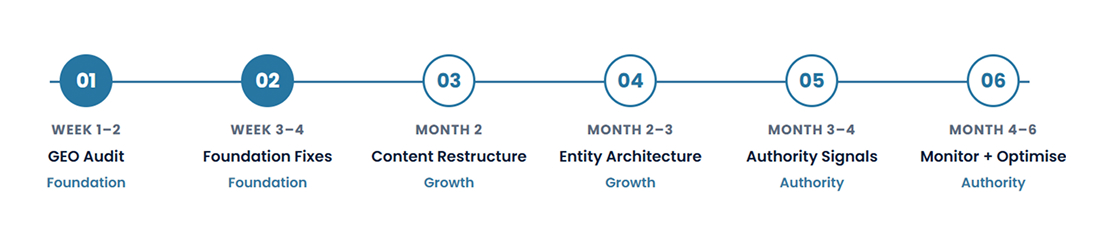
One of the most common questions agencies ask before starting GEO work is: what does the first six months actually look like? The timeline below maps what happens at each phase, what it produces, and what the client-facing output is at each milestone.
How Long Does Generative Engine Optimization Take?
Foundation fixes — crawler access, passage restructuring, schema basics — produce measurable results within 30–60 days. Full Authority GEO, including entity architecture, external mentions, and citation compounding, takes 4–6 months. The same timeline any serious organic visibility investment requires. What’s different about GEO is that results are visible much earlier, and the compounding curve is steeper.
| Phase | Timeline | What Happens | Client-facing Output |
| Phase1: GEO audit | Week 1–2 | Crawler access check, schema audit, passage extractability score, entity consistency review | GEO readiness report with red/amber/green scoring |
| Phase 2: Foundation fixes | Week 3–4 | robots.txt update, core schema implementation, passage restructuring on top 10 pages | Technical GEO baseline — before/after extractability score |
| Phase 3: Content restructuring | Month 2 | H2/H3 rewrites with direct answer openings, definition blocks, comparison tables, numbered processes | Citation-ready content brief + implemented pages |
| Phase 4: Entity architecture | Month 2–3 | llms.txt, sameAs markup, author schema, Organization schema, external profile alignment | Entity confidence report — which platforms now recognise the brand |
| Phase 5: Authority signals | Month 3–4 | External mention strategy, Reddit presence, LinkedIn entity consistency, industry citation outreach | External authority tracker — mentions acquired and citation impact |
| Phase 6: Monitor + optimize | Month 4–6 | Monthly citation tracking, passage A/B testing, platform-specific adjustments, competitor gap analysis | Monthly GEO performance scorecard with platform breakdown |
How to Measure GEO Performance
Standard analytics tools were not built for AI citation measurement. GA4 shows referral traffic but doesn’t distinguish AI-referred visits clearly. Google Search Console shows traditional search performance but not AI Overview citation frequency. Measuring GEO requires a combination of dedicated tracking and manual verification.
How to measure success in generative engine optimization
| What To Track | Where To Find It | What Good Looks Like at 90 Days |
| AI Overview appearances | Google Search Console → Search results → Filter by “AI Overviews” | Appearances on 3–5 target queries per pillar page |
| ChatGPT citation frequency | Manual: query ChatGPT Search with target keywords, record citation presence | Brand cited on 40%+ of manually tested target queries |
| Perplexity citation frequency | Manual: query Perplexity with target keywords, check source citations | Domain appears as cited source on core topic queries |
| AI-referred traffic | GA4 → Traffic acquisition → Filter referral source by chatgpt.com, perplexity.ai | Month-on-month growth from AI referral sources |
| Brand mention in LLM responses | Manual testing + tools like Profound, Otterly, or AthenaHQ | Brand named in response (not just cited as source link) |
| Schema validation status | Google Rich Results Test, Schema.org validator | Zero errors across Article, FAQPage, Organization, Person |
The measurement gap to close first: Most businesses have no baseline. The first thing to do before implementing any GEO change is manually query your top 10 target keywords across Google AI Overviews, ChatGPT, and Perplexity and record whether your domain appears. That baseline is what makes every subsequent improvement measurable.
Why Most GEO Efforts Fail — And What to Do Instead
In practice, most GEO retainers stall or produce no measurable results not because the strategy is wrong but because of five entirely avoidable implementation mistakes. Here’s what we consistently see — and what the correct approach looks like.
| . | |
| ❌ What goes wrong Restructuring content before fixing crawler access. Beautifully optimized passages that GPTBot and PerplexityBot can never read. | ✓ What to do instead Audit robots.txt on day one. Confirm all six major AI crawlers are allowed before touching a single word of content. |
| ❌ What goes wrong Writing GEO content for the page rather than the passage. Long introductions, buried answers, context-dependent explanations that collapse when extracted from the surrounding article. | ✓ What to do instead Write every H2 section so the first 40 words answer the section heading as a standalone statement. The passage must work without the surrounding page context. |
| ❌ What goes wrong Inconsistent entity naming. The company is “ZealousWeb” on the website, “Zealous Web” on LinkedIn, and “ZealousWeb Technologies” on Clutch. LLMs treat these as different entities. | ✓ What to do instead Audit every external platform where the brand appears. Standardise the name, description, and URL across every profile before implementing Organization schema. |
| ❌ What goes wrong Treating GEO as a one-time content project. Publishing optimized pages and then stopping. Citation share requires ongoing content updates and monthly monitoring. | ✓ What to do instead Treat GEO as an ongoing retainer, not a project. Monthly passage updates, citation tracking, and competitor gap analysis are what sustain and grow citation share past month three. |
| ❌ What goes wrong Skipping the authority tier entirely. Foundation and Growth GEO is implemented but external signals — Reddit, YouTube, industry citations — are ignored. The ceiling on citation share without external authority is low. | ✓ What to do instead Build external presence systematically from month three. Even one authoritative Reddit thread or YouTube video on a core topic can accelerate Perplexity citation share significantly. |
What Makes ZealousWeb Different for GEO
Most agencies added GEO to their service page in 2025. Very few have actually run a GEO audit, restructured content for passage retrieval, or tracked AI citation gains for a real client. The difference shows up fast — in the first audit report, in the first month of implementation, and in whether the retainer produces measurable movement or just activity.
ZealousWeb built its GEO practice the way it builds everything else: from implementation first, not from theory. Every framework in this guide — the passage restructuring rules, the schema stack, the entity architecture workflow, the platform-specific tactics — comes from work already done for clients across multiple verticals. Not from reading about GEO. From doing it.
Four things that are structurally different about how we work:
- We audit before we recommend.
Every GEO engagement starts with a scored readiness report — crawler access, passage extractability, schema coverage, entity consistency, external signals. You see exactly where you stand before a single dollar of execution budget is spent. - We cover all four platforms, not just Google.
Most SEO agencies optimize for Google AI Overviews and call it GEO. Only 12% of AI citations overlap between Google and ChatGPT. That means Google-only optimisation leaves the majority of AI citation opportunity untouched. The team tracks and optimizes across Google AI Overviews, ChatGPT Search, Perplexity AI, and Bing Copilot simultaneously. - We operate invisibly for agency partners.
If you’re an agency, your client never sees us. We run the full GEO workflow — audit, content restructuring, schema implementation, monthly reporting — under your brand. Your client sees your name on every deliverable. - We report on citation share, not just effort.
Activity reports tell you what was done. Monthly GEO scorecard tells you whether citation frequency moved — by platform, by query, by page. The metric that matters is whether your content is being quoted by AI systems. That’s what we track.
Conclusion
The businesses and agencies winning AI citation share right now are not the biggest ones. They’re the best-structured ones. They wrote for passage retrieval instead of page ranking. They built entity architecture before it was fashionable. They gave AI crawlers permission and direction instead of leaving them to guess.
That gap — between cited and invisible — is real, measurable, and still wide open in most industries. Every quarter of inaction is a quarter of citation share you’ll need to recover later, against competitors who started earlier.
The technical foundation is not complicated. The content restructuring is not a rewrite — it’s a repositioning of what you’ve already written. The schema takes weeks. The entity architecture takes one sprint. None of it requires a new website, a new CMS, or a new content team.
It requires starting. ZealousWeb exists for exactly that — and the businesses that move in 2026 will hold a citation advantage in 2027 that latecomers cannot close quickly.
Are You Ready To Lead Your Business in AI Search?
Book A GEO Consultation

FAQs
How do we know your team understands our agency's standards and way of working?
We start every engagement with a working alignment session — your processes, your quality bar, your communication preferences. We don't assume. We ask, document, and work to your standard from day one.
How do we evaluate the quality of your GEO work before committing to a full engagement?
Start with the audit. It's a contained, defined deliverable that shows you exactly how we think, how we structure findings, and how we communicate recommendations. Most agencies use it as the quality benchmark before moving to execution.
How do you handle missed deadlines or delivery delays?
Every engagement runs on a documented sprint schedule with agreed delivery dates. If something shifts on our end, we flag it before the deadline — not after. You're never chasing us for an update.
What happens if the work delivered doesn't meet our expectations?
We don't close a deliverable until it's signed off. Every audit, brief, and implementation output goes through a review cycle. If something doesn't meet the mark, we revise it — that's built into the process, not treated as an exception.
How is GEO work priced — project-based, retainer, or hourly?
We work on both project and retainer models depending on scope. A one-time GEO audit is a fixed-scope engagement. Ongoing implementation — content restructuring, schema, citation tracking — runs on a monthly retainer. We scope every engagement before quoting so there are no surprises mid-way.
We've had bad experiences with outsourced SEO partners before. What's different here?
Most outsourcing disappointments come from vague scope, unclear ownership, and no measurable output. Every ZealousWeb GEO engagement starts with a defined audit, a documented implementation brief, and monthly citation tracking that shows whether the work is moving the needle — not just getting done.