
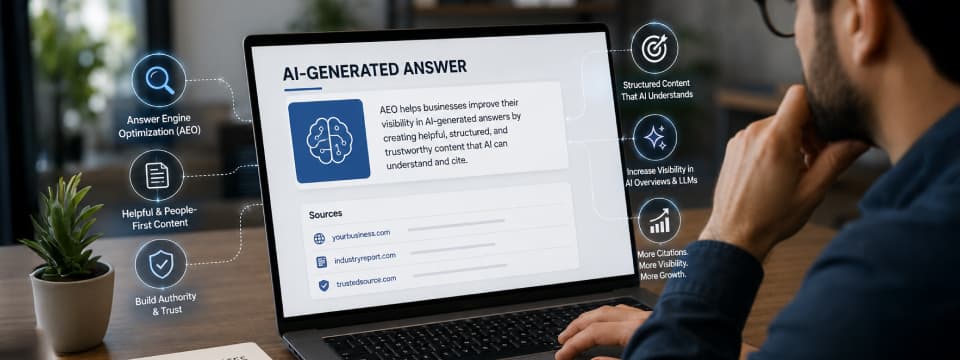
AI search is changing what visibility means for agencies and their clients.
Ranking on Google is no longer enough if a business is missing from Google AI Overviews, ChatGPT, Perplexity, Gemini, and other AI-generated answers. Clients now want to know whether their brand is being cited, recommended, and trusted by answer engines.
That is where Answer Engine Optimization, or AEO, becomes critical. But for agencies, the challenge is not just knowing the best practices. It is executing them consistently across content, technical SEO, schema markup, entity signals, E-E-A-T, and AI search visibility.
This article breaks down the AEO best practices agencies need to help clients get featured in AI-generated answers and turn AI search into a stronger visibility and conversion channel.
Why AEO Best Practices Matter for Agencies in 2026
For agencies, Answer Engine Optimization is no longer just another SEO add-on. It is becoming a delivery requirement as clients expect visibility across Google AI Overviews, ChatGPT, Perplexity, Gemini, Claude, and other AI-generated answer experiences.
The real challenge is not knowing that AEO matters. It is having the execution capacity to turn AEO best practices into structured content, technical SEO improvements, schema markup, entity clarity, and measurable AI search visibility across multiple client accounts.
How AI-Generated Answers Are Changing Client Visibility
AI-generated answers are changing how users discover and evaluate businesses. Instead of clicking through several search results, users now rely on direct answers from Google AI Overviews, ChatGPT, Perplexity, Gemini, and other answer engines.
For agencies, this means page-one rankings are no longer the full visibility story. A client may rank well and still remain absent from AI-generated answers if their content is not clear, structured, credible, and easy to cite.
Key shifts agencies need to address:
- Clients want visibility in AI-generated answers, not only search rankings.
- Content must answer real questions clearly and directly.
- Answer engines favor structured, credible, and context-rich content.
- AI search visibility depends on content quality, authority, entity signals, and technical accessibility.
Agencies that help clients move from search visibility to answer engine visibility will be better positioned to retain and grow accounts.
Why Rankings Alone No Longer Guarantee Business Results
A client can rank for important keywords and still fail to generate qualified leads. This often happens when content is optimized for traditional SEO but not structured for answer engines, featured snippets, People Also Ask results, or conversational search.
In 2026, visibility is not only about ranking. It is about whether content can be understood, extracted, trusted, and cited by AI-generated answer platforms.
Common reasons rankings fail to convert:
- Content ranks but does not answer buyer questions directly.
- Pages are keyword-focused but not answer-first.
- Schema markup is missing or incomplete.
- Service pages lack proof, expertise, and trust signals.
- Content does not match how users ask questions in AI search.
This is where AEO best practices help agencies connect SEO visibility with real business outcomes.
The Execution Gap Agencies Must Solve for AEO Success
Most agencies understand why AEO matters. The real issue is delivering it consistently across content, technical SEO, schema, entity optimization, E-E-A-T, and AI citation tracking.
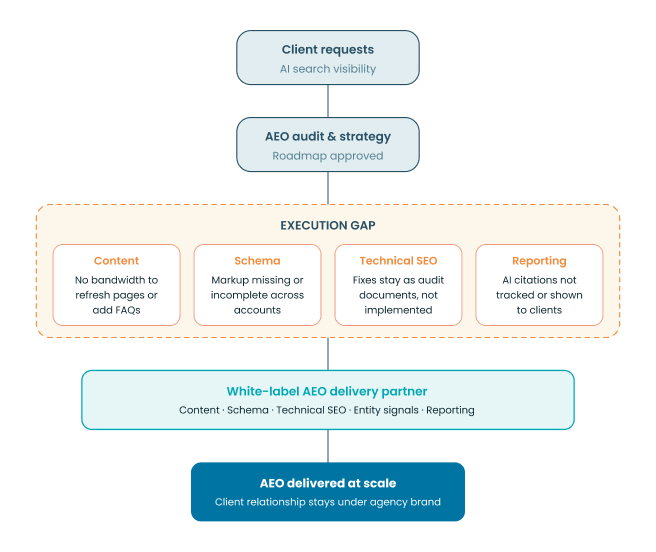
AEO execution usually breaks when internal teams are already stretched. Strategy gets approved, but implementation slows down because there is not enough bandwidth to optimize pages, add structured data, improve content depth, or track AI search visibility properly.
The execution gap appears when agencies struggle to:
- Turn AEO audits into implemented fixes.
- Refresh existing blogs and service pages.
- Add FAQ sections based on buyer questions.
- Implement schema markup across client websites.
- Strengthen authority and entity signals.
- Report AI citations and AEO visibility clearly.
This is where white-label AEO delivery becomes an operational solution. It helps agencies keep client ownership while using backend execution support for content optimization, technical SEO, schema implementation, and AI search visibility improvements.
Answer Engine Optimization best practices create value only when they are executed consistently. Agencies that close the execution gap can help clients move beyond traditional rankings and earn visibility inside AI-generated answers, where buying decisions increasingly begin.
Start With AI Search Intent Before Creating Content
Before creating AEO content, agencies need to understand what the buyer is trying to solve. Answer engines do not surface content only because it has keywords; they surface content that answers the right question with clarity, context, and credibility.
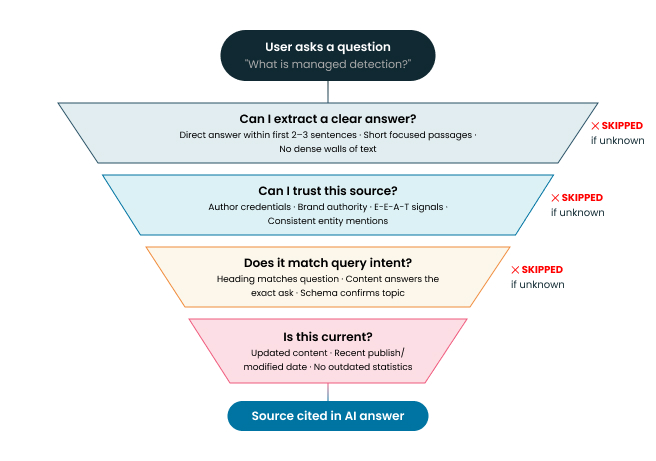
This is where AEO execution should begin. Once agencies map buyer questions and intent stages, content becomes easier to structure for Google AI Overviews, ChatGPT, Perplexity, Gemini, Claude, and other AI-generated answer platforms.
| AEO Focus | What Agencies Should Do | Why It Matters |
| Buyer’s questions | Identify real questions from search data, sales calls, FAQs, PAA, and support queries. | Helps content match how buyers actually search and ask. |
| Intent stages | Map queries across awareness, consideration, and decision stages. | Builds content for the full buyer journey, not just traffic. |
| Answer quality | Make answers direct, structured, credible, and easy to extract. | Improves chances of being cited in AI-generated answers. |
Starting with AI search intent helps agencies avoid content that ranks but does not convert. It gives every page a clearer purpose: answer the buyer’s question, support decision-making, and improve visibility across answer engines.
Build Answer-First Content for AI-Generated Answers
Answer Engine Optimization works when content is built to answer clearly, not just rank. For agencies, answer-first content helps client pages become easier to understand, extract, and cite across Google AI Overviews, ChatGPT, Perplexity, Gemini, Claude, and other answer engines.
Write Direct Answers AI Can Extract and Cite
AI-generated answers need clear source material. When content opens with a direct answer, answer engines can quickly understand the page’s relevance.
This improves AEO visibility because the content becomes easier to extract, summarize, and cite.
- Start with a clear one or two-line answer.
- Avoid long introductions before the answer.
- Use simple, specific language.
- Support the answer with proof or context.
For a SaaS client, a CRM page can begin with: “A CRM helps sales teams manage leads, automate follow-ups, and track customer interactions in one place.” This gives both buyers and answer engines a clear starting point.
Structure Content Around Questions, Definitions, and Use Cases
Answer engines follow user intent. Questions, definitions, and use cases help AI systems understand what the content answers and who it is useful for.
This improves AEO performance because the content directly matches how buyers ask questions.
- Use question-based headings.
- Add short definitions for key terms.
- Include practical use cases.
- Connect each answer to buyer intent.
For a healthcare client, a page can first answer “What is robotic knee replacement?” and then explain suitability, benefits, and differences from traditional knee replacement.
Use Clear Summaries, Lists, Comparisons, and Step-Based Explanations
AI search platforms prefer content that is organized and easy to interpret. Summaries, lists, comparisons, and steps make key information easier to scan and extract.
This helps answer engines identify important points and decision-making factors faster.
- Add short summaries where needed.
- Use bullets for benefits and steps.
- Use comparison formats for “A vs B” topics.
- Break processes into clear stages.
For an eCommerce client, a “Shopify vs WooCommerce” section can compare cost, scalability, customization, and maintenance in a simple table.
Keep Passage Length Optimized for AI Retrieval
Long, dense sections make the main answer harder to extract. Short, focused passages help answer engines retrieve the most relevant response with less confusion.
This improves AEO visibility because each section answers one clear intent.
- Keep paragraphs short.
- Avoid mixing multiple questions in one block.
- Place the key answer near the beginning.
- Use headings to separate topics.
For a local service client, one long section on emergency plumbing can be split into “When should you call an emergency plumber?” and “What issues count as plumbing emergencies?”
Strong answer-first content is not thin content. It is focused, structured, and built to help agencies turn client pages into citation-ready assets for AI-generated answers.
Refresh Existing SEO Content for AEO Visibility
Not every AEO strategy needs to start with new content. For agencies, the faster opportunity often lies in improving existing SEO pages that already rank, but fail to convert or appear in AI-generated answers.
Refreshing these pages with direct answers, stronger structure, clearer FAQs, and buyer-focused intent helps answer engines understand, extract, and cite the content more effectively.
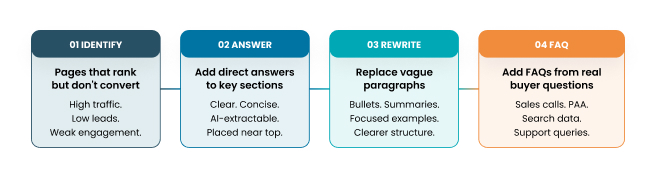
Refreshing existing SEO content helps agencies create faster AEO wins without rebuilding everything from scratch. It turns underperforming pages into clearer, more useful, and more citation-ready assets for AI search visibility.
Get Discovered Across AI Search and Answer Engines
Speak To Our Growth Experts

Technical, Authority, and Platform Best Practices for AEO Visibility
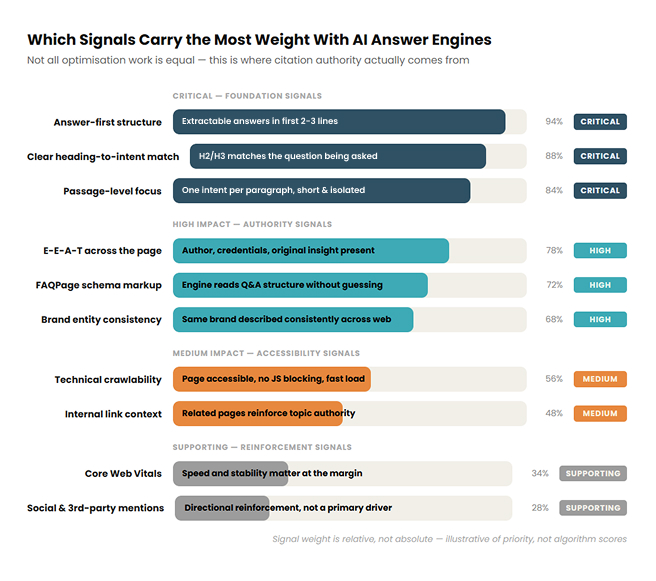
AEO visibility does not depend on content alone. To help clients appear in Google AI Overviews, ChatGPT, Perplexity, Gemini, Claude, and other LLM-powered search experiences, agencies need to align content quality, schema markup, technical SEO, authority signals, and answer-friendly formatting. These best practices also support broader GEO visibility, but the focus remains on making content easier for answer engines to understand, trust, extract, and cite.
Optimize Content for Google AI Overviews and AI Search Results
AI-generated answers pull from content that is clear, useful, and strongly aligned with search intent. For agencies, the goal is to help client pages become strong source material for Google AI Overviews and AI search results, not just traditional rankings.
To improve visibility:
- Write concise answers near the top of important sections.
- Use clear H2s and H3s that match real search queries.
- Add summaries, definitions, examples, and comparison points.
- Keep content specific to the client’s service, audience, and location where relevant.
- Include proof points, expert inputs, and supporting context to improve trust.
For example, if an agency is optimizing a cybersecurity client’s page, the content should not only explain “what is managed detection and response.” It should also answer who needs it, how it works, when to use it, and how it compares with traditional security monitoring. This gives AI search platforms more useful information to extract and cite.
Use Schema Markup to Support Answer Engine Optimization
Schema markup helps answer engines understand what a page is about, who the business is, what services it offers, and how the content is structured. While schema alone does not guarantee AI visibility, it supports stronger Answer Engine Optimization by making content easier to interpret.
Agencies should use schema where it genuinely fits the page.
Useful schema types include:
- FAQPage schema for question-and-answer sections.
- HowTo schema for step-based educational content.
- Article schema for blogs, guides, and thought leadership content.
- Organization schema for business identity and brand clarity.
- Service schema for service pages.
- LocalBusiness schema for location-based businesses.
For example, a dental clinic page can use LocalBusiness schema, Service schema, and FAQPage schema to help search engines and answer engines understand the clinic, its services, location, and patient questions more clearly.
Agencies should also avoid common schema mistakes, such as adding irrelevant schema, marking up content that is not visible on the page, using duplicate schema, or leaving key business information inconsistent across the website.
Strengthen Technical SEO for Better AEO Performance
Answer engines still depend on accessible, crawlable, and technically sound content. If important content cannot be crawled, indexed, loaded quickly, or understood properly, it becomes harder for Google AI Overviews, ChatGPT, Perplexity, Gemini, Claude, and other LLM models to surface it confidently.
Technical SEO supports AEO by improving content accessibility.
Agencies should focus on:
- Clean crawlability and indexability.
- Fast page speed and strong Core Web Vitals.
- Mobile-friendly page experience.
- Clear URL structure.
- Proper heading hierarchy.
- Strong internal linking between related pages.
- Avoiding important content hidden behind heavy JavaScript.
- Fixing broken links, duplicate content, and thin pages.
For example, if a client’s service content is loaded only after user interaction or hidden in scripts, answer engines may not easily access or interpret it. Making key content visible in the HTML, supported by clean headings and internal links, improves its ability to appear in AI-generated answers.
Build Credibility and Authority for AI Citations
AEO is not only about formatting content. AI-generated answers also need trustworthy sources. Agencies must help clients build credibility signals that make their content more reliable for users and answer engines.
This includes strengthening E-E-A-T across key pages, blogs, service content, and author profiles.
Important authority signals include:
- Clear author or expert attribution.
- Relevant credentials or industry experience.
- Original insights, examples, and proof points.
- Case studies, testimonials, and client outcomes.
- Updated content with current information.
- Consistent brand mentions across trusted third-party channels.
- Strong About, Contact, and service pages.
- External references, reviews, directories, and media mentions where relevant.
For example, a healthcare client’s article should not read like generic medical content. It should include expert review, practical patient-focused explanations, clear service context, and trust signals that show why the business is qualified to speak on the topic.
This helps improve AI citation potential because answer engines are more likely to rely on content that appears credible, specific, and supported by real expertise.
Optimize for Featured Snippets, People Also Ask, and Voice-Based Answers
Featured snippets, People Also Ask results, and voice-based answers are closely connected to AEO because they all depend on clear, direct, question-led content. When agencies optimize for these formats, they also make content more suitable for AI-generated answers and LLM-based discovery.
The best approach is to structure content around how people naturally ask questions.
Agencies should:
- Use concise answers for common questions.
- Build FAQ sections around real buyer queries.
- Write in a conversational but professional tone.
- Use “what,” “how,” “why,” “when,” and “best” question formats.
- Add short summaries under important sections.
- Include local intent where it supports the client’s business.
- Keep answers clear enough for voice search and AI extraction.
For example, a local HVAC client can include questions like “How often should an AC be serviced?” or “What are the signs your HVAC system needs repair?” These questions support People Also Ask visibility, voice search, and AI-generated answers because they match real customer intent.
When agencies combine platform optimization, schema markup, technical SEO, authority building, and answer-based formatting, AEO becomes stronger and more scalable. These best practices help client content move beyond traditional search rankings and become a trusted source for AI search visibility, GEO performance, and LLM-powered answer discovery.
Measure and Improve AEO Performance
Measuring Answer Engine Optimization requires agencies to look beyond traditional SEO metrics like rankings, impressions, and organic traffic. AEO performance should track whether client content is being cited, mentioned, and included across Google AI Overviews, ChatGPT, Perplexity, Gemini, Claude, and other answer engines. This includes monitoring AI citations, brand mentions, answer engine visibility, Google AI Overview appearance, content inclusion, featured snippet presence, People Also Ask coverage, and changes in leads or conversions from AI search visibility.
Agencies should also run a quarterly AEO content and technical audit to review answer-first content, schema markup, crawlability, entity signals, E-E-A-T, and outdated pages. The goal is not only to show visibility gains, but to connect AEO reporting with business outcomes, so clients can see how AI-generated answer visibility supports trust, qualified traffic, and conversion opportunities.
How Agencies Can Execute AEO Best Practices at Scale
For agencies, the biggest AEO challenge is not awareness; it is delivery. Clients expect visibility across Google AI Overviews, ChatGPT, Perplexity, Gemini, Claude, and other AI-generated answer platforms, but executing content optimization, schema markup, technical SEO, entity signals, and reporting across multiple accounts can quickly stretch internal teams. This is where a white-label AEO partner can quietly strengthen delivery without changing the agency’s client-facing role.
- Agencies can keep control of strategy, client communication, and brand positioning while getting structured execution support in the background.
- A white-label AEO partner helps convert recommendations into completed actions, so audits do not remain stuck as documents.
- Existing SEO pages can be refreshed with direct answers, FAQs, summaries, schema, and clearer content structure without overloading internal teams.
- Technical SEO, structured data, and answer engine optimization tasks can move faster because delivery is supported by a dedicated backend team.
- Agencies can offer AEO services without hiring separate content strategists, technical SEO specialists, schema experts, and reporting resources.
- Internal teams get more room to focus on client relationships, strategy, approvals, and growth instead of getting buried in execution.
- A white-label model helps agencies maintain consistency across multiple client accounts, especially when AEO work needs regular updates and optimization.
- It supports better margin control because agencies can expand their AI search visibility services without adding permanent overhead.
- The right partner works as a delivery extension, helping agencies improve speed, quality, and client-ready output without appearing as a separate vendor.
- This makes Answer Engine Optimization easier to package, sell, manage, and deliver at scale.
With the right white-label delivery support, agencies can turn AEO best practices into a scalable service offering while keeping the client relationship fully under their brand.
Conclusion
Answer Engine Optimization is no longer just a content trend for agencies. It is becoming a practical way to help clients earn visibility inside Google AI Overviews, ChatGPT, Perplexity, Gemini, Claude, and other AI-generated answer platforms. But the real value of AEO comes from execution — structured content, schema markup, technical SEO, entity clarity, E-E-A-T, AI citation tracking, and consistent optimization across client accounts.
For agencies, this is where the opportunity and pressure meet. Clients want to be found, cited, and trusted in AI-generated answers, but internal teams may not always have the bandwidth to deliver AEO at scale. With the right white-label AEO delivery partner, agencies can strengthen execution, protect margins, and expand AI search visibility services without losing control of the client relationship.
ZealousWeb helps agencies turn Answer Engine Optimization best practices into client-ready execution through content optimization, technical SEO support, schema implementation, and AI visibility-focused delivery. As AI search continues to reshape discovery, agencies that execute AEO consistently will be better positioned to help clients move beyond rankings and earn visibility where buying decisions increasingly begin.
Build AI-Ready Digital Experiences That Drive Business Growth
Let’s Talk

FAQs
How can agencies offer AEO without hiring in-house?
Agencies can partner with ZealousWeb to deliver AEO services without hiring separate content, SEO, schema, and reporting specialists. The agency manages the client relationship while ZealousWeb supports execution.
Are white-label AEO services more cost-effective than hiring in-house?
Yes. With ZealousWeb, agencies can offer AEO services without hiring full-time content strategists, technical SEO experts, schema specialists, and reporting resources. This helps reduce fixed overhead while keeping delivery scalable.
What does ZealousWeb deliver as a white-label AEO partner?
ZealousWeb helps with AEO audits, content refreshes, FAQ optimization, schema implementation, technical SEO fixes, AI visibility improvements, and reporting support for Google AI Overviews, ChatGPT, Perplexity, Gemini, and Claude.
How does white-label AEO help agencies protect margins?
ZealousWeb supports backend AEO execution, so agencies can expand their service offering without increasing internal workload. This helps maintain
Why is white-label AEO more efficient for scaling client work?
AEO needs consistent execution across content, schema, technical SEO, entity signals, and AI visibility tracking. ZealousWeb helps agencies manage this work across multiple clients without slowing down internal teams.